Latest Buzz...
                  

Translate

Showing posts with label Home Automation. Show all posts

Sunday, October 11, 2015

A smart home market for buying and selling electricity

The customary 3-month billing cycle for utilities made sense when meter reading was done manually and electricity consumers weren't in the business of generating electricity from solar panels or supplying power from batteries.

Having to wait 3 months to be paid for electricity you supply to the electricity grid is no longer appropriate or necessary. Smart meters continuously measure power supplied from and to the grid and transmit this data at 15 minute intervals to the network provider.

"Cost-reflective pricing" - Pricing electricity to reflect short term fluctuations in supply and demand - can be most effective in influencing peak-period supply and demand when these price fluctuations are actually experienced in real time. If the averaged effect is only noticed once every 3 months in a quarterly bill for electricity, cost-reflective pricing has little or no chance to influence supply and demand decisions in the peak periods.

Though short term trading in the supply and purchase of electricity may not be for everyone, it could be available on the same basis as the stock exchange: for those who have an interest. A household or business with a large battery bank but no space for solar panels might wish to buy electricity at peak solar supply times when the price is low, then sell it back during overcast days in peak demand periods. The availability of a market to buy and sell electricity may be essential to encourage this type of entrepreneurial activity.

There are a number of Internet tools that are making it more secure and less expensive to construct such applications.
PayPal recently introduced a low-cost payment option for digital goods

PayPal recently introduced a low-cost payment option for digital goods. Though electricity is not a "digital good" it doesn't require PayPal to provide posting and delivery tracking, dispute resolution and return-to-sender processing as it does for physical products.

Using PayPal eliminates risks such as this one at mycause.com.au:

"On Tuesday July 29 2014 we discovered that there had been a data security breach in the mycause system and donor credit card data from transactions was compromised.
The theft has been carried out by a sophisticated and highly coordinated group of hackers who have managed to skim credit card data as it passed through the mycause server to the payment gateway."

Other modular components can be incorporated. For instance:
  • There is no need to create user identifiers and facilities to reset forgotten passwords. Google account services take care of this functionality.
  • There is no need to construct a community discussion forum facility. Disqus provides the functionality for this requirement.
Google provides free software development tools for building robust and flexible web applications. The Google App Engine software development kit (SDK) for Python is one of several powerful development tools available for the task.

There are recently devised software tools with which to dynamically reshape each web page after the web server has sent it to the client device. That is to say a web page can format itself to fill a Tablet or desktop PC screen and reshape itself to suit a mobile phone upon inspecting the screen size of the device in which it finds itself.

"Play YouTube videos on your T‑Box" is an example of a web site that takes advantage of these development tools and the available ready-built modules to supply a community discussion forum, subscriber accounts and secure payment for digital goods.

Thursday, November 27, 2014

Checking energy use and controlling devices on the world wide web

It is now relatively easy to assemble a composite module that incorporates 4 existing electronic circuits available on eBay that use mains voltage and is packaged so that the mains voltage components just plug in and are not exposed like the 5 V dc embedded system connectors of the modules.

The four modules that I think would make a useful and safer composite module if the mains voltage connectors are separated and simplified are -
  • An ACS712 current sensor module
ACS712 Current Sensor Module
  • An ac voltage sensor module
Voltage sensor module
  • A zero-crossing solid state relay similar to those made by FOTEK, and
Solid state relay
  • A 5V AC-DC Power Supply Buck Converter Step Down Module similar to those sold by ICStation
5V ac dc step down power supply
The composite module could have a simple mains voltage plug and an output power socket, with no mains voltage connectors exposed such as this -
AU Plug Power device

Adding a further two low-voltage modules to the composite module allows energy use of any device to be measured and logged on the world wide web and also allows control of the device to be managed automatically from anywhere on the world wide web -

  • A Mini USB Nano V3.0 ATmega328P 5V 16M Micro-controller Module similar to those sold on eBay

Mini USB Nano V3.0
  • An ESP8266 Esp-01 Serial Port WIFI Transceiver Module similar to those sold on eBay
ESP8266 Esp-01 Serial Port WIFI Transceiver

UPDATE 27 January 2023 - See an example of what others are doing with this approach to energy monitoring technology - Mini Smart Wi-Fi Socket with Energy Monitoring

Monday, May 27, 2013

Getting ready to go off the grid

Suppose you have a solar photovoltaic system or a BlueGen fuel cell home generator and a collection of appliances that can be monitored and controlled automatically by a tablet computer.

A hot water system might be set to keep water between 50°C and 60°C.
  • If the water temperature is at or below 50°C, the water heater should be on. 
  • If the water temperature is at or above 60°C the water heater should be off.
When the water temperature is anywhere between these upper and lower temperatures the status of the heater could be on or off. From your point of view, the status of the water heater ("on" or "off") is "Don't care if on or off".

Refrigerators, freezers, air-conditioners and space heaters can be automatically controlled having regard to:
  • A lower temperature at which the appliance should be "on" (for heating appliances) and "off" (for cooling appliances)
  • An upper temperature at which the appliance should be "off" (for heating appliances) and "on" (for cooling appliances) 
  • For any temperature that is between the lower and upper temperature, the appliance has a status of "Don't care if on or off".
When your home energy system is generating more energy than is required for all appliances that are turned on, extra energy can be sent to some or all appliances that are "off" but have a status of "Don't care if on or off".

A ZigBee HVAC Application
When your home energy system is not generating enough energy for all appliances that are turned on, energy can be saved by cutting energy being sent to some or all appliances that are "on" but have a status of "Don't care if on or off".

Controlling appliances in this way reduces the size and cost of energy storage.
  • Excess energy being generated is added to any appliance that can use it.
  • Peak energy use is lowered - when more energy is being used than is being generating - by automatically withholding supply from any appliance that can postpone its energy needs.
If your household has an electric vehicle parked in a garage, it can be controlled in an even better way. For example:
  • When the battery charge is below 40 percent, charging should be "on".
  • When the battery charge is at 100 percent, charging should be "off".
  • When the battery charge is between 40 percent and 80 percent, charging can be considered to be "Don't care if on or off".
  • When the battery charge is between 80 percent and 100 percent, the battery can be considered to be "Don't care if charging is on or off, OR if discharging is on or off". (That is to optionally SUPPLY energy to the home.)
Notice that the last status above allows the household to make use of any electric vehicle parked in its garage for energy storage - at no extra cost...

A smart meter is not a requirement to implement such an energy management system.
ZigBee Alliance Integrated ZigBee low-cost controllers in a range of appliances from different manufacturers are a prerequisite.
  • Proprietary communication protocols and energy automation software would make it very difficult and expensive to implement the desired level of control. 

If you are still connected to the grid, this level of control allows you to reduce the peak demand your household makes from the grid. This strategy helps:
  • To reduce the need for network investment in extra poles and wires.
  • To avoid the need for price increases for the electricity that you purchase from the electricity grid.
There are a number of businesses with Zigbee technology experience that could help manufacturers begin to offer versions of their appliances that are "ZigBee-enabled".

For example:

Sunday, August 26, 2012

Team Work on Energy Costs

Beef Exports, Technology Imports and the High Australian Dollar


Australian beef growers can get better returns and their overseas customers a better deal if energy costs can be cut for a firm at the front line of beef exports.

The high Australian dollar is a two-edged sword. On one hand Australian exports are more expensive. On the other Australia gets good value for money on high-technology purchases that can be used to reduce costs and increase profits.

Finding overseas suppliers for equipment and developing ongoing business relationships has further important benefits for all parties. There is a two-fold benefit when Australia can find good sources for equipment from its trading partners. This supports the momentum in their economies. It maintains Australia's customers purchasing power for buying its exports.

It helps to counteract the slowing of economic activity in Australia's major trading partners such as China and in Europe that reduces the demand for Australian exports.

A business that is a staging area for beef exports has extensive cool-rooms and freezers with very high energy requirements. The carbon price is a significant impost as is the rapidly rising cost of electricity distribution in Australia.

The challenge and opportunity is to find cost-savings with commercially viable energy supply and automated management technology.
HACCP Food Safety Management Programmes

Systematic international food safety management in the industry in accordance with "Hazard analysis and critical control points" (HACCP) may be simplified if automated energy management technology can tackle part of the compliance costs for record-keeping. Automating alerts and responses when any cool room temperature deviates from what is required could avert product spoiling.

Energy Generation Technology to Cut Costs

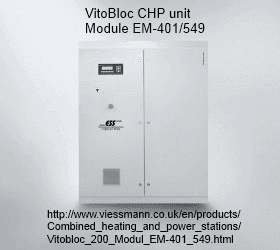
VitoBloc CHP unit Module EM-401/549
VitoBloc CHP unit
Module EM-401/549
Retail energy costs in Australia are especially high by international standards as a result of massive investment in the distribution grid. The carbon price that commenced on July 1, 2012 has added to this cost.

These costs make the goal of commercially viable local generation an easier one to achieve.

Generating energy locally tends to be cheaper per kilowatt with larger systems. This means that larger systems such as the recently installed trigeneration plant at Coca-Cola Place in North Sydney are proving to be commercially viable. A generation system for a single residential household is more difficult to cost-justify.

Establishing commercial viability of generation systems suited to medium sized businesses with multiple sites is getting easier. Continually growing retail energy prices and advances in technology both make this problem easier to solve.

A business paying about $1,200 a month for carbon dioxide emissions for electricity from coal-fired power plants is using about 60,000 kilowatt-hours each month. (The carbon price for coal-fired power is nearly 2 cents per kilowatt-hours.)

In broad terms a local energy generation system can be used to produce electricity to supply about half of the energy needed for cool rooms and freezers. The "waste heat" from the generation system can be used in absorption chillers to supply the other half of energy needed for cool rooms and freezers.

Savings from the system come from four sources:

  • Fuel is used far more efficiently than in large central power stations.
  • The carbon price is not payable by any enterprise emitting less than 25,000 tonnes of carbon dioxide per year.
  • The amount of carbon dioxide emitted is much less than that from a coal-fired power station even if any carbon price becomes payable. About 75 percent less.
  • The major cost component - the infrastructure to transmit power from large central power stations - is not avoided. It is not only the owner of the local generation system who saves money; Electricity grid investment is avoided and this bestows a benefit on every energy consumer.

Potential suppliers may be easier to find in Europe where local generation is more widespread than in Australia. One example is the German manufacture Viessmann Group that builds Vitobloc combined heat and power units. These power generation systems are manufactured in a range of outputs so matching the technology to different businesses' energy requirements is not too difficult.

Automation Technology to Cut Costs

A small number of businesses have designed and created a huge range of wireless sensors, controllers and information systems that build upon internet and smart phone technology. These new devices have enormous potential in many areas of home life, agriculture and industry.
Wireless irrigation system
Wulian Sensors and Automation Technology

Safety, health and comfort of the elderly and people with disabilities living in their own homes is just one of many areas where this technology should be applied sooner rather than later.

Another area is in monitoring and controlling the operation of business equipment such as energy generators, freezers and cool rooms. All operations can be continuously monitored and controlled according to an automated schedule. Alerts where any unusual situation arises can be immediately notified via the internet to any smart phone. People can send instructions over the internet with smart phone apps to remotely control business machines and without needing to travel to the business premises.

One of these businesses is Nanjing IOT Sensor Technology that has developed a great many different devices and software. The slow-down in major world economies is making business conditions difficult for such innovators. An Australian business could benefit by establishing an ongoing working relationship with such a supplier, providing feedback and design ideas to tailor products to best suit its needs while at the same time helping create wider awareness of the benefits this innovative technology provides.