Latest Buzz...
                  

Translate

Showing posts with label Renewable Energy. Show all posts

Saturday, December 7, 2024

Replacing natural gas for domestic use and LNG exports

Farms in Australia have an opportunity to earn income from crop and animal waste streams. Queensland in particular has a network of coal seam gas pipelines crossing farmland. These could be exploited to make and sell bio-methane on farms with renewable energy. 

This avoids the need for construction of connections to Australia's electricity grid, and the wait for approval to connect solar and wind farms to the grid. 

One tonne of bio-methane stores approximately 55 gigajoules of energy. It consists of 750 kilograms of carbon and 250 kilograms of hydrogen. 

Biomass created on farms, whether crop waste or animal waste, is a mixture of carbon, hydrogen and oxygen. It represents solar energy stored by photosynthesis in plants that have removed the carbon from the atmosphere. 

Biomass containing carbon and hydrogen to make one tonne of bio-methane would also contain about two tonnes of oxygen. 

If the biomass was, say, sawdust, the quantity required to make one tonne of bio-methane would be two tonnes dry weight with a moisture content of about 30 percent - equal to one tonne of water. 

Sawdust

To start the process of bio-methane production, an initial supply of hydrogen is needed.

After the process has begun, steam that is a by-product of making bio-methane would be converted to hydrogen and oxygen in a steam electrolyser using renewable energy. 

World’s Largest High-Temperature Electrolysis Module Deliveries Started

"...the electrolyzer processes water steam to hydrogen at highest conversion efficiencies. As the steam reduces electricity demand, Sunfire’s SOEC (solid oxide electrolysis cell) technology is the most efficient electrolysis solution on the market..." Read more >>>

The hydrogen made in this step would then be used to create more bio-methane, and more steam. An external hydrogen supply is not needed to continue the production of bio-methane. 

Also note that no supply of water is needed. The process obtains the water for electrolysis from the biomass that is used to make bio-methane. 

Recent articles on the process include:

This approach to making bio-methane stores renewable energy from two sources:

  • The solar energy stored by the plants that made the biomass via photosynthesis, and
  • The renewable energy from wind and/or solar photovoltaic panels that splits the hydrogen from oxygen in the steam electrolysis step. 

Other advantages include:

  • There is no need to wait for the cost of making "green hydrogen" to become viable.
  • There is no need to wait for the development of hydrogen supply lines to be built.


Monday, April 25, 2022

Fossil energy cost analysis puzzles

 Santos proposes making hydrogen for $2 per kilogram from methane. 

With 48 kgs of methane Santos might make 84 kgs of carbon monoxide and 12 kgs of hydrogen. 

methane + oxygen → hydrogen+ carbon monoxide

3CH4(g) + 3/2O2(g)6H2(g) + 3CO(g)


The 84 kgs of carbon monoxide then could be used in two different processes: 

Reaction with 54 kgs of steam to produce another 6 kgs of hydrogen and 132 kgs of carbon dioxide, 

steam + carbon monoxide → hydrogen+ carbon dioxide

3H2O(g) + 3CO(g) → 3H2(g) + 3CO2(g)

or 

Reaction with 160 kgs of iron ore to produce 112 kgs of iron and 132 kgs of carbon dioxide.

iron(III) oxide + carbon monoxide → iron + carbon dioxide

Fe2O3(s) + 3CO(g) → 2Fe(l) + 3CO2(g)

With the first option, the 6 kgs of hydrogen produced at a value of $2 per kilogram would be worth $12. 

With the second option, the 160 kgs of iron ore would cost about $16 (at $100 per tonne for iron ore) and the 112 kgs of iron produced, at a value of $3 per kilogram would be worth $336. 

See Redox reactions are involved in the extraction of metals from their ores

Blast furnace reducing iron ore to iron


QUESTION/PUZZLE

Why would Santos propose making hydrogen worth $12 from carbon monoxide made from methane when it could produce iron worth $336 from the same amount of carbon monoxide?

Friday, December 24, 2021

Removing fossil fuels from ammonia-based fertiliser production

Farm productivity depends on nitrogen fertilisers. 

Large-scale ammonia plants have dominated the industry and these use fossil fuels as a chemical feed stock and energy. 

Other options are available - that use renewable feed stock and renewable energy to replace the fossil fuels used in traditional plants. 

Their is also an opportunity to make smaller scale production plants that will allow fertiliser to be manufactured near to both the renewable feed stock and to the farms that use the fertiliser. 

Urea is a widely used nitrogen fertiliser. Global production is estimated to have been 240 million tonnes in 2019. 

Most is made with natural gas as a feed stock and a source of energy. 

One tonne of urea has for much of the last ten to twenty years has cost about $500. It has risen sharply in price in 2021, costing around $1,500 a tonne. 

One tonne of urea contains 200 kilograms of carbon. 

Wheat straw and other crop waste containing cellulose contains this same amount of carbon in each 450 kilograms of cellulose. 

The first step in making urea is to produce synthesis gas - a mixture of hydrogen and carbon monoxide. 

This can be carried out with a device to gasify biomass. 

An example is the gasifier made by All Power Labs which it builds to make synthesis gas it uses to power an engine to drive an electricity generator. 


The PP30 Power Pallet is the culmination of our long work to create an expertly engineered, small-scale gasification solution that is realistic for today’s user. While personal scale gasification has long held tremendous promise, the realities of making it work usually prove too much for regular mortals. The high bar of operator expertise and extreme sensitivity to fuel particulars usually combine to make what seems simple in principle, exceedingly difficult in practice.

The Power Pallet has significantly widened this window for success by embedding the needed operator expertise in an onboard electronic brain.

To increase the proportion of hydrogen in the synthesis gas - for a following ammonia production step - an electrolyzer that produces some hydrogen by electrolysis of water using renewable electricity - could also supply pure oxygen to use in the gasifier. 

To convert the carbon monoxide to carbon dioxide and more hydrogen - both of which are used in later steps-

  • hydrogen to react with nitrogen to produce ammonia, and 
  • carbon dioxide to react with that ammonia to produce urea 

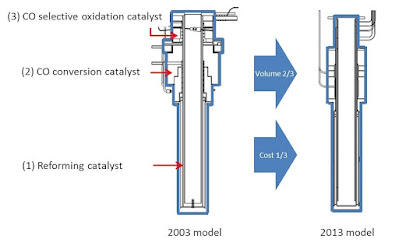
- a small-scale methane reforming unit is produced by Tokyo Gas that it uses as a fuel processing module in domestic fuel cell appliances.

Ene Farm Fuel Processing System by Tokyo Gas


Because the three reactions take place at different temperatures, conventional practice is to use three varieties of reaction vessel. However, Tokyo Gas developed an integrated fuel processor that can handle the three chemical reactions in one vessel in 2000. 

We set a mass production target for 2003, and subsequently achieved further structural streamlining, developed and improved a high-performance catalyst, and reviewed the catalyst operating method. 

As a result, we succeeded in reducing total volume of the fuel processor by one third and production costs by two thirds in 2013.

The only other ingredient is nitrogen. Membrane filters are available that filter nitrogen from air for medium scale production processes.

A typical manufacturer of nitrogen membrane filters is Generon

Since the first large-scale ammonia production plants were built, many technical enhancements have been identified in the equipment to maintain the optimum temperature and pressure, the design of catalysts, and the development of chromium-molybdenum steel reaction tubes. Each of these enhancements can be replicated in a scaled-down plant. 

Small scale ammonia production plants are in operation that operate with renewable energy. 

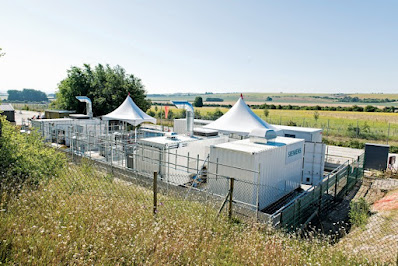
The Siemens green ammonia test plant uses wind power to convert hydrogen and nitrogen to ammonia.


Siemens in the UK is working with researchers at the University of Oxford, the UK’s Science and Technology Facilities Council, and Cardiff University to run a demonstration plant using the typical Haber-Bosch process, powering it with wind. Ian Wilkinson, program manager in corporate technology at Siemens, names two reasons the firm chose to use only mature technology available today to run its plant.

First, Siemens wants to show that it can produce ammonia renewably, in a way that it can quickly scale up. The company also views the plant as a test system for ongoing technology development, including Haber-Bosch catalyst development and ammonia combustion tests.

The plan has worked so far. The small plant, set up in shipping containers, takes electricity from a wind turbine, runs it through a hydrogen electrolysis unit, and then uses the resulting hydrogen to synthesize ammonia.

Saturday, May 29, 2021

ACT Large-Scale Feed in Tariff experience

The ACT Government has contracted large-scale renewable energy projects to supply electricity. 

Each project sells its electricity in the National Energy Market at the price set by the market at half-hourly intervals. 

If that price is greater than the contracted price, the generator pays the excess to the ACT Government. If the price is less than the contracted price, the ACT Government pays the difference to the generator. 

The ACT Government relies on Evoenergy for a number of electricity supply functions. 

One of those is to purchase wholesale electricity from the National Energy Market for ACT consumers. 

Another is to pay or receive amounts for contracted large-scale renewable energy projects each quarter. 

Evoenergy recently requested an increase in the price it charges for wholesale electricity to the ACT because, it said, payments for the ACT Government large-scale renewable energy generators had increased. 

“Over the past year, there has been a significant drop in wholesale electricity prices making them much lower than the contract prices the ACT Government established with large-scale generators. This has resulted in significant top-up payments required to cover the difference,” said Evoenergy’s General Manager Peter Billing.

“We understand it can be confusing when wholesale prices are going down and these costs have gone up. The reality is these costs are fixed by contracts whereas the electricity market and the wholesale electricity price moves based on supply and demand.”

“Evoenergy has no control over the long-term contracts with renewable energy generators or the resulting top up payments, however we will continue to work with the ACT Government as part of our legislated responsibility to administer the large-scale feed-in tariff scheme.”

The statement "we understand it can be confusing" is quite precise. 

The wholesale price at which Evoenergy purchases electricity for ACT consumers has fallen sharply. 

The amount Evoenergy pays for contract prices for ACT Government large-scale generators has risen for the same reason. 

Evoenergy has made no attempt to explain why the savings in its wholesale electricity purchases have not offset the resulting increase in payments for ACT Government large-scale generators. 

If it has failed to achieve this offset, then its purchase strategy needs to be reviewed and responses put in place to address this. 

The second quarter of 2019-2020 (October to December 2019) and of 2020-2021 (October to December 2020) illustrate why it is confusing for Evoenergy to "explain" an increase in its electricity charges that ignores the decrease in the price of electricity it purchases...

In each of the above quarters, the ACT Government contracted large-scale renewable energy generators sold about 500,000 megawatt-hours of electricity. 

In October to December 2019 the renewable energy generators received $27.4 million from the National Energy Market. Evoenergy paid the generators $18.7 million under the ACT Government contracts with them. 

A year later, in October to December 2020 the renewable energy generators received just $13.8 million from the National Energy Market. Due to that decrease, Evoenergy paid the generators $30.8 million under the ACT Government contracts with them. 

THE NET CHANGE IS A POTENTIAL SAVING OF $1.5 MILLION BY EVOENERGY.

Evoenergy's payments for the ACT Government contracts increased by $12.1 million (from $18.7 to $30.8 million) - but only because the electricity it and other wholesale electricity purchasers paid via the National Energy Market decreased by $13.6 million (from $27.4 to $13.8 million).

The following charts illustrate that as the National Energy Market price changes - from day to day - the offsetting payments under the ACT Government large-scale renewable energy contracts vary by an identical but opposite amount. The result is a fairly constant cost - that Evoenergy should aim to achieve - of about $90 per MWh.


AEMO Price per MWh and ACT Government Payment per MWh - 2nd Quarter 2019-2020

AEMO Price per MWh and ACT Government Payment per MWh - 2nd Quarter 2020-2021

The price of electricity the renewable energy projects received in the average of each half hour of all the days from October to December 2019, and  from October to December 2020, show a consistent and steep fall in 2020. 

This fall reflects the reduction in the cost of wholesale electricity Evoenergy purchases for supply to ACT busnesses and homes. 

AEMO average price per MWh in each half hour for ACT renewable energy generators


Friday, January 3, 2020

Phasing-out-fossil-fuels

Scott Morrison has failed to develop a plan for phasing out thermal coal exports and for phasing out vehicles running on fossil fuels.

Simply claiming "you can't shut these down overnight" is a nonsense answer.

IEA - World Energy Outlook, 2019 - Thermal Coal Demise


A plan for phasing out both thermal coal exports and vehicles running on fossil fuels is straightforward.

Australia has seen how such plans work. It implemented one in phasing out vehicles that ran on leaded petrol.
  1. Announce a date for the ban on new vehicles that use leaded petrol. 
  2. Announce a date for the ban of the supply of leaded petrol. 
The period to the date of the first ban sees a burst of investment for the supply of fuel and of vehicles to use the new energy source.

The period to the date of the second ban allows for the gradual retirement of all vehicles using the fuel being replaced, and for winding down the supply chain for that fuel.
 
From a paper by Troy Whitford, Fuel Mandates have a History of Success and a Lesson for Bio Fuels Implementation. Australian Policy and History, April 2010.
URL: http://aph.org.au/fuel-mandates-have-a-history-of-success-and-a-lesson-for-bio-fuels-implementation/
"In 1981, Australian state and federal transport ministers met to address pollution problems. Driving the shift towards unleaded petrol were vast environmental and health concerns.

During the 1980s, automobile associations were critical of the introduction of unleaded fuel. The RACV opposed the implementation believing it was too costly. The oil industry was cynical, too, arguing the introduction of unleaded fuel did not follow from a technological breakthrough but rather a decision by ministers. Without doubt, the position taken by oil companies, automobile associations and other stakeholders regarding unleaded fuel changed over time.

Despite opposition to unleaded fuel, the Transportation Council adopted a program to mandate unleaded petrol by 1985. The implementation policy for unleaded fuel was undertaken in stages. Initially, regulations were made calling for all new motor vehicles made after January 1986 (manufactured within Australia or imported) to meet the new fuel requirements. The policy then called for a complete phase out of leaded fuel by 2002. Prior to the national mandate, states had led the way on unleaded fuel of which NSW took the lead. The decision to mandate was essential for implementing unleaded fuel. It forced car manufacturers, oil producers and consumers to make the transition."

Saturday, September 1, 2018

Energy transition


Final Report Summary - HELMETH (Integrated High-Temperature Electrolysis and Methanation for Effective Power to Gas Conversion), 25 July 2018

A highly efficient Power-to-Gas process has been realized by the European research project HELMETH. It has the potential to be the most efficient storage solution for renewable energy utilizing the existing natural gas grid without capacity limitations and to be a source for “green” Substitute Natural Gas (SNG) to avoid fossil carbon dioxide emissions.

The objective of the HELMETH project is the proof of concept of a highly efficient Power-to-Gas process by realizing the first prototype that combines a pressurized high temperature steam electrolysis with a CO2-methanation module.

The demonstration plant was assembled at the sunfire facility in Dresden. The methanation unit, developed and built by KIT in Karlsruhe, was set up inside a container and transported to sunfire to perform combined operational tests.

The steam outlet from the methanation cooling circuit is fed to the electrolyser and the hydrogen output from the electrolyser is fed to the methanation unit. The steam is converted to hydrogen in the electrolyser.
Coupled Power-to-Gas plant (left container: methanation; right container: electrolyser)

The efficiency is significantly increased by using the heat of reaction from the exothermic methanation reaction to produce steam for the high temperature electrolysis.

Since the produced SNG is fully compatible with the existing natural gas grid and storage infrastructure, practically no capacity limitations apply to store energy from fluctuating renewable energy sources.


Steam Hydrogasification

By replacing the CO2 methanation module in the Power-to-Gas process realized by the HELMETH research project with a lignite methanation module, Australia can manufacture 50% renewable methane. That is, synthetic natural gas containing 50% renewable energy (as hydrogen) and 50% fossil fuel (from low-cost wet lignite).

This can fuel dispatchable generators in conjunction with renewable intermittent generators to provide 100% reliable electricity generation: the intermittent renewable generators supplying 50% of electricity and dispatchable generators powered by 50% renewable methane providing the other 50%.

The lignite methanation module has been developed in the U.S.

Steam Hydrogasification in a hydrogen environment

Making synthetic natural gas from hydrogen and a variety of waste streams and coal has been researched for some time.

For example:

UC Riverside researchers receive two grants to advance steam hydrogasification reaction for waste-to-fuels, 15 September 2011

Researchers at the University of California, Riverside’s Center for Environmental Research and Technology (CERT) at the Bourns College of Engineering have received two grants to further explore a steam hydrogasification process they developed...

A $650,000 grant from the California Energy Commission (CEC) extends its commitment to $2 million to CERT for the patented steam hydrogasification reaction (SHR), which can turn any carbonaceous material into transportation fuels or natural gas. The CEC grant will allow for the completion of a process demonstration unit at CERT that will provide data needed before a proposed pilot plant is built at the city of Riverside’s waste water treatment facility.

Synthetic natural gas made from wet carbonaceous feedstock such as lignite

Friday, August 3, 2018

Transition from thermal coal exports

Australia exports 200 million tonnes of thermal coal each year.

Japan is the largest importer, importing 80 million tonnes per year. In planning to eliminate its reliance on fossil fuel imports, Japan is looking to CO2-free hydrogen to replace its imports of coal and LNG, used primarily for electricity generation, and oil, used primarily for road transport.

One step in the 20-year transition timetable is to invest in large solar PV installations in Saudi Arabia and construction of a 'hydrogen pipeline" to deliver hydrogen produced by electrolysis to Japan.

Another step is the construction of combined-cycle gas turbine power stations that have integrated gasification plants to convert imported coal to gas to fuel them. These plants can later run on hydrogen when sufficient supply is available.

Australia and Japan could co-ordinate projects in this transition of Japan's energy systems.
One of the benefits of co-ordination is that Australia's industry and workforce has a planned transition in how it prepares energy for export, adapting employment skills and infrastructure as the plan progresses.

Another of the benefits is that part of the infrastructure development is undertaken by Australia, sharing the effort so that Japan can focus its investments on the most efficient technology to use the energy it imports.

The long-term transition would see Australia's coal export terminals replaced with hydrogen export facilities and the fleet of bulk ore carriers replaced with specialised hydrogen shipping vessels. The coal mining workforce would gradually be replaced with a workforce that constructs and operates hydrogen production plants.

During the early years of the transition it may be beneficial to convert hydrogen and coal to methane and make use of existing natural gas pipelines, LNG export terminals and LNG tankers to transport the hydrogen to Japan's existing LNG import facilities.

One benefit for Japan would be to avoid the time and cost of building integrated coal-gasifiers with new combined-cycle gas turbine power stations and fuel cell generators. The gasification can be carried out in Australia before exporting the coal with hydrogen as LNG.

Large-scale solar farms are currently built with inverters that are a significant part of the cost.
The inverters change direct-current electricity produced by the solar panels into alternating-current electricity for distribution on the electricity grid.

Inverters aren't needed when the goal is to produce hydrogen by electrolysis with the electricity generated.

A second income-stream from renewable electricity production will assist farmers struggling with drought near coal-mining regions. Solar PV installations could be designed to be "stock-friendly" for Australian livestock producers, and not copies of European installations where fields are covered with closely-spaced solar panels just above ground level.

Cattle and solar PV systems


The renewable energy generated would be fed to electrolysis units creating hydrogen.
The hydrogen is to be transferred into methanation units that have pulverised coal handling equipment where the hydrogen and coal is transformed into methane, ready for transfer to LNG export terminals.

Thyssenkrupp coal handling system
Gasification technologies


See Thyssenkrupp Australia - "Power-to-gas: Storing wind and sun [energy] in natural gas"

Power-to-gas: storing wind and sun renewable energy in natural gas

The 2015 Japanese government report "Overview of Assessment by Power Generation Cost Verification Working Group", Institute of Energy Economics, Japan (IEEJ) explained that renewable energy costs are higher in Japan than in other countries, and showed Australia has a comparative advantage in large-scale wind and solar installations.
"Unit construction costs for solar PV and wind power generation systems in Japan are higher than in other countries. ...Apparent factors behind the cost gap include higher personnel costs, complex topography and FIT scheme introduction backgrounds in Japan." (at pages 8-9)

International comparison of unit construction costs for solar PV generation systems

Related posts:

Australian energy exports

Keeping waste plastic out of landfill


Monday, July 9, 2018

Keeping waste plastic out of landfill

The March 30, 2018 report by the Australian Packaging Covenant Organisation describes the fall in the price of waste plastic following Chinese import restrictions for packaging.

There is a relatively small drop in the price for Plastic - HDPE ($575/tonne during 2015-2017 to $500/tonne in 2018), a larger drop in price for Plastic - PET ($575/tonne during 2015-2017 to $375/tonne in 2018) and a substantial fall in price for Plastic - mixed ($325/tonne during 2015-2017 to $75/tonne in 2018).

One avenue that raises the value of waste plastic is to convert it to methane and use it with natural gas.

A number of projects are underway to convert renewable energy to hydrogen and inject that hydrogen into natural gas distribution pipelines.


The wholesale price of energy delivered via that method is about $10/GJ. The retail price is about $35/GJ.

One tonne of methane can be made from about 875 kilograms of plastic waste and 125 kilograms of hydrogen. The energy content of this methane is about 55 gigajoules. At $10/GJ its value is $550.
Steam Hydrogasification in a hydrogen environment

The 125 kilograms of hydrogen made with renewable energy has an energy content of about 15 gigajoules. It contributes about $150 to the $550 value of the tonne of methane.

Put another way, 875 kilograms of plastic waste adds $400 to the value of the hydrogen that is to be injected into natural gas pipelines. This lifts the value of plastic waste to about $455/tonne: more than the $325/tonne price for Plastic - mixed during 2015-2017 and substantially more than the $75/tonne in 2018.

Using hydrogen to produce of methane is the subject of a number of research papers and patents.

The availability of hydrogen that is intended to be injected into natural gas pipelines means that this established body of knowledge is increasingly likely to find commercially viable applications.

Some References

  1. Hydrogasifcation of biomass to produce high yields of methane, U.S. Patent 4,822,935 April 18, 1989
  2. Production of Substitute Natural Gas by Biomass Hydrogasification, M. Mozaffarian, R.W.R. Zwart, Netherlands Energy Research Foundation, ECN, April 7, 2008
  3. The steam hydrogasification reaction, which researchers at the University of California, Riverside’s Center for Environmental Research and Technology engineers began developing in 2005, has been found to be 12% more efficient, with 18% lower capital costs, compared to other mainstream gasification technologies, September 15, 2011.
A different process is helpful if, for instance, you want to upgrade biogas - a mixture of carbon dioxide and methane - to be suitable for injection into a natural gas pipeline. One method is to separate the carbon dioxide from the biogas.

Another method available if you have a quantity of hydrogen that is to be injected into the same natural gas pipeline is to convert the carbon dioxide that it is in the biogas into methane with the hydrogen. This avoids both the overhead and cost of separating the carbon dioxide from the biogas. It also dodges the limitation that the quantity of hydrogen that can be safely mixed with natural gas should be no more than 10 percent: the hydrogen gets converted into methane.

Monday, June 25, 2018

Three-eighths of a coal power station

Some notable milestones to pass on the way to 100% renewable energy are one-quarter, one-half, and three-quarters renewable electricity generation.

The average CO2 emissions per kilowatt-hour for all electricity generated at each of these milestones might be 660 grams, 440 grams and 220 grams respectively.

But they could be much less.

We'll look at the halfway milestone to see why this is so:

At this milestone, one-half of all electricity is delivered from renewable energy sources with no fossil-fuel CO2 emissions - solar PV and solar thermal, wind farms, hydroelectric including pumped hydroelectric storage, and battery storage.

The other half of electricity is delivered from fossil fuel power generators. These power plants are only dispatched at times when total demand exceeds the total capacity of all the available renewable energy sources.

These fossil fuel power plants may have average CO2 emissions per kilowatt-hour of electricity of 880 grams.
Average CO2 emissions and efficiency of a coal-fired power plant
In this case the average CO2 emissions per kilowatt-hour for all electricity generated at the halfway milestone will be 440 grams: (Zero for the half from renewable energy sources plus 880 grams for the half from fossil fuel power plants) divided by two.

It isn't necessary for the CO2 emissions from the electricity generated by fossil fuels to be nearly this high. They can be reduced to three-eighths of 880 grams per kilowatt-hour of electricity.

A way of doing this allows the use of power plants that are far more efficient than coal-fired power plants, are far cheaper to build, and are able to start more quickly in response to increases in demand.

A further advantage is that they use only three-eighths of the coal to generate each kilowatt-hour of electricity so the cost of mining and transporting coal for electricity generation is cut to just three-eighths of the cost with the less efficient, more expensive coal-fired power plants.

This way of supplying electricity at the halfway milestone reduces the average CO2 emissions for all electricity generated to just 165 grams: (Zero for the half from renewable energy sources plus 330 grams for the half from fossil fuel power plants) divided by two.
Average CO2 emissions and efficiency of a combined cycle power plant
The reduced quantity of coal for fuel for the combined cycle power plants can converted to methane by a reaction with hydrogen. The hydrogen can be produced by electrolysis using excess renewable energy generated whenever total demand is less than the output of renewable energy sources.

A coal-fired power plant that is emitting 880 grams of CO2 per kilowatt-hour burns coal containing 240 grams of carbon for one kilowatt-hour of electricity. Coal containing just 90 grams of carbon (three-eighths of 240 grams) is all that's needed for a combined cycle power plant to generate a kilowatt-hour of electricity.

Coal may be converted directly to methane by reacting it with hydrogen:

Hydrogen - A Key to the Economics of Pipeline Gas from Coal, C. L. Tsaros, Institute of Gas Technology, Chicago, Illinois

The objective in manufacturing supplemental pipeline gas is to produce high- heating-value gas that is completely interchangeable with natural gas - essentially methane.

The basic problem in making methane from coal is to raise the H2/C ratio. A typical bituminous coal may contain 75% carbon and 5% hydrogen, a H2/C mole ratio of 0.4:1; the same ratio for methane is 2:1. To achieve this ratio it is necessary to either add hydrogen or reject carbon. The most efficient way is to add hydrogen. The hydrogen in the coal can supply about 25-30% of the required hydrogen, but the bulk must come by the decomposition of water, the only economical source of the huge quantities needed for supplemental gas.

In the second, or direct, method, methane is formed directly by the destructive hydrogenation of coal by the reaction:
C + 2H2 → CH4

There is a steadily growing list of commercially available systems to produce hydrogen using excess renewable energy:
Clean and Low-cost Hydrogen for Industry
The Sunfire steam electrolysis system, based on solid oxide cell (SOC) technology, promises lower onsite hydrogen production costs compared to legacy technologies. The ability to supply steam directly to the electrolysis module is unique and maximises efficiency.


Saturday, June 23, 2018

National Energy Guarantee and known pitfalls

A Japanese study released in October 2017 warns of costly European policy mistakes when investment in renewable energy is increasing.

Though details of the National Energy Guarantee policy are still under discussion, the Japanese study is worth checking so that Australia doesn't fall into any of the pitfalls it warns of.

This is an extract with some of the warnings in the Japanese study.


The Ways Forward for Japan EPCOs in the New Energy Paradigm
October 2017
Renewable Energy Institute, The Ways Forward for Japan EPCOs in the New Energy Paradigm (Tokyo: REI, 2017), 76 pp.
Executive Summary
Japan electric power companies(EPCOs) have essentially been focusing on their domestic market so far. Yet, business opportunities also exist overseas. ... Critical to successful internationalization of Japan EPCOs business will be their ability to deploy cost efficient Renewable Energy (RE).
To make their way through this new energy paradigm, Japan EPCOs have the chance to learn critical lessons from their European peers.
European EPCOs have already faced similar challenges to those Japan EPCOs are now confronted with. And European EPCOs have failed to adapt quickly. Japan is lagging behind, and that is not necessarily a bad thing. Indeed, it means that Japan EPCOs may benefit from their European peers painful experiences.
Struggling, several European EPCOs posted record losses and saw their market capitalization collapse in recent years. They were victims of low wholesale electricity prices resulting from sluggish electricity demand and dramatic expansion of wind and solar power with lower marginal cost, leading to overcapacity and pushing fossil power plants out in the competitive market merit order. (page 1)
Key Challenges Faced by Japan’s EPCOs
Global Annual Change in Electricity Generation 2010-2016
In the past two years RE accounted for the majority of new power capacity globally driven by dramatic cost reductions in wind and solar, and globally for the past three years the increase in RE electricity generation has been higher than the increase in fossil electricity generation. (Page 15)
European EPCOs Failed to Adapt Quickly
These overall negative performances result from the European EPCOs failure to quickly adapt to the energy transition, at the generation level especially. While electricity consumption stagnated, significant expansion of close to zero marginal cost wind and solar power, in which European EPCOs did not sufficiently invest, took place in Europe. The latter helped lowering wholesale electricity prices due to the merit order effect. At the same time, conventional power capacity did not significantly decrease which combined with stagnating electricity consumption and the expansion of RE resulted in overcapacity further reducing wholesale electricity prices (Chart 31). European EPCOs conventional power plants were thus outcompeted due to their higher marginal costs and suffered from low wholesale electricity prices, thus significantly affecting European EPCOs profitability. (page 26-27)
In Europe, several EU Member States including France, Germany, Italy, Spain, and the UK, notably, have introduced rewards for making capacity available, in the form of capacity mechanisms. However, capacity mechanisms are considered problematic because they risk distorting electricity markets. Inappropriate designs of mechanisms may for instance result in existing uneconomic power plants receiving financial support and disturbing the transition to a low-carbon economy – a failure. 31  The UK and Germany offer telling examples of far from perfect capacity mechanisms. (page 28)
In Germany, from this year 2.7GW of largely inflexible and high-emitting lignite capacity will be placed into an emergency stand-by reserve, only to be used as back-up when required for a period of four years, after which these plants will be permanently retired. 33  This comes at an estimated cost of €1.6 billion to the German government to compensate for lost revenues from the electricity market during these years of security stand-by. 34
These flawed designs are unsurprising insofar as it has been found that many of EU Member States did not adequately assess the need or cost-effectiveness before introducing such mechanisms. 35
In addition, it has also been recognized that capacity mechanisms implementation must be accompanied by appropriate market reforms. 36
Thus, before adding gigawatts of new conventional power plants and/or pushing for the implementation of a capacity mechanism in Japan, Japan EPCOs should thus be well aware of these painful lessons learnt in Europe (page 29)
ENDNOTES
31   European Parliament, “Capacity mechanisms for electricity – May 2017” (accessed 28 August 2017)  
33   The Economist Intelligence Unit, “Is Germany’s Energiewende cutting GHG emissions? – 20 March 2017” (accessed 31 August 2017)
34   Overseas Development Institute, Rethinking Power Markets: Capacity mechanisms and decarbonisation (London, United Kingdom: ODI, 2016), 46 pp
35   European Parliament, op. cit. note 31
36   Ibid.

Friday, June 15, 2018

Electric vehicles make solar power mobile

Solar PV systems can reduce electricity bills for many families and businesses.

Unfortunately this isn't the case for families who rent because properties available for rent rarely have solar panels installed.

Even for families who do have solar PV systems, the savings aren't that great when everyone is at work or school during the the day when the sun is shining and the solar energy output is mostly being fed into the grid.

There is another way to supply solar energy to these households and help them cut their electricity bills.

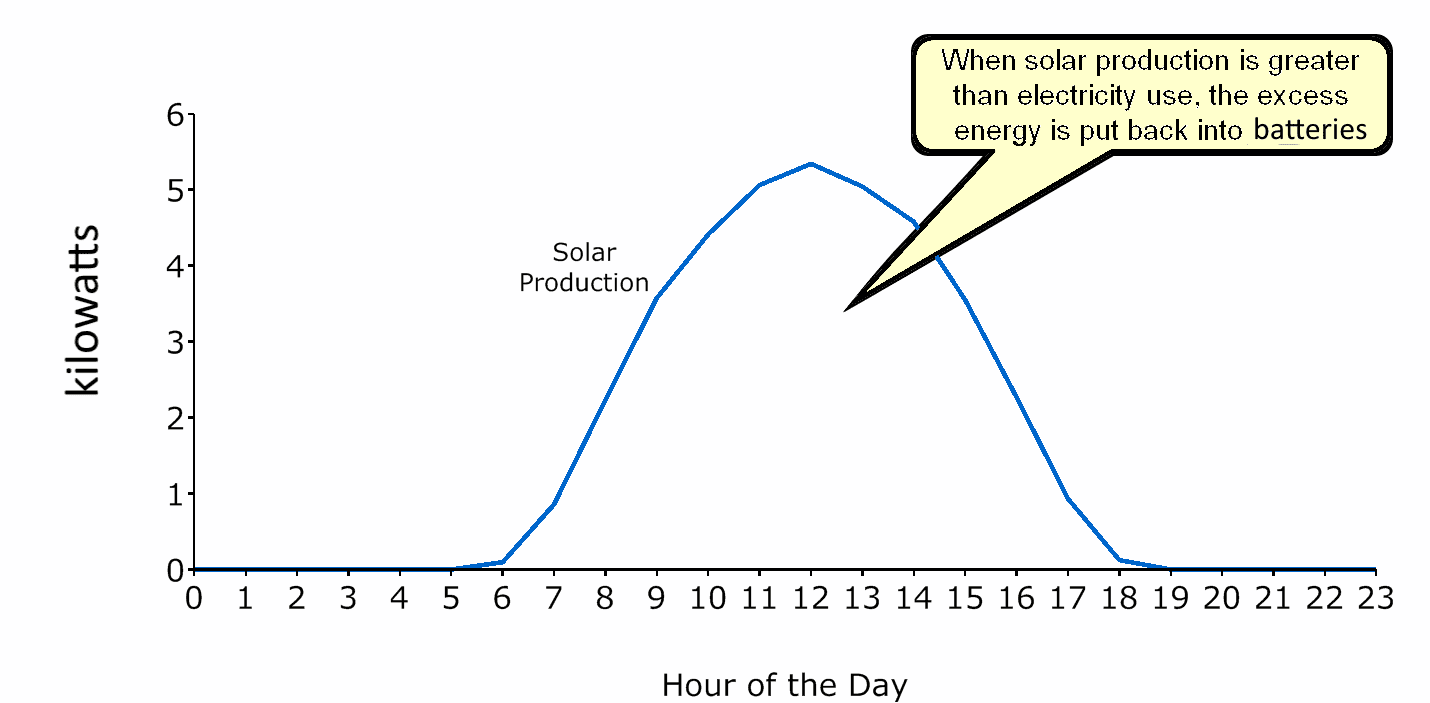
Many businesses are saving on their power bills by installing solar panels, but the savings would be greater if they had batteries to provide power early in the day and late in the afternoon when the output of the solar system is below the midday peak output.

Solar PV system output varies during the day
Suppose a business with a solar PV sysytem buys 4 or 5 electric vehicles that can deliver electricity from their batteries - the Nissan Leaf with a 40 kilowatt-hour battery is one electric vehicle designed for this role -  and leases them to its workers to be used in the following way:
  • The worker drives the electric vehicle to work each morning and plugs it into a power exchange socket where it provides electricity to the business whenever electricity use is greater than the output of the solar PV system AND has its battery recharged whenever there is excess solar energy being produced. 
  • The worker drives the car home each day after work and plugs it into a power exchange socket where it powers the home - with solar energy stored during the day while at work - during the evening peak period when electricity prices are at their greatest. 
  • By late evening or early morning, if the car battery charge has fallen below the level that is needed for the morning peak period to prepare breakfast and for the commute to work, some additional energy from the grid is stored in the battery - again at off-peak rates.
  • ...and so on, each day.
This may make electric vehicles a better investment than just assessing their value as a replacement for a simple petrol-fueled vehicle. They can provide electricity as backup generators for businesses when solar energy output is less than the amount of electricity used and they can let workers take solar energy home. This is especially valuable for anyone who lives in rented accommodation and/or lives in one of the many households where all the members are away from the home during daytime.

The following video uploaded in 2013 describes the process in 2 minutes. At that time, the Nissan Leaf had only a 24 kilowatt-hour battery. The recently released model has a 40 kilowatt-hour battery. 


One application of the technology is described in Adam Vaughan's the article published in The Guardian on October 3, 2017:

Electric car owners 'can drive for free by letting energy firms use battery' 

Electric car owners will be paid for letting an energy company use their vehicle’s battery in a pioneering scheme to increase take-up of the cleaner vehicles and help power grids manage the growth in green energy.

Nissan and one of the UK’s biggest challenger energy suppliers, Ovo, will offer the “vehicle-to-grid” service to buyers of the Japanese carmaker’s new Leaf from next year.

After installing a special charger in a customer’s home, the supplier will take over the management of the car’s battery, with owners able to set a minimum amount of charge they want for driving the next day. Ovo will then automatically trade electricity from the battery, topping it up during off-peak periods when power costs about 4p per kilowatt hour (kWh), and selling it at peak times for about four times as much.


Thursday, June 7, 2018

Australian Government Minister unaware of ratification of Paris Agreement

In September 2017 Steven Ciobo, the Australian Minister for Trade, Tourism and Investment made a decision to allow taxpayer funding of coal projects.


After this decision became known he was asked on 6 June 2018 to give reasons for it.

The reasons reveal the loss of capacity of the Coalition Government to obtain economic intelligence needed for policy decisions.

Steven Ciobo mistakenly believed (his answer to the question is shown in full below) that decisions by a number of banks and others to not invest in thermal coal mines was a consequence of social pressure rather than economic pressure.

Australian banks have made climate-related investment policies for coal projects in the interests of their shareholders following from the Australian Government's ratification of the Paris Agreement. (See "Ratification of the Paris Agreement on Climate Change") This ratification was made on 10 November 2016:
The Australian Government today reaffirmed Australia’s strong commitment to effective global action on climate change with the ratification of both the Paris Agreement on climate change and the Doha Amendment to the Kyoto Protocol.
Further information on the Government's commitment to the Paris Agreement describes "key outcomes" for coordinated global action including:
A global goal to hold average temperature increase to well below 2°C and pursue efforts to keep warming below 1.5°C above pre-industrial levels.
This "coordinated global action" has a number of economic impacts and it is these that underpin decisions by banks to reduce investment in thermal coal projects - NOT "social pressure" as Steven Ciobo mistakenly believes.

The economic intelligence he should have been across includes the material produced by the International Energy Agency following the Paris Agreement. Note that the announcement by the Westpac bank to which Steven Ciobo took umbrage is made with this material clearly in mind:
Global coal demand and share of coal in world energy demand by scenario

Westpac launched its updated Climate Change Action Plan on 28 April 2017. It said:
"the International Energy Association’s (IEA) modelling indicates that under a two degree scenario thermal coal demand will peak in the current decade and decline thereafter."
The economic pressures that result from global action are being felt beyond Australia. The Turnbull Government is poorly advised in deciding to risk taxpayer funds in a futile last-stand against change:
Over 18,000 jobs cut in industries building thermal power plants

Minister for Trade, Tourism and Investment

The Hon Steven Ciobo MP

National Press Club interview

6 June 2018
QUESTION: Amy Remeikis from The Guardian. Just to come back home for a moment, last year you reversed the Efic decision to allow for onshore resource investment. I'm just wondering what is the rationale behind that decision given that major Australian financial institutions have been pulling away from that sort of investment since 2015, and if you didn't consult with your department, who did you get advice from, if at all?
STEVEN CIOBO: Sure. Well, the rationale for it was because the decision by a number of banks and others to not invest was a consequence of social pressure rather than economic pressure. And the reason I can say that is because, contrary to The Guardian's claims and reporting, I did actually obtain advice. In fact, my decision to alter the statement of expectations for Efic went through Cabinet. And of course by definition I received advice from the department in relation to it, and they, in fact, highlighted it was a consequence of social pressure rather than economic decision-making that led to that. So that's the reason why we made the change. Because in essence it is obviously preposterous to deny viable resource projects - completely separate to the issue of coal - from securing financing for export, which creates livelihoods, drives, in many respects, rural or urban economies. I think Australia owes it to our people to do everything we can to provide and uphold their standard of living.


Sunday, April 22, 2018

Food drying with renewable energy

Increases in energy costs are a signal for industry to audit its energy use and survey new plant that lowers energy use.

The food processing industry in Victoria has received quotes for natural gas with prices more than doubling in just a few years.
Echuca-based food processor Kagome expects to pay $3.6 million for gas this year, up from $2.4 million last year, despite plans to use less gas. Kagome employs more than 200 people. 
Natural gas is the dominant form of energy use for the food processing plant at KAGOME Australia
Kagome Australia's processing plant receives about 4,000 tonnes of tomatoes each day during the harvest period of 70 days. Natural gas is used to evaporate water from the tomatoes for the production of tomato paste.

Evaporating 1,000 tonnes of water from 4,000 tonnes of tomatoes each day can use an enormous amount of energy. This isn't necessary but it depends on how it is done.

One way to evaporate 1,000 tonnes of water that does use an enormous amount of energy is to simply put batches into large cauldrons with gas burners beneath them. Allow the tomatoes in the cauldrons to simmer until the desired volume of water has evaporated.

This way requires 2,257 gigajoules of thermal energy that converts 1,000 tonnes of water into steam. If this heat energy is supplied by natural gas costing $9 per gigajoule, the daily energy bill would be about $20,000 and the total bill over the tomato harvest period of 70 days woul be about $1.4 million.

There are several other ways to perform the same process using much less energy.

For instance, the energy needed to convert 1 kilogram of water into water vapour is 2,257 kilojoules. The same amount of energy can be recovered when that kilogram of water vapour is condensed back into water.
Mechanical Vapour Recompression (MVR)

The mechanical vapour compressor uses a very small amount of electrical energy to transfer a very large quantity of heat energy from the condensing steam back into the cauldron of tomatoes where it boils off an identical amount of water.
The cost saving of this method is all of the natural gas used in the inefficient method of converting 1,000 tonnes of water into water vapour. This method also produces distilled water while continually recycling the latent heat of evaporation in the water vapour as it condenses back into water.

The condensed water produced may have some value too as a pure, distilled by-product.

Equipment using this method is commercially available. One type is marketed as "forced circulation evaporators". These are for concentrating fruit paste (tomato paste, peach paste, apricot paste and etc.) and some other products with high viscosity. Another type is marketed as "falling film evaporators". These are for concentrating products with low viscosity, for example: fruit juice, milk etc.

The value of the energy savings may make it worthwhile for Kagome Australia to invest in a forced circulation evaporator and eliminate the need for natural gas.