Latest Buzz...
                  

Translate

Showing posts with label electricity price. Show all posts

Tuesday, August 25, 2026

How Battery Energy Storage Shrinks the Peak Capacity Component of Your Electricity Bill

KaTeX Example

Author: C Dunstan
Research: Google Gemini
Date:August 25, 2026

Adding Battery Energy Storage creates new ways to reduce peak capacity and its cost

Title: The 5-to-1 Grid Lever: How Household Batteries Can Re-engineer Electricity Economics

Big power numbers may be confusing. When energy planners talk about 500-Megawatt (MW) peaking gas stations or multi-billion-dollar network expansions, the sheer scale obscures a simple mathematical reality.

To understand why our power bills contain such a heavy "peak capacity tax," you don't need to look at the whole grid. You only need to look at a single house.

The Math of a Single Home

Consider a typical household with two baseline numbers:

  • Daily consumption: 24 kWh per day (an average draw of 1 kW every hour).

  • Peak demand: 5 kW when the air conditioner, oven, and clothes dryer run at the same time for an hour.

Before battery storage, the entire supply chain—from the power station down through every transformer, pole, and wire leading to that house—had to be built to deliver 5 kW of continuous throughput.

Even if that 5 kW peak only happens for one hour a day, 80% of that grid infrastructure sits idle for the remaining 23 hours. Ratepayers pay for that unused capacity 24/7.

TRADITIONAL GRID (5 kW capacity required)
Grid Infrastructure (5 kW) ═════════════════════════> [ House ] (Peak: 5 kW)

BATTERY-BUFFERED GRID (1 kW capacity required)
Grid Infrastructure (1 kW) ═══> [ 5 kW Battery ] ═══> [ House ] (Peak: 5 kW)

The New Strategy: Continuous 1 kW Supply

With a home battery system equipped with a 5 kW inverter:

  1. The Grid's Job: The network only needs to deliver a steady 1 kW to the home every hour.

  2. The Battery's Job: During peak hours, the battery bridges the gap, supplying the extra 4 kW instantly.

  3. The Result: Peak load on the distribution system drops by 80% without changing the total energy consumed.

Scaling the Arithmetic: From 1 House to 100,000 Homes

When you multiply this strategy across a suburban network, the capital savings become staggering.

Metric Traditional Grid Model Battery-Buffered Strategy Difference / Savings
Average Demand per Home 1 kW 1 kW 0 kW
Required Grid Capacity per Home 5 kW 1 kW -4 kW per home
Total Grid Capacity (100,000 Homes) 500 MW 100 MW -400 MW
Peaking Plant Required 500 MW Gas Peaker None 100% Avoided

Instead of building a 500 MW peaking power station and sizing every local substation and wire to match it, the utility only needs to maintain 100 MW of continuous distribution capacity.

By buffering peak demand at the point of consumption, 80% of the physical grid infrastructure needed to support peak spikes becomes redundant—slashing the highest fixed-cost component on consumer electricity bills.


Title: How Battery Energy Storage Shrinks the "Peak Capacity Tax" on Your Electricity Bill

Ever wonder why electricity infrastructure is so expensive? For decades, energy networks had to be built for the absolute worst-case scenario: the hottest days of the year when millions of air conditioners run simultaneously.

Before commercial battery storage, ratepayers paid a massive premium for power plants and grid infrastructure that sat idle 98% of the time. Here is the math behind why that happened—and how batteries eliminate that cost.

The Math of the Peak Demand Problem

Imagine an electricity grid with the following typical profile:

  • Average demand: 5,000 Megawatts (MW)

  • Peak demand (1 week/year): 10,000 MW

  • Capacity utilization: The top 5,000 MW of capacity is only needed for 168 hours out of 8,760 hours in a year (less than 2% of the time).

Infrastructure Component Power Capacity Hours Used Per Year Utilization Rate
Base & Intermediate Infrastructure 5,000 MW 8,760 hours 100%
Peak Infrastructure (Peaker Plants/Poles) 5,000 MW 168 hours 1.92%

Because traditional power grids cannot easily store electricity, the network operators had no choice: they must build 10,000 MW of generation, transmission lines, and substations to prevent blackouts.

The Economic Penalty

If building and maintaining that extra 5,000 MW of peak grid infrastructure costs $500 million per year in capital and operational costs, that cost gets spread across the electricity bills of all consumers.

  • Traditional cost calculation:

Compare that to baseline power, which carries a capital infrastructure cost closer to $10–$20 per MWh due to high utilization. Consumers were effectively paying a massive "capacity tax" embedded in their supply charges to keep those extra plants on standby.

The Battery Storage Solution

Battery Energy Storage Systems (BESS) change the arithmetic by decoupling generation from instantaneous demand.

Instead of building 5,000 MW of expensive "peaker" generators and upgrading thousands of miles of wires:

  1. Charge during low demand: Batteries absorb cheap, excess solar and wind power during off-peak hours when the grid has plenty of spare capacity.

  2. Discharge during peak demand: During those critical 168 peak hours, batteries inject power directly into local networks.

The Savings Shift

  • Avoided Generation: Capital cost shifts from building gas peaker plants (high fixed cost, low use) to modular battery assets (which can perform daily energy arbitrage and grid stabilization all year round).

  • Avoided Distribution (Poles & Wires): Strategically placed batteries reduce the peak load on transformers and substations, deferring or eliminating billions in network upgrade costs.

By clipping the top off the annual demand curve, battery storage allows the grid to operate at a much higher capacity factor—lowering the average cost per megawatt-hour for everyone.


Sunday, January 26, 2025

Dispatchable power and dispatchable internet of things

The National Electricity Market in Australia experiences periods where more electricity is supplied than is needed, and periods where demand exceeds the available supply. 

"Dispatchable power" has been mentioned as a partial remedy to the latter periods.

The ability to remotely turn off rooftop solar PV systems and air conditioners has been mentioned as a partial remedy to the former periods. 

A more flexible solution is available, one echoes a feature in operating systems design, where hundreds of concurrent processes queue to use scarce resources and relinquish them when finished or surrendered.

Appliances and devices can be equipped with smart switches that send one of several status signals to distributed National Electricity Market management systems: 

  • "I am not currently consuming electricity, but can if requested."
  • "I am currently consuming electricity, but can pause if requested."
  • "I am not currently sending electricity to the grid, but can if requested."
  • "I am currently sending electricity to the grid, but can pause if requested."

The appropriate subset of status signalling, and the ability to respond to a request, can be incorporated into existing devices, including:

  • Hot Water Storage systems,
  • Home Battery Energy Storage systems,
  • Pool pumps and heaters,
  • Air conditioners,
  • Rooftop solar PV systems, and
  • Electric Vehicles.

There is a substantial cost in not having this approach to managing the National Electricity Market. 

In November 2024, over $700 million was paid by retailers in NSW for electricity used in just 7 hours and 40 minutes. This was more than the total paid for ALL the electricity the retailers purchased for the entire remainder of the month.

This pushed to average electricity price for NSW in November 2024 to $263.46 per megawatt hour (MWh). 

In December 2024, with fewer extreme price periods, the average wholesale price for NSW was only $164.72 per megawatt hour (MWh).

The National Electricity Market compels consumers to pay exorbitant prices for electricity

It would have helped if any electricity consumed in those 7 hours and 40 minutes with exceptionally high prices in NSW in November 2024 could have been postponed by just 5 or 10 minutes. 

There were also far more periods when the National Electricity Market price was exceptionally low. 

If more electricity had been consumed in those periods, avoiding the need to consume in other periods with higher prices, the average cost of electricity could be further reduced.

See "How to lower the price of electricity" for more analysis of data from the National Electricity Market.


Sunday, January 19, 2025

Better appliances to work with rooftop solar PV systems

Households and businesses with rooftop solar PV systems produce so much electricity in the middle of the day that feed-in tariffs are going down fast, and there are moves afoot to be able to turn them off to avoid overloading the electricity grid with surplus electricity. 

However electricity bills are kept high by the price of electricity that increases in the mid to late afternoon as air-conditioning loads increase at the same time solar PV output is falling. 

If your business or household is exporting a large amount of electricity in the middle of the day, and paying a large amount for electricity used later in the day, more suitable appliances can be available to save you money.

There are air-conditioning options that can shift energy use from late afternoon, when cooling is needed, to the middle of the day, when electricity from solar PV systems is at a peak. 

An insulated storage tank that holds 3,000 litres of water costs about $4,000 - using a "Slim Steel" water tank, R7.0 ceiling insulation and a garden storage shed - all available at Bunnings. 

Kingspan 3000L Slim Steel Water Tank - 850mm x 1860mm x 2300mm
Kingspan 3000L Slim Steel Water Tank - 850mm x 1860mm x 2300mm - $2,695

Cooling 3,000 litres of water from 20℃ to 5℃ uses about 18 kWh of electricity - assuming a water chiller with a co-efficient of performance (COP) of 3 is used.

The cooling can be done in the middle of the day using only solar PV generated electricity. 

The chilled water is then available for air-conditioning later in the day - avoiding the need to run reverse-cycle air-conditioners using electricity from the National Electricity Market - where the price can go as high as $15,000 per MWh ($15 per kWh) in some 5-minute intervals.  

Water Source Heat Pumps (WSHP) use chilled water to cool the air in summer, (or heated water to warm air in winter) unlike typical reverse cycle units which rely on external fan assisted condensers to exchange energy with the outside air.

Monday, December 30, 2024

How to lower the price of electricity

The Australian National Electricity Market is a surprising source of high electricity prices.

For instance, in November 2024, households and businesses in New South Wales used electricity in just ten hours that cost electricity retailers over $672 million. 

All of the electricity used in the other 29 days and 14 hours of November costs retailers less: $615 million. 

Chart of cumulative wholesale cost of elctricity for NSW in November 2024

The retailers will recoup this cost from their customers via higher retail prices that take effect in one year's time. Note that the higher retail prices will affect all the customers of electricity retailers - even if they did not use any electricity during those ten hours in November when the wholesale cost was so extreme. 

There are some things that can be done to overcome these exorbitant wholesale electricity costs. 

If homes and businesses had energy management systems, these could have a function to reduce electricity consumption from the National Electricity Market in those brief periods that contribute so much to the retail price in the following year. 

The homes and businesses with energy management systems could enter their choices on how to deal with each 5-minute interval where the cost of electricity from the National Energy Market was extreme. 

  • If any battery storage was available, the system could be instructed to use stored electricity at those times. 
  • If an appliance did not need to run in any five-minute interval, such as a pool pump, it could be instructed to switch off for one or more 5-minute intervals - until it had to be started or the wholesale price had dropped.

UPDATE, 1 January 2025

Comparison of Electricity purchased in NSW in November and December 2024

The National Electricity Market data available for the wholesale cost of electricity in NSW in November and December shows: 

  • For November, NSW electricity consumers used a total of 5,074,855 megawatt-hours (MWh) for a total cost of $1,337 million. That is $263 per megawatt-hour (MWh).
  • For December, NSW electricity consumers used a total of 5,381,036 megawatt-hours (MWh) for a total cost of $886 million. That is $165 per megawatt-hour (MWh).

National Electricity Market data for electricity sold in NSW
The data for producing the above summary was downloaded from the Australian Energy Market Operator (AEMO) web page "Aggregated price and demand data". 

The difference in price, $263/MWh in November and $165/MWh in December is the result of there being fewer 5-minute intervals in which the price was greater than $1,000 per MWh. 

  • In November there were 92 x 5-minute intervals, which is 7 hours and 40 minutes, when the electricity price was greater than $1,000 per MWh. In these 7 hours and 40 minutes the amount of electricity sold was 70,358 MWh and the price was $706 million.
  • The electricity used in those 7 hours and 40 minutes cost NSW businesses and households $10 per kWh. How many would pay that much for so little if they were given a choice?
  • In December there were 45 x 5-minute intervals, which is 3 hours and 45 minutes, when the electricity price was greater than $1,000 per MWh. In these 3 hours and 45 minutes the amount of electricity sold was 37,498 MWh and the price was $276 million.

The National Electricity Market compels consumers to pay exorbitant prices for electricity
 

The difference in cost to the electricity retailers who bought this electricity and supplied it to their customers was $430 million. This difference is responsible for the average wholesale price of $263 / MWh in November and $165 / MWh in December.

Note that the change was not because of a change in the total demand for electricity, and it was not due to the technology used to generate electricity. There were the same coal-fired power plants operating in both months. There were the same renewable energy producers operating in both months.

These wholesale electricity costs will be reflected in retail electricity prices in a year's time. 

For information on how to lower the cost of electricity, see "Energy Storage without the cost of a battery", which includes specific specific advice at the sub-heading "The Argument for Smart Switches".

This is a list of the 45 x 5-minute intervals in December 2024 when the wholesale cost of all electricity bought from the National Energy Market in NSW cost more than $1,000 per megawatt-hour: 

REGIONSETTLEMENTDATETOTALDEMANDRRPPERIODTYPE
NSW12/12/2024 11:306651.211062.2TRADE
NSW12/12/2024 11:556915.821120.5TRADE
NSW12/12/2024 12:057108.531120.5TRADE
NSW12/12/2024 12:157217.561072.66TRADE
NSW12/12/2024 17:3511420.624438.07TRADE
NSW12/12/2024 17:4011345.361265.73TRADE
NSW12/12/2024 17:4511334.871060.61TRADE
NSW12/12/2024 17:5011419.915619.87TRADE
NSW12/12/2024 17:5511364.4715502.98TRADE
NSW12/12/2024 18:0011296.7715529.65TRADE
NSW12/12/2024 18:0511266.0315576.4TRADE
NSW12/12/2024 18:1011231.3610854.53TRADE
NSW12/12/2024 18:1511227.9514028.89TRADE
NSW12/12/2024 18:2011221.2615799.26TRADE
NSW12/12/2024 18:2511189.6314028.89TRADE
NSW12/12/2024 18:3011126.4610722.84TRADE
NSW12/12/2024 18:3511050.584308.54TRADE
NSW12/12/2024 18:4010980.054231.24TRADE
NSW13/12/2024 11:409317.2111267.8TRADE
NSW13/12/2024 11:459329.6317499.89TRADE
NSW13/12/2024 11:509440.5114100TRADE
NSW13/12/2024 11:559495.4511922.71TRADE
NSW16/12/2024 14:3011100.6917480TRADE
NSW16/12/2024 14:3511160.0617499.89TRADE
NSW16/12/2024 14:4511445.7115766.43TRADE
NSW16/12/2024 14:5511505.0614101.5TRADE
NSW17/12/2024 18:3010371.84127.15TRADE
NSW18/12/2024 18:008800.482268.8TRADE
NSW19/12/2024 14:404981.681071.59TRADE
NSW112/12/2024 17:5010089.881227.61TRADE
NSW112/12/2024 17:559949.161079.75TRADE
NSW112/12/2024 18:009944.711027.83TRADE
NSW112/12/2024 18:1510037.171257.89TRADE
NSW112/12/2024 18:2510068.364450.07TRADE
NSW112/12/2024 18:309915.421259.54TRADE
NSW112/12/2024 18:359928.091276.32TRADE
NSW112/12/2024 18:409867.521276.93TRADE
NSW112/12/2024 18:459864.791276.83TRADE
NSW112/12/2024 19:009897.331292.69TRADE
NSW112/12/2024 19:059755.561310.71TRADE
NSW112/12/2024 19:109730.424396.17TRADE
NSW112/12/2024 19:159687.34451.8TRADE
NSW112/12/2024 19:209685.149463.19TRADE
NSW112/12/2024 19:259591.381108.15TRADE
NSW112/12/2024 19:309650.851129.09TRADE

Friday, June 15, 2018

Electric vehicles make solar power mobile

Solar PV systems can reduce electricity bills for many families and businesses.

Unfortunately this isn't the case for families who rent because properties available for rent rarely have solar panels installed.

Even for families who do have solar PV systems, the savings aren't that great when everyone is at work or school during the the day when the sun is shining and the solar energy output is mostly being fed into the grid.

There is another way to supply solar energy to these households and help them cut their electricity bills.

Many businesses are saving on their power bills by installing solar panels, but the savings would be greater if they had batteries to provide power early in the day and late in the afternoon when the output of the solar system is below the midday peak output.

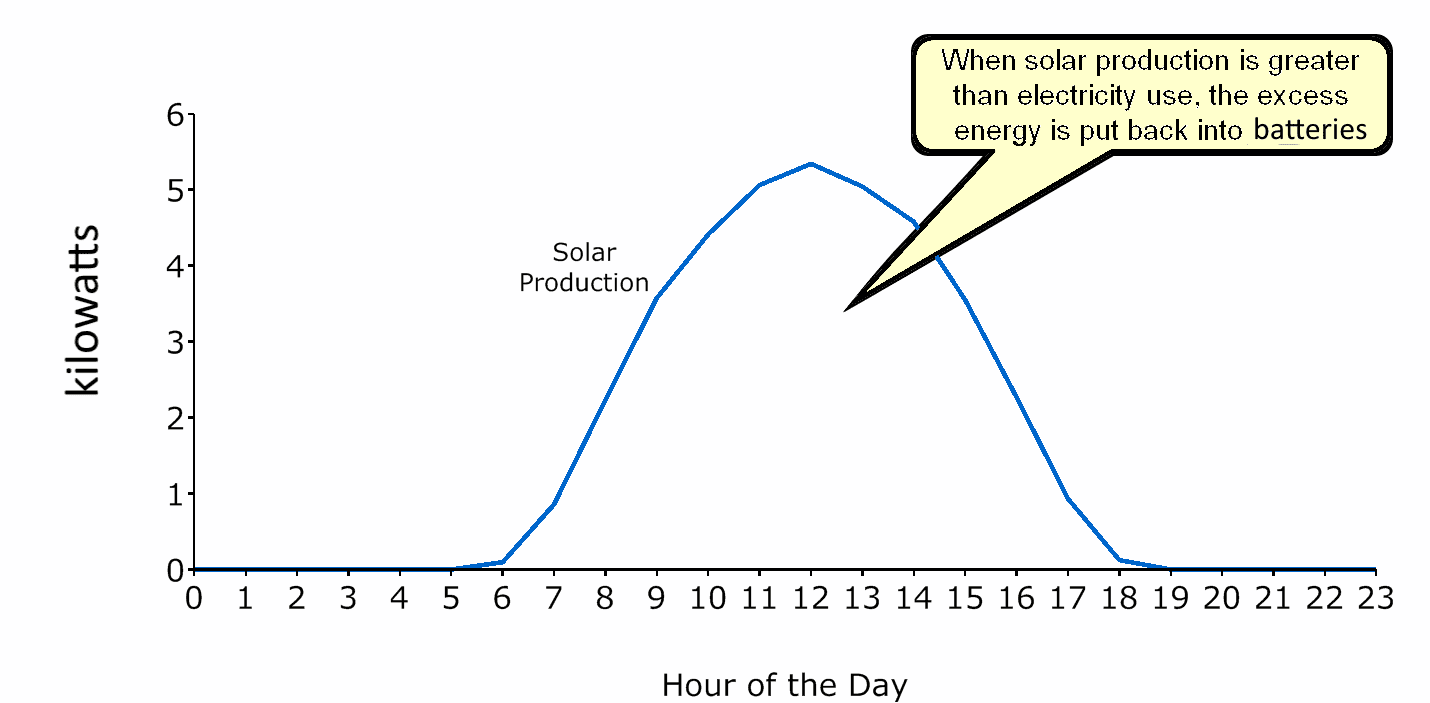
Solar PV system output varies during the day
Suppose a business with a solar PV sysytem buys 4 or 5 electric vehicles that can deliver electricity from their batteries - the Nissan Leaf with a 40 kilowatt-hour battery is one electric vehicle designed for this role -  and leases them to its workers to be used in the following way:
  • The worker drives the electric vehicle to work each morning and plugs it into a power exchange socket where it provides electricity to the business whenever electricity use is greater than the output of the solar PV system AND has its battery recharged whenever there is excess solar energy being produced. 
  • The worker drives the car home each day after work and plugs it into a power exchange socket where it powers the home - with solar energy stored during the day while at work - during the evening peak period when electricity prices are at their greatest. 
  • By late evening or early morning, if the car battery charge has fallen below the level that is needed for the morning peak period to prepare breakfast and for the commute to work, some additional energy from the grid is stored in the battery - again at off-peak rates.
  • ...and so on, each day.
This may make electric vehicles a better investment than just assessing their value as a replacement for a simple petrol-fueled vehicle. They can provide electricity as backup generators for businesses when solar energy output is less than the amount of electricity used and they can let workers take solar energy home. This is especially valuable for anyone who lives in rented accommodation and/or lives in one of the many households where all the members are away from the home during daytime.

The following video uploaded in 2013 describes the process in 2 minutes. At that time, the Nissan Leaf had only a 24 kilowatt-hour battery. The recently released model has a 40 kilowatt-hour battery. 


One application of the technology is described in Adam Vaughan's the article published in The Guardian on October 3, 2017:

Electric car owners 'can drive for free by letting energy firms use battery' 

Electric car owners will be paid for letting an energy company use their vehicle’s battery in a pioneering scheme to increase take-up of the cleaner vehicles and help power grids manage the growth in green energy.

Nissan and one of the UK’s biggest challenger energy suppliers, Ovo, will offer the “vehicle-to-grid” service to buyers of the Japanese carmaker’s new Leaf from next year.

After installing a special charger in a customer’s home, the supplier will take over the management of the car’s battery, with owners able to set a minimum amount of charge they want for driving the next day. Ovo will then automatically trade electricity from the battery, topping it up during off-peak periods when power costs about 4p per kilowatt hour (kWh), and selling it at peak times for about four times as much.


Friday, December 22, 2017

Snowy Hydro 2.0 has competition

There are many ways to store renewable energy.

A problem with Snowy Hydro 2.0 is that it won't work without a large investment in additional 'poles and wires'. This is needed to move renewable energy to the centralised storage facility and to deliver it to consumers when needed. This very large outlay will add to already high electricity prices in Australia.

Another option reduces the need for spending on 'poles and wires' and cuts electricity prices: installing energy storage along-side solar PV systems owned by electricity consumers. See Affordable reliable electricity the easy way for a discussion on this option.

A different option for energy storage has even more advantages...

The Australian Government and other coal lobbyists express concerns with a fifty percent renewable energy target such as the one proposed by the Australian Labor Party:
"50% Renewable Energy by 2030 ...The Climate Change Authority has found that for Australia to achieve its bipartisan agreement to limit global warming by less than 2°C, renewable energy will need to comprise at least half of Australia’s electricity generation by 2030." 
Opponents make claims such as:
"Labor’s energy policy to deliver $200 bill shock ...Labor’s policy of a 50 per cent ­renewable energy target by 2030 would require the closure of 75 per cent of existing coal-fired power in Australia."
It's not as challenging a problem as some people think. Instead of using renewable energy to pump water uphill in a Snowy Hydro 2.0, it can be converted to despatchable fuel in two steps:
  1. Produce hydrogen by electrolysis of water.
  2. Use the hydrogen from the first step to manufacture methane from brown coal. 
The resulting fuel contains 50% renewable energy and 50% fossil fuel energy. If biomass was gasified in place of the coal, the fuel would be 100% renewable, despatchable energy.

The advantages include:
  • There is no need for fracking to produce coal seam gas.
  • There is no shortage of natural gas for the domestic market.
  • Inefficient old brown coal power stations that produce over 1,100 kilograms of carbon dioxide per megawatt-hour are replaced by efficient combined-cycle gas turbine power stations that produce only 330 kilograms of carbon dioxide per megawatt-hour. 
The reduction in carbon dioxide emissions from over 1,100 kilograms to just 330 kilograms per megawatt-hour points to a fairly remarkable benefit:
  • For Snowy Hydro 2.0 only about 2 megawatt-hours of renewable energy are returned for each 3 megawatt-hours of renewable energy that are stored... 
  • Carbon in brown coal is only being converted into electricity at an efficiency of about 25% in existing coal-fired power stations.
  • After this carbon is used to make methane with hydrogen from renewable energy, it is converted into electricity with an efficiency of 60% in combined cycle gas turbine power stations. 
  • This change means the amount of coal needed for the same amount of electricity is cut by over 70%. Output is increased, not reduced in this option.
E.on launches power-to-gas plant
The unit uses wind power to run electrolysis equipment that transforms water into hydrogen

The conversion of coal and biomass into high energy synthetic gases suitable for use as fuels focused attention on the hydrogasification reaction: C + 2H2 ⇄ CH4.

Because this reaction is highly exothermic and requires the presence of hydrogen, it has been suggested that it be integrated with endothermic hydrogen-producing reactions such as the steam/carbon gasification reaction, C + H20 ⇄ C0 + H2, and the methane/steam reforming reaction, CH4 + H20 ⇄ C0 + 3H2, to conserve heat and reduce the amount of hydrogen which must be provided.

It has been found that this can be done by reacting the coal or other carbonaceous material with steam and hydrogen in a hydrogasification zone to produce a methane-rich gas, passing at least a portion of this gas stream through a methane reforming zone where it is contacted with steam to reduce part of the methane and form hydrogen, and then recycling hydrogen and carbon monoxide recovered from the steam reformer overhead gas to the hydrogasification zone.

Coal char or other carbonaceous solids are circulated between the hydrogasification and reforming zones to provide heat integration.

Saturday, November 4, 2017

Affordable reliable electricity the easy way

Australian Government politicians often begin media announcements about energy with the phrase "What do you do when the sun doesn't shine and the wind doesn't blow?"

I suppose they often ask this because they don't know the answer. If they did, surely they'd have stopped asking themselves the same question ages ago.

Another over-used phrase the Australian Prime Minister repeats to himself  is: "When you flick the switch, you want the light to come on."

Many old people still think the electricity grid runs like it did in the 1950's: demand for electricity sprang up from the random actions of countless people flicking light switches on and off willy-nilly and the electricity generation and distribution system, startled by all this activity, sprang into life to send the right number electrons down wires to make their lights come on.

Today, managing electricity supply and demand is much easier. It is also a lot cheaper: it was expensive to keep enough capacity spinning at all hours of the day just in case another 300 or 400 people suddenly flicked on light switches at the same time.

Weather forecasts make it easy to predict a day ahead how much energy any customer is going to need and how much energy the customer's solar panels are going to generate.

Data on customers' energy use and production at five minute intervals is available with historical data for several years with which to predict changes from season to season and forecast energy demand on exceptionally hot or exceptionally cold days. It is available for analysis at PVOutput which is a free service for sharing and comparing PV output data.

The following chart is an example of data for one day of a household with a 5 kilowatt solar PV system and all electric appliances:
Solar PV output vs Electricity Consumed

The chart shows output from a 5 kilowatt solar PV system - that begins generating electricity about 7:00 am in the morning and ceases generation about 5:30 pm - producing a total of 20 kilowatt-hours of energy for the day.

Also shown is the energy consumption by appliances in the household. Though this seems to proceed at a fairly steady pace through the day, details in the source data show that there are a number of short bursts of energy use and relatively quiet periods.

The grey line shows the difference between energy generated and energy used. The total produced for the 24 hour period on this day was slightly above the total used.

The solar panels however didn't produce energy early enough in the day to match the energy used before 9:00 am, and stopped producing electricity when the total amount used was only about 12.5 kilowatt-hours at 5:30 pm.

If the household had a 15 kilowatt-hour battery for energy storage:
  • Beginning the day with 5 kilowatt-hours stored energy would have supplied the morning energy needs in the hours before the solar panels began to produce enough energy to meet the demand.
  • Adding about 12.5 kilowatt-hours of solar energy to the battery by 5:30 pm would be sufficient to continue meeting demand for the rest of the day.
  • As the total energy generated for the day was slightly greater than the total consumed, the battery would end the day at about the same level of charge it had at the start of the day - ready to repeat the process the next day.
 If the energy used was a little greater than initially predicted, or the amount generated was a little below the amount forecast a day earlier, the battery would end the day with a bit less than the 5 kilowatt-hours of energy stored that it held at the beginning of the day.

The battery management software could then place an order for a 'top-up' to be sent to it after midnight - while spare generating capacity and distribution assets are sitting idle doing very little. The automated battery 'top-up' order could be modified by energy management software to take into account the weather forecast for the following day.

Energy is very cheap to generate and deliver after midnight: beat the rush, save money.

So the next time someone asks "What do you do when the sun doesn't shine and the wind doesn't blow?" tell them.


Monday, September 4, 2017

Future energy technology is here

Australia ran an expensive experiment to encourage investment in electricity generation and distribution capacity to ensure supply on a few days of the year when demand is at a maximum.

Electricity demand on the hottest days in summer is about double the average electricity demand on other days. To encourage investment in capacity that is idle on all but these few extremely hot days each summer, a very profitable incentive was created.


State-owned electricity generators and distribution network operators that were able to borrow $billions at discounted interest rates were guaranteed a high rate of return on every dollar they could spend. The inevitable result was excessive and extravagent spending. It is commonly known now as "gold-plating".


As an aside, it is sometimes misunderstood that switching from coal-fired power generation to low-emission electricity generation increases prices. Note that the US maintained low electricity prices while making rapid progress on replacing coal-fired power stations.

Wind adds the most new generation capacity, followed by gas and solar

Technology is available to solve the problem that Australia created with these incentives to spend up big on electricity generating and distribution capacity that is planned to be idle on all but a few of the hottest days each summer.

This technology also solves the problem of what to do with the surplus electricity supply when the sun is shining on solar panels and the wind is spinning wind turbines, but all available battery storage is filled and demand is being fully met...

Distributed power-to-gas plants can convert the surplus electricity into renewable natural gas. This can be fed into the existing natural gas distribution lines to flow upwards to liquified natural gas plants for export. On the few occasions each year when electricity demand is exceptionally high, as many distributed power-to-gas plants as required can be reversed within a few minutes to generate electricity from natural gas stored in the natural gas distribution lines.

Renewable natural gas produced from farm and urban waste can be fed into the natural gas distribution lines and, where carbon dioxide has been separated from biogas, it can be piped to power-to-gas plants that combine carbon dioxide with hydrogen to produce renewable natural gas.

Australia is in the fortuitous position of being able to use renewable energy for 100 percent of its electricity supply, 100 percent of its transport energy and 100 percent of its energy exports.


Saturday, August 12, 2017

Renewable energy technology is affordable and reliable

Incumbent electricity and transport fuel producers lobby to hold back the adoption of renewable energy, but innovation has now eliminated the logic of their concerns.

When the roll-out of Australia's first-generation electricity supply system was finalised in the 1960's it relied upon simple management strategies for economic use of the capital investment:
  • Coal-fired power stations met electricity demand during peak loads during the day and at night heated off-peak hot water systems and stored further energy in pumped hydro storage.
  • The pumped-hydro storage system was available to supplement the coal-fired power generation capacity during the highest peak demand periods during each day. 
With the low cost of small-scale energy storage that is now available, it is practical to transfer the 1960's experience with centralised  electricity generation into managing electricity supply for individual homes, businesses and villages...

A large household in Australia uses up to 20 kilowatt-hours of electricity a day - about the same amount of energy that a 5 kilowatt rooftop solar photovoltaic (PV) can produce reliably on most days of the year.

For reliable electricity supply, a household only needs to install enough battery storage to provide it with all the energy it needs for just one day. On most days, the solar PV system will recharge all the energy used from the battery storage, and the household can meet occasional peak loads by drawing energy from both its solar PV system and battery storage at the same time.

Solar Battery Storage Comparison Table
Extract from SolarQuotes table


On days where solar PV energy output is below the usual level, the battery storage system can be topped-up overnight from large-scale generators. The large-scale generators can be informed of the total overnight demand well in advance - from data transmitted from battery storage systems, and schedule generation and distribution at times to make use of unused distribution capacity. This is like having supermarkets restocked by trucks using roads at 3 am in the morning to deliberately avoid busy peak-hour traffic.

In periods of extreme day-time peak demands, the large-scale generators can be brought online to supplement the regular levels of demand that are met by solar PV and battery storage of homes, businesses and villages.

This strategy eliminates the need for 'gold-plating' which is the major cause of high electricity prices in Australia: idle capacity for generation and distribution that is kept in reserve for as little as a few hundred hours each year when peak demand reaches unusual, extreme levels.

Sunday, July 23, 2017

Energy storage and meeting peak demand

The cost of storing energy and meeting peak demand can be cut dramatically with a good combination of technologies and judicious use of available assets.

Depleted gas fields in South Australia have provided a return on investment over a number of years and when reused for new purposes, save the need for investment in locating and tapping similar geological structures.

Subsurface geological conditions which may be suitable for underground gas storage have been identified in the Two Wells - Port Wakefield area of the Northern Adelaide Plains. This area is within 100km of Adelaide. (See "Underground Gas Storage", Department of the Premier and Cabinet, South Australia)

Cutaway view of gas turbine engine
A cutaway view of Solar Turbines' Taurus 70 engine, which is similar to a jet engine, but is used to generate electricity in power plants on the ground.
In a solar thermal turbine compressed air is heated by concentrated solar energy...

CSIRO Solar Air Turbine Project


Heat energy in a solar thermal turbine can be supplemented with natural gas when there is partial cloud cover. At night natural gas can take over from solar thermal heating.

Whether a turbine engine is run on natural gas or solar thermal energy, about half the energy available from the turbine is used to power the compressor, leaving the other half to run a generator to supply electricity.

That is, a gas turbine power station with a nameplate rating of 100 MW is actually able to produce 200 MW of energy - if it did not have to drive a compressor.

Energy from renewable energy generators may be stored by driving compressors to compress air that is stored in depleted gas fields.

Compressed Air Energy Storage
The compressed air energy storage can deliver electricity to the grid when it is required by supplying it to a gas turbine generator, relieving the generator of the need to drive a compressor while it is being supplied with compressed air.


A solar thermal power station can store energy in a compressed-air energy store and use the compressed air at night to significantly reduce the amount of stored thermal energy or natural gas needed for operation.

During peak demand periods, output from existing gas turbine generation plant can be quickly increased by reducing the energy used to drive compressors while supplying them with compressed air from storage.

Saturday, March 4, 2017

Fossil fuel energy is unreliable

Natural gas power is increasingly unreliable in Australia.

A simple law of physics explains why natural gas power stations are unreliable:
6 gigajoules of natural gas are needed to generate 3.6 gigajoules of electrical energy in a combined-cycle gas turbine power station.

Each 3.6 gigajoules of electrical energy (which is 1 megawatt-hour or 1 MWh) has a price of about $50 in the Australian Energy Market Organisation's National Electricity Market.

The natural gas used to generate this electrical energy costs about $9 per gigajoule in the Australian Energy Market Organisation's Wholesale Gas Market.

The result:
It costs about $54 for the natural gas used as fuel to generate each megawatt-hour of electricity. This has a wholesale price of only $50.

Rising domestic gas prices

In terms of production costs, over the last decade the finding and development costs for the petroleum industry have increased six-fold. And, in the three years to 2013, total Australian finding and development costs averaged $4.16/GJ, which was 2.7 times the average for the three years to 2007. These rising costs are partly explained by the fact that unconventional gas production involves significantly higher capital expenditure than that of conventional off-shore wells, given that CSG requires multiple wells to be drilled in order to access equivalent volumes of gas.

SANTOS July 2, 2015
Public Submission to ACCC East Coast Gas Inquiry

Natural Gas price in the U.S. - 1 million BTUs = 1.055 gigajoules


The projected US exports of around 7 trillion cubic feet of natural gas, or about 140 million tonnes of LNG is almost double the projected Australian exports of 85 million tonnes of LNG per year.

1 metric ton liquefied natural gas (LNG) = 48,700 cubic feet of natural gas.
1 trillion cubic feet of natural gas is about 20 million tonnes of LNG.

Given the much higher cost of producing coal seam gas in Australia, the ramping up of US LNG exports to 2020 is likely to bring the enthusiastic expansion of coal seam gas in Australia to a sudden end.


Wednesday, February 8, 2017

LNG exports and heatwaves drive up energy costs


The Australian Government's LNG export policy - with no reservation for industry and residential consumers - has resulted in a 250 percent increase in the cost of natural gas since 2014. The resulting $8.60 per gigajoule price for natural gas makes efficient, low emission combined cycle gas turbine (CCGT) power stations like that at Pelican Point, South Australia, quite costly to run compared to a high emission low efficiency (HELE) coal-fired power station.

The raucous noise over renewable energy in South Australia and the upsurge in government members spruiking high emission low efficiency (HELE) coal-fired power stations is most likely a deliberate distraction from this fiasco that is the government's "sell-it-all" LNG export policy.

AEMO Short Term Natural Gas Trading Market Quarterly Average Price


Gladstone LNG plant places a demand on gas from NSW and elsewhere

Energy Action | Feb 19, 2016

Gas flows on the Moomba-to-Sydney gas pipeline has supplied NSW with gas since 1976. However, according to data from the Australian ­Energy Market Operator (AEMO), the flow was reversed in December for the first time as the third of three gas export projects being built at Gladstone powered up.

New Moomba Gas Supply Hub launched

MEDIA RELEASE - AEMO
Wednesday, 1 June 2016

The Australian Energy Market Operator (AEMO) has today announced the launch of the newly established Moomba Gas Supply Hub and two additional trading locations at the Moomba to Adelaide pipeline and the Moomba to Sydney pipeline, which are now open for trading.

The Moomba Gas Supply Hub follows the successful introduction of the Wallumbilla Gas Supply Hub (GSH), established in 2014 to enhance the transparency and reliability of gas supply by creating a voluntary market that offers a low-cost, flexible method to buy and sell gas at interconnecting transmission pipelines.

Gas and LNG Market Outlook, January 2017

National Australia Bank

The exposure of eastern Australia to LNG export markets will have far reaching implications for domestic gas use.

Wholesale prices are likely to increase significantly and some questions remain over availability of commercially recoverable gas from Queensland coal seam gas fields.

Higher wholesale gas prices are likely to spill over into electricity markets by increasing fuel costs for peak load open cycle gas turbines.

Higher gas prices are already flowing through to large domestic customers, with reports that contracts are being offered well in excess of current netback export parity prices.

The price of gas for residential customers in Australia’s five largest cities could increase by more than 50% by 2020.


Boyne Smelter to close cells, cut production after power price spike

Tegan Annett | 21st Jan 2017, Updated: 23rd Jan 2017
Gladstone Observer

IF nothing changes in Queensland's electricity market, 40 aluminium-producing cells at Boyne Smelter will be closed.

That's the message from general manager Joe Rea who says it will result in jobs lost and leave the Boyne Smelter down 45,000 tonnes in aluminium production.

The price hike was driven by high electricity demand in response to very hot weather conditions in Queensland. He said on January 18, a new demand record was set at 9,357MW exceeding the previous record of 9,097MW.

Queensland moves to reserve gas for domestic use

Matt Chambers | 26th Jan 2017
The Australian

Gas producers have voiced alarm at Queensland’s move to earmark a small patch of new exploration ground for domestic use, although former federal resources ministers and previously staunch domestic gas reservation opponents Ian Macfarlane and Martin Ferguson have changed their position and now back the move.

Queensland Resources Minister Anthony Lynham yesterday announced the release of 58sq km of exploration ground in the onshore Surat Basin with the “strict” condition that any gas produced must be used in Australia.

The Queensland Resources Council, which counts both the big gas exporters and some big gas users (such as Incitec Pivot, Rio Tinto and Glencore) among its members and is now run by Mr Macfarlane, applauded the move.

Friday, January 27, 2017

Coal hard cash

India builds a low-efficiency, high emission (LEHE) coal-fired power station for Bangladesh


This is not so good for the Bangladesh economy and its environment. But it's not all bad news: the Government of India is lending Bangladesh the money for the project that will create jobs for India and boost India's economy.
Maitree Super Thermal Power Project gets cashed up
Business run by Indian Government bags Maitree Super Thermal Power Project contract

Ultra-supercritical tech won't be used in Rampal plant: official
October 31, 2016

Environmentalists have been pressing the government to relocate the Rampal power plant arguing that emissions of the power plant, and transportation and handling of coal through the Sunderbans would destroy the biodiversity of the world’s largest mangrove forest.

In the backdrop of severe criticism against the Rampal power project, the government has been claiming that it would use ‘ultra-supercritical’ technology which would put minimum impact on the Sunderbans, only 14km off the location of the power plant in Bagerhat.

Bangladesh-India Friendship Power Company Limited managing director Ujjal Kanti Bhattacharya told New Age on October 27, ‘The term ultra-supercritical has been made popular by the manufacturers of steam generators for commercial purposes.’

A top official of Bangladesh Coal Power Generation Company, which would implement Matarbari 1,200MW coal-fired power project, said that they would use supercritical technology and there was nothing called ‘ultra-supercritical’ technology in coal fired power generation.

Contract signing for Maitree Super Thermal Power Project
July 13, 2016

"I am extremely happy that Bharat Heavy Electrical Ltd has been awarded the engineering, procurement and construction (EPC) contract for the 2 X 600 MW Maitree Super Thermal Power project (also known as the Rampal power station) in Rampal (a small village in Bangladesh)."

Financing for the project has been arranged by EXIM Bank under the special financing package for strategic projects approved by the Government of India.

BHEL bags NTPC's Bangladesh project
July 14, 2016

Indian public sector company, Bharat Heavy Electricals Ltd (BHEL), has bagged the engineering, procurement and construction contract for a 1,320 megawatt power station for Bangladesh-India Friendship Power Company (BIFPC).

BIFPC is a 50:50 joint venture floated by Bangladesh Power development Board and Indian public sector company National Thermal Power Corporation (NTPC) of India. The company signed a contract agreement for the main plant engineering, procurement and construction contract on a turnkey package with BHEL India to construct the 2 X 600 MW Maitree Super Thermal Power Project...

...The contract value of the project is $1.49 billion which will be financed by Indian EXIM Bank. The plant is expected to start generation during 2019-20.

The Export-Import Bank of India - Indian Exim Bank

Export-Import Bank of India (EXIM Bank) is a specialized financial institution, wholly owned by Government of India, set up in 1982, for financing, facilitating and promoting foreign trade of India.

Bharat Heavy Electricals Ltd - BHEL

The Indian Government's Department of Heavy Industry is concerned with the development of the Heavy Engineering and Machine Tools Industry, Heavy Electrical Engineering Industry and Automotive Industry. It administers 32 Central Public Sector Enterprises (PSEs), including Bharat Heavy Electricals Limited (BHEL) of which the Government of India is the majority shareholder.

China builds a low-efficiency, high emission (LEHE) coal-fired power station for Pakistan


China strong-arms 'all-weather friend' Pakistan on coal power project
January 26, 2017

China has strong-armed 'all-weather friend' Pakistan to scale back up a coal-fired power project in Balochistan, Dawn reported.

In November, Pakistan had scaled down its Hub power project - that was to be run on imported coal -from 1,320MW plant to 660MW. This was as part of an overall decision to restrict power plants based on imported fuels. The project is being developed by a consortium of Hub Power Company and China Power International Holding Company at an estimated cost of $2.5 billion, Dawn said.

"The Chinese side is reported to have told Pakistan that commercial viability of the Hub power project on supercritical technology was possible only with 1,320MW for which it had also been given tariff by the National Electric Power Regulatory Authority on the request of the government of Pakistan," the newspaper said.