Latest Buzz...
                  

Translate

Showing posts with label Decentralised Generation. Show all posts

Saturday, June 23, 2018

National Energy Guarantee and known pitfalls

A Japanese study released in October 2017 warns of costly European policy mistakes when investment in renewable energy is increasing.

Though details of the National Energy Guarantee policy are still under discussion, the Japanese study is worth checking so that Australia doesn't fall into any of the pitfalls it warns of.

This is an extract with some of the warnings in the Japanese study.


The Ways Forward for Japan EPCOs in the New Energy Paradigm
October 2017
Renewable Energy Institute, The Ways Forward for Japan EPCOs in the New Energy Paradigm (Tokyo: REI, 2017), 76 pp.
…
Executive Summary
…
Japan electric power companies(EPCOs) have essentially been focusing on their domestic market so far. Yet, business opportunities also exist overseas. ... Critical to successful internationalization of Japan EPCOs business will be their ability to deploy cost efficient Renewable Energy (RE).
To make their way through this new energy paradigm, Japan EPCOs have the chance to learn critical lessons from their European peers.
European EPCOs have already faced similar challenges to those Japan EPCOs are now confronted with. And European EPCOs have failed to adapt quickly. Japan is lagging behind, and that is not necessarily a bad thing. Indeed, it means that Japan EPCOs may benefit from their European peers painful experiences.
Struggling, several European EPCOs posted record losses and saw their market capitalization collapse in recent years. They were victims of low wholesale electricity prices resulting from sluggish electricity demand and dramatic expansion of wind and solar power with lower marginal cost, leading to overcapacity and pushing fossil power plants out in the competitive market merit order. (page 1)
…
Key Challenges Faced by Japan’s EPCOs
Global Annual Change in Electricity Generation 2010-2016
In the past two years RE accounted for the majority of new power capacity globally driven by dramatic cost reductions in wind and solar, and globally for the past three years the increase in RE electricity generation has been higher than the increase in fossil electricity generation. (Page 15)
…
European EPCOs Failed to Adapt Quickly
These overall negative performances result from the European EPCOs failure to quickly adapt to the energy transition, at the generation level especially. While electricity consumption stagnated, significant expansion of close to zero marginal cost wind and solar power, in which European EPCOs did not sufficiently invest, took place in Europe. The latter helped lowering wholesale electricity prices due to the merit order effect. At the same time, conventional power capacity did not significantly decrease which combined with stagnating electricity consumption and the expansion of RE resulted in overcapacity further reducing wholesale electricity prices (Chart 31). European EPCOs conventional power plants were thus outcompeted due to their higher marginal costs and suffered from low wholesale electricity prices, thus significantly affecting European EPCOs profitability. (page 26-27)
…
In Europe, several EU Member States including France, Germany, Italy, Spain, and the UK, notably, have introduced rewards for making capacity available, in the form of capacity mechanisms. However, capacity mechanisms are considered problematic because they risk distorting electricity markets. Inappropriate designs of mechanisms may for instance result in existing uneconomic power plants receiving financial support and disturbing the transition to a low-carbon economy – a failure. 31  The UK and Germany offer telling examples of far from perfect capacity mechanisms. (page 28)
…
In Germany, from this year 2.7GW of largely inflexible and high-emitting lignite capacity will be placed into an emergency stand-by reserve, only to be used as back-up when required for a period of four years, after which these plants will be permanently retired. 33  This comes at an estimated cost of €1.6 billion to the German government to compensate for lost revenues from the electricity market during these years of security stand-by. 34
These flawed designs are unsurprising insofar as it has been found that many of EU Member States did not adequately assess the need or cost-effectiveness before introducing such mechanisms. 35
In addition, it has also been recognized that capacity mechanisms implementation must be accompanied by appropriate market reforms. 36
Thus, before adding gigawatts of new conventional power plants and/or pushing for the implementation of a capacity mechanism in Japan, Japan EPCOs should thus be well aware of these painful lessons learnt in Europe (page 29)
ENDNOTES
31   European Parliament, “Capacity mechanisms for electricity – May 2017” (accessed 28 August 2017)  
33   The Economist Intelligence Unit, “Is Germany’s Energiewende cutting GHG emissions? – 20 March 2017” (accessed 31 August 2017)
34   Overseas Development Institute, Rethinking Power Markets: Capacity mechanisms and decarbonisation (London, United Kingdom: ODI, 2016), 46 pp
35   European Parliament, op. cit. note 31
36   Ibid.

Friday, June 15, 2018

Electric vehicles make solar power mobile

Solar PV systems can reduce electricity bills for many families and businesses.

Unfortunately this isn't the case for families who rent because properties available for rent rarely have solar panels installed.

Even for families who do have solar PV systems, the savings aren't that great when everyone is at work or school during the the day when the sun is shining and the solar energy output is mostly being fed into the grid.

There is another way to supply solar energy to these households and help them cut their electricity bills.

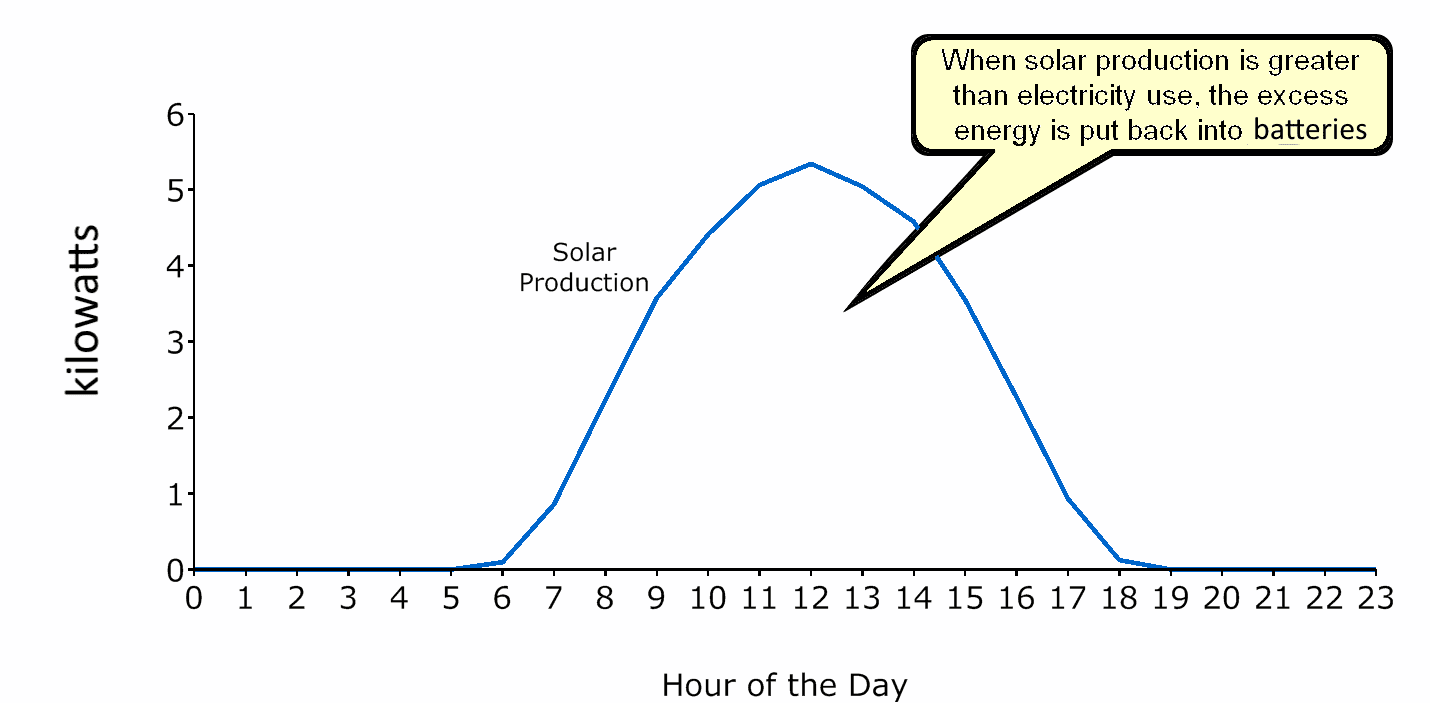
Many businesses are saving on their power bills by installing solar panels, but the savings would be greater if they had batteries to provide power early in the day and late in the afternoon when the output of the solar system is below the midday peak output.

Solar PV system output varies during the day
Suppose a business with a solar PV sysytem buys 4 or 5 electric vehicles that can deliver electricity from their batteries - the Nissan Leaf with a 40 kilowatt-hour battery is one electric vehicle designed for this role -  and leases them to its workers to be used in the following way:
  • The worker drives the electric vehicle to work each morning and plugs it into a power exchange socket where it provides electricity to the business whenever electricity use is greater than the output of the solar PV system AND has its battery recharged whenever there is excess solar energy being produced. 
  • The worker drives the car home each day after work and plugs it into a power exchange socket where it powers the home - with solar energy stored during the day while at work - during the evening peak period when electricity prices are at their greatest. 
  • By late evening or early morning, if the car battery charge has fallen below the level that is needed for the morning peak period to prepare breakfast and for the commute to work, some additional energy from the grid is stored in the battery - again at off-peak rates.
  • ...and so on, each day.
This may make electric vehicles a better investment than just assessing their value as a replacement for a simple petrol-fueled vehicle. They can provide electricity as backup generators for businesses when solar energy output is less than the amount of electricity used and they can let workers take solar energy home. This is especially valuable for anyone who lives in rented accommodation and/or lives in one of the many households where all the members are away from the home during daytime.

The following video uploaded in 2013 describes the process in 2 minutes. At that time, the Nissan Leaf had only a 24 kilowatt-hour battery. The recently released model has a 40 kilowatt-hour battery. 


One application of the technology is described in Adam Vaughan's the article published in The Guardian on October 3, 2017:

Electric car owners 'can drive for free by letting energy firms use battery' 

Electric car owners will be paid for letting an energy company use their vehicle’s battery in a pioneering scheme to increase take-up of the cleaner vehicles and help power grids manage the growth in green energy.

Nissan and one of the UK’s biggest challenger energy suppliers, Ovo, will offer the “vehicle-to-grid” service to buyers of the Japanese carmaker’s new Leaf from next year.

After installing a special charger in a customer’s home, the supplier will take over the management of the car’s battery, with owners able to set a minimum amount of charge they want for driving the next day. Ovo will then automatically trade electricity from the battery, topping it up during off-peak periods when power costs about 4p per kilowatt hour (kWh), and selling it at peak times for about four times as much.


Monday, September 4, 2017

Future energy technology is here

Australia ran an expensive experiment to encourage investment in electricity generation and distribution capacity to ensure supply on a few days of the year when demand is at a maximum.

Electricity demand on the hottest days in summer is about double the average electricity demand on other days. To encourage investment in capacity that is idle on all but these few extremely hot days each summer, a very profitable incentive was created.


State-owned electricity generators and distribution network operators that were able to borrow $billions at discounted interest rates were guaranteed a high rate of return on every dollar they could spend. The inevitable result was excessive and extravagent spending. It is commonly known now as "gold-plating".


As an aside, it is sometimes misunderstood that switching from coal-fired power generation to low-emission electricity generation increases prices. Note that the US maintained low electricity prices while making rapid progress on replacing coal-fired power stations.

Wind adds the most new generation capacity, followed by gas and solar

Technology is available to solve the problem that Australia created with these incentives to spend up big on electricity generating and distribution capacity that is planned to be idle on all but a few of the hottest days each summer.

This technology also solves the problem of what to do with the surplus electricity supply when the sun is shining on solar panels and the wind is spinning wind turbines, but all available battery storage is filled and demand is being fully met...

Distributed power-to-gas plants can convert the surplus electricity into renewable natural gas. This can be fed into the existing natural gas distribution lines to flow upwards to liquified natural gas plants for export. On the few occasions each year when electricity demand is exceptionally high, as many distributed power-to-gas plants as required can be reversed within a few minutes to generate electricity from natural gas stored in the natural gas distribution lines.

Renewable natural gas produced from farm and urban waste can be fed into the natural gas distribution lines and, where carbon dioxide has been separated from biogas, it can be piped to power-to-gas plants that combine carbon dioxide with hydrogen to produce renewable natural gas.

Australia is in the fortuitous position of being able to use renewable energy for 100 percent of its electricity supply, 100 percent of its transport energy and 100 percent of its energy exports.


Thursday, March 23, 2017

Energy cost savings in industry

Increases in energy costs are a signal for industry to audit its energy use and survey new plant that lowers energy use.

The abalone industry in South Australia in December 2016 received quotes for electricity supply at almost double its previous contract price:
Yumbah Aquaculture at Port Lincoln, on South Australia’s west coast, received an electricity contract quote for $1.35 million, $650,000 more than its current $700,000 contract.
Also in December 2016 the South Australian State Government announced a program to assist large businesses to audit energy use and invest in energy saving measures -
The 2016-17 Mid Year Budget Review provides $31 million over two years to help large South Australian businesses manage their electricity costs.

The Energy Productivity Program will be available to businesses that use more than 160MWh of electricity each year to incentivise investment in energy saving measures.

The funding will be available for businesses to undertake energy audits of their facilities to determine where efficiencies can be made.

The audits will also make recommendations about technology or infrastructure upgrades that could be carried out to reduce cost and grants will be available to implement the those recommendations. 

One area to examine in an energy audit at Yumbah Aquaculture is the circulation of  water from sea level up to its abalone growing tanks and back into the sea. The energy needed for pumps to raise water by, say, 20 metres is the same as the energy that is available when the same volume of water falls by 20 meters. Adding a micro hydro generator on the outflow from abalone growing ponds could generate almost as much energy used by the pumps to raise the water.


The value of the energy savings may make it worthwhile to invest in a micro hydro generator.


The food processing industry in Victoria has received quotes for natural gas with prices more than doubling in just a few years.
Echuca-based food processor Kagome expects to pay $3.6 million for gas this year, up from $2.4 million last year, despite plans to use less gas. Kagome employs more than 200 people. 
Natural gas is the dominant form of energy use for the food processing plant at KAGOME Australia
Kagome Australia's processing plant receives about 4,000 tonnes of tomatoes each day during the harvest period of 70 days. Natural gas is used to evaporate water from the tomatoes for the production of tomato paste.

Evaporating 1,000 tonnes of water from 4,000 tonnes of tomatoes each day can use an enormous amount of energy. This isn't necessary but it depends on how it is done.

One way to evaporate 1,000 tonnes of water that does use an enormous amount of energy is to simply put batches into large cauldrons with gas burners beneath them. Allow the tomatoes in the cauldrons to simmer until the desired volume of water has evaporated.

This way requires 2,257 gigajoules of thermal energy that converts 1,000 tonnes of water into steam. If this heat energy is supplied by natural gas costing $9 per gigajoule, the daily energy bill would be about $20,000 and the total bill over the tomato harvest period of 70 days woul be about $1.4 million.

There are several other ways to perform the same process using much less energy.

For instance, the energy needed to convert 1 kilogram of water into water vapour is 2,257 kilojoules. The same amount of energy can be recovered when that kilogram of water vapour is condensed back into water.
Mechanical Vapour Recompression (MVR)

The mechanical vapour compressor uses a very small amount of electrical energy to transfer a very large quantity of heat energy from the condensing steam back into the cauldron of tomatoes where it boils off an identical amount of water.
The cost saving of this method is all of the natural gas used in the inefficient method of converting 1,000 tonnes of water into water vapour. This method also produces distilled water while continually recycling the latent heat of evaporation in the water vapour as it condenses back into water.

The condensed water produced may have some value too as a pure, distilled by-product.

Equipment using this method is commercially available. One type is marketed as "forced circulation evaporators". These are for concentrating fruit paste (tomato paste, peach paste, apricot paste and etc.) and some other products with high viscosity. Another type is marketed as "falling film evaporators". These are for concentrating products with low viscosity, for example: fruit juice, milk etc.

The value of the energy savings may make it worthwhile for Kagome Australia to invest in a forced circulation evaporator and eliminate the need for natural gas.

Another option for Kagome Australia is new technology that makes renewable natural gas from wet biomass - such as tomato plants - collected during  crop harvesting...


Thursday, October 29, 2015

Solar-Biogas Hybrid Power Solution


AORA Solar Energy Local Power

AORA TO PROVIDE FIRST SOLAR-BIOGAS HYBRID POWER SOLUTION
FOR OFF-GRID COMMUNITIES IN AFRICA

Ethiopian Ministry of Water, Irrigation and Energy Meets with AORA Solar
Ahead of Deployment of its Tulip™ Technology

December 2, 2014 – ADDIS ABABA, Ethiopia & REHOVOT, Israel – AORA Solar
(www.aora-solar.com), a leading developer of solar-biogas hybrid power technology, today announced it has met with the Ministry of Water, Irrigation and Energy of the Federal Democratic Republic of Ethiopia (www.mowie.gov.et), to plan the construction of an initial pilot of AORA’s Tulip™ solar-hybrid power plant. The meeting follows the March signing of a Memorandum of Understanding (MoU) between the parties.

The project is tied to Ethiopia’s Climate-Resilient Green Economy Strategy, in which the country aims to enhance access to affordable and environmentally friendly renewable energy. The goal is to provide adequate uninterruptible and grid independent power to support the achievement of middle-income status by 2025 while developing a green economy.

"We are transforming our Green Economy Strategy into action and are pleased to partner with AORA to help achieve our vision,” said H.E. Mr. Alemayehu Tegenu, Minister of Water, Irrigation and Energy for Ethiopia. "AORA’s unique solar-hybrid technology is impressive and well-suited to provide both energy and heat to support local economic development in off-grid rural locations in Ethiopia.”

Construction of the first pilot plant is expected to begin by mid-2015. Following the trial, the Ministry intends to expand deployment of AORA installations for rural economic development to off-grid communities in selected areas of the country. The AORA Tulip technology requires less land per kWh to generate usable power and heat than other systems. Each Tulip station is small and modular, producing 100kW of electricity in addition to 170kW of heat, while occupying less than 3,500 square meters (0.86 acres).

AORA’s technology runs not only on solar radiation, but also on almost any gaseous or liquid fuel, including biogas, biodiesel and natural gas. This enables a variety of operational modes – from solar-only mode, where electricity is supplied from ample sunlight, to hybrid-mode, where fuel helps generate full power when sunlight is insufficient, to fuel-only mode during night hours or heavily overcast periods. This guarantees an uninterrupted and stable power supply 24 hours a day in all weather conditions.

"We are pleased to partner with the Ministry and look forward to bringing our technology to Ethiopia to provide the population with affordable access to power,” said Zev Rosenzweig, CEO of AORA. "Such access will have significant social and economic impact on off-grid communities, helping to provide power to schools and medical facilities, refrigeration for food processing and post-harvest storage, groundwater pumping and much more.

# # #


About the Ethiopia Climate Resilient Green Economy Strategy
Ethiopia launched the Climate Resilient Green Economy Strategy in November 2011, which aims to achieve the development objective of being a middle income nation by 2025. The Strategy's four pillars include the generation of energy from renewable sources for domestic and regional markets.


About AORA Solar
AORA Solar is a leading developer of solar-biogas hybrid power technology that specializes in small-scale off-grid solutions. AORA’s flexible power stations operate on both sunlight and biogas (or other alternative fuel sources) in order to supply uninterrupted green power 24hrs/day. Each AORA station produces 100 KW of energy and 170 kW of heat as a by-product, which may be used for a variety of heating and cooling applications for agricultural, industrial or domestic use. AORA stations occupy just a half-acre of land and may be standalone or linked together into centrally controlled power plants for increased output. For more information please visit www.aora-solar.com.

Media Contacts
Finn Partners for AORA Solar
Nicole Grubner
+972 58 444 5418
nicole@finnpartners.co.il

Wednesday, April 16, 2014

The next step: Australia's Energy Productivity Roadmap


The next step in our campaign to double energy productivity is to gather additional support for the Joint Statement on Lifting Energy Productivity and to engage government and businesses in developing an
Australian Energy Productivity Roadmap.


We will keep you informed of progress through these newsletters.

If your organisation would like to support the Roadmap, please contact A2SE


Presentations from the 2XEP Forum can now be viewed online. Click here to view the video catalogue.

We will feature some presentation highlights in the weeks ahead.


Have your say
 
Thank you to the dozens of people who have already provided feedback on the 2XEP Forum.

We have also circulated an online feedback form to all delegates.  For those who have not yet had an opportunity to do so,  please
send us your feedback so we can continue to improve our future events.


Supporters
A2SE gratefully acknowledges the support of its partners and sponsors


If you would like more information on the Forum, the 2XEP initiative, or A2SE membership
please contact Event Manager, Georgie Roberts at events@a2se.org.au or (02) 9514-3675