Latest Buzz...
                  

Translate

Saturday, June 20, 2015

Better concentrated solar thermal power plants

Concentrated solar thermal power stations using steam turbines or  compressed air turbines are less efficient than they could be.

This video describes the difference between steam turbine power plants and gas turbine power plants. Concentrated solar thermal power plants use the same technology without using fossil fuels as the source of thermal energy.


Steam power plants and compressed air turbines can only convert about 35% of the energy collected into electricity:
  • On the back end of the steam turbine the steam must be condensed back into water.  During this condensation process, heat is “rejected” up cooling towers and into the atmosphere, resulting in a loss of 30% to 40% of the original heat energy supplied to the system. More energy is then used in pumping the condensed water back into the boiler at very high pressure.

  • Compressed air turbines discard a large amount of energy collected in the exhaust flow out of turbine. More energy is used by the axial flow compressor that compresses air on input to the turbine. 
"Solutions" focus on methods to make use of the heat energy wasted by these engines. One often-used approach is to build an entire steam power station behind a compressed air turbine generator! This "solution" is known as a combined-cycle gas turbine or "CCGT" power plant.

For reasons that are not clear solutions that simply avoid the waste of thermal energy in the first place are overlooked.

Adding a high-efficiency compressor to the front of a conventional axial-flow air compressor and turbine generator allows the exhaust to cool to ambient temperature with no heat energy wasted.
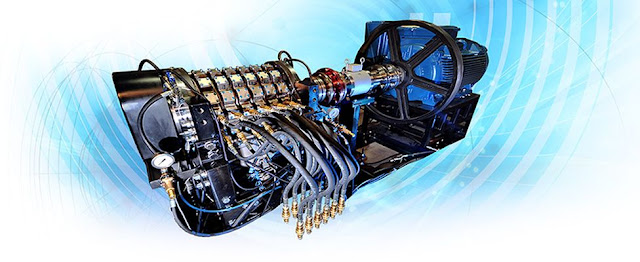
Hicor technology achieves a more efficient compression process

Compression Basics

Compression Basics
The Hicor technology achieves a more efficient compression process by minimizing the temperature rise associated with compression, improving efficiencies over conventional compressors by 30% or more.
At its most basic, compression is a mechanism by which work is put into a fluid and results in an increase in pressure. Heat is also generated as a by-product of compression, which serves to make the process less efficient by turning some of the input work into heat instead of pressure. As the gas being compressed heats up further and further, the compression process gets less and less efficient.

Hicor’s technology achieves a more efficient compression process by minimizing the temperature rise associated with compression, improving efficiencies over conventional compressors by 30% or more.

Hicor’s proprietary compression technology provides a myriad of additional benefits as well, including fewer moving parts, less vibration and noise, and a variable pressure ratio. Finally, Hicor’s near-isothermal compression technology allows for compression ratios of 30 to 1 or higher, reducing system level complexity and resulting in lower capital and operating costs.

Positive Displacement Compression

The compression process can be displayed graphically, as in the pressure-volume (PV) plot shown below. The curves in a PV plot show how the pressure increases as volume decreases. For different compression processes, the curves will vary. The work of compression can be visualized as the area under the curve corresponding to a given compression curve.
graph
All compression processes fall between two extremes: adiabatic, where no heat is exchanged with the outside environment and the energy put into the system remains internal; and isothermal, where energy is removed from the system in the form of heat and the temperature of the gas remains constant.

In practice, all compression processes fall somewhere between adiabatic and isothermal and are known as polytropic processes. To achieve a more highly efficient compression process, it is ideal to reduce the polytropic constant to as close to the isothermal process as possible, where the polytropic constant is 1.

The Hicor proprietary compressor design is capable of achieving polytropic constants as low as 1.06, improving efficiencies over conventional, near-adiabatic compressors by as much as forty percent.


Sunday, June 7, 2015

Selective blindness by coal mining companies

Coal mining companies deny the existence of technology that cuts the amount of coal needed to produce electricity.


Pakistan's first coal gasification plant will start generating low cost electricity from next year.

"The renowned scientist Dr. Samar Mubarakmand who is head of the Thar Coal Gasification Project  ...  was participating and Chairing the Clean Coal conference held here on October 23 and 24 to mark the World Clean Coal Week."


“The Future of Asia: Be Innovative” - Speech by Prime Minister Shinzo Abe at the Banquet of the 21st International Conference on the Future of Asia

 Thursday, May 21, 2015
"...efficiency jumps remarkably through the use of the latest technologies for the combustion of gasified coal. ...
By utilizing gasification technology, brown coal, which until now has been regarded as unfit for coal-fired thermal power, will become a promising resource.
...
By introducing Japanese gasification technology to Mongolia, your vast resources of brown coal dormant in the ground of Mongolia will become a treasure trove."


Special Feature. Dawn of a New Era for Coal. Clean Production of Energy Using IGCC (Integrated Coal Gasification Combined Cycle)

Nakoso Power Plant, Joban Joint Power Co., Fukushima Prefecture, Japan

"Integrated coal Gasification Combined Cycle (IGCC) is a coal-based power generation technology that achieves the twin objectives of reduced CO2 emissions and increased efficiency by "gasifying" the coal and then using a gas turbine and a steam turbine in a two-stage generation process.
MHI has been researching and developing this technology since the 1980s. It has accumulated numerous proprietary technologies and demonstrated their reliability primarily with test operations at an enormous IGCC demonstration plant. The demonstration plant quite successfully finished the test operations, satisfying all targets set. With its capabilities highly evaluated through the series of test operations, the decision was made to convert it to a commercial plant owned by a utility company and to commence commercial operations in June 2013. This marks the long-awaited practical application of a pioneering technology that will open a new era for the effective use of coal.
...
MHI has committed every possible technology towards the pursuit of the IGCC plant's efficiency. As well as combining gas and steam turbines with a highly efficient energy-converting gasifier, MHI also makes use of the discharged heat to avoid waste.
This mechanism delivers 10-15 percent better thermal efficiency than a state-of-the-art coal-fired conventional thermal power plant (ultra-supercritical coal-fired thermal power plant: USC). Because it can provide the same amount of power as a USC but using less fuel, it also cuts CO2 emissions by about 10-15 percent. This puts it on a par with oil-fired thermal power plants in terms of emissions.
...
The IGCC plant is a complex system that combines a gasifier, a gas turbine, a steam turbine and other interconnected equipment.
It is a testimony to MHI's advanced design and engineering skills that the plant succeeds in harnessing them together into an efficient and reliable working unit. Within just a year of its start, the Nakoso demonstration plant had racked up 2,238 hours of continuous operation.
This unparalleled achievement owes its speedy progress to the smooth interaction of the plant's various equipment.
IGCC is expected to spawn new technologies in the future. There is a real prospect of a MHI power plant achieving thermal efficiency of over 65 percent when it launches the J-Series gas turbine"

Sunday, May 31, 2015

Democracy versus the Trans-Pacific Partnership

Corporate Management Isn't Democratic


I didn't get the significance of the separation of powers until I had the need to understand a little of administrative law.

What I learned was that the democracy has a number of checks built in to limit abuses of power.

The "separation of powers" refers to three groups that exercise power:
  • The executive arm of government,
  • The parliament, and
  • The judiciary
The executive arm of government is the Crown (or President in democratic republics), the Prime Minister and Cabinet, and the public service bureaucracy.

The parliamentary arm is the two houses of parliament with the power to review, amend and pass legislation.

The judiciary is the system of Courts and Judges with the power to review decisions of the executive arm of government to ensure they are consistent with the laws passed by parliament.

These built-in limits are essential to a healthy democracy. They stand in the way of corporate managers who aren't accustomed to having their decisions challenged.


The Battle of Amoy was fought between British and Chinese forces in Amoy (Xiamen), China, on 26 August 1841, during the First Opium War
18th Royal Irish Regiment storming Amoy, First Opium War, 1841


Opium Wars

The Opium Wars arose from China’s attempts to suppress the opium trade. British traders had been illegally exporting opium to China, and the resulting widespread addiction was causing serious social and economic disruption in the country.

In 1839 the Chinese government confiscated all opium warehoused at Canton by British merchants.

The outraged merchants lobbied the British government for assistance. A British naval fleet arrived in June 1840, attacking along the Chinese coast. With their inferior military technology, the Chinese were no match for the British and, after a series of military defeats, they agreed to sign humiliating peace terms.

These stipulated that China pay a large fine to Britain, open up five more ports to foreign trade, give the British a 99-year lease on the island of Hong Kong and offer British citizens special legal rights in China.


Related material


The scariest treaty you've never heard of


Breaking '08 Pledge, Leaked Doc Shows Obama Wants to Help Corporations Avoid Regulations


DemocracyNow.org -A draft agreement leaked Wednesday shows the Obama administration is pushing a secretive trade agreement that could vastly expand corporate power and directly contradict a 2008 campaign promise by President Obama. A U.S. proposal for the Trans-Pacific Partnership (TPP) trade pact between the United States and eight Pacific nations would allow foreign corporations operating in the U.S. to appeal key regulations to an international tribunal. The body would have the power to override U.S. law and issue penalties for failure to comply with its ruling. We speak to Lori Wallach, director of Public Citizen's Global Trade Watch, a fair trade group that posted the leaked documents on its website. "This is not just a bad trade agreement," Wallach says. "This is a 1% power tool that could rip up our basic needs and rights."

To watch the complete weekday independent news hour, read the transcript, download the podcast, search our vast archive, or to find more information about Democracy Now! and Amy Goodman, visit http://www.democracynow.org/ 


Sunday, May 17, 2015

Ammonium nitrate fertiliser ban underway since 2004

The same waiting for the LNP to solve any issue

Wreckage of a truck that exploded near Charleville in south-west Qld
Photo:  Highway construction work may have shielded emergency workers from the full force of the blast.

Friday, May 8, 2015

Australia a global energy superpower thanks to oil and gas industry

May 18, 2015 - Australian Financial Review
The oil and gas industry plays a major role in Australia's success as a modern nation, says Ian Macfarlane.

Ian Macfarlane, Minister for Industry and Science ... Australia is poised to become the world's largest LNG exporter
Ian Macfarlane, Minister for Industry and Science ... Australia is poised to become the world's largest LNG exporter.
Wayne Taylor

by Ian Macfarlane
The following is an excerpt from the speech to be delivered at the APPEA conference by the Minister for Industry and Science, Ian Macfarlane.
The oil and gas industry is one of Australia's most resounding success stories.
BEIJING: Slumping prices saved China more than $160 billion on its imports of commodities such as oil, iron ore, coal and copper last year, official figures showed on Wednesday.
Australia's position as a global energy superpower is in large part due to the growing strength of this industry.
Its importance to our national economy by way of export revenue, job creation and regional development cannot be overemphasised.


Australia's LNG export value in 2014-15 is $18.2 billion and is projected to increase at an annual growth rate of 21 per cent to $46.7 billion in 2019-20.
Australians use more oil and gas than any other energy source and this trend is expected to increase in the years ahead.
Oil and gas will continue to account for more than two-thirds of Australia's energy consumption to the end of the forecast period in 2049–50.
Given its importance to our economy and energy security, the oil and gas industry plays a major role in our success as a modern nation.


We are in an exciting period of both significant transition and great opportunity for Australia's oil and gas industry.
This year marks a new industry milestone with the east coast producing its first LNG – and the world's first LNG export from unconventional gas from Queensland's Curtis LNG Project.
This project joins the North West Shelf, Pluto and Darwin LNG operating projects – and there's more to come.
With the Australia-Pacific and Gladstone LNG projects scheduled to start production this year, 2015 will be a momentous year for the east coast's oil and gas industry.


The future also looks bright for the north-west, where construction of the Gorgon, Wheatstone, Ichthys and Prelude projects is well advanced, and production is due to start in the next few years.
We hope that in the next two years we can add Browse FLNG to our list of committed developments.
Australia is strengthening its leadership position significantly in the global natural gas industry.
We are the only LNG-producing country in the world with projects in construction that use three LNG production models.


Conventional offshore gas with onshore LNG production, floating LNG production, and coal seam gas-based LNG production are all part of the industry's impressive development portfolio.
The majority of current global investment in LNG projects is in Australia and we are poised to become the world's largest LNG exporter by the end of this decade.
This is an extraordinary achievement that reflects the breadth of knowledge and technological knowhow in the industry, and the diversity of our natural resources.
However there are challenges facing the petroleum sector, including the significant movement in oil prices which impacts on the oil and gas industry on an everyday basis, as well as affecting long-term decision-making.
Australia's LNG projects under construction continue to forge ahead despite the challenges, but we shouldn't be complacent. We should turn our focus towards securing the next wave of investments.
It is particularly important we don't overlook the ongoing growth in gas demand, particularly here in the Asia-Pacific region, which has experienced around 7 per cent year-on-year growth in gas demand over the past few years.
To capitalise on emerging opportunities to help meet this demand, we must remain competitive and continue to secure new investment.
While the industry does its bit to contain project costs, the government is putting in place the right policy settings to support the sector.  This includes the energy white paper, which is a blueprint for enhancing energy productivity and investment, and the establishment of a growth centre for oil, gas and energy resources.
We are strengthening the policy and regulatory environment to help ensure the industry remains competitive and continues to attract investment.

Sunday, May 3, 2015

Energy storage is an outdated 20th century meme

In the 20th century electricity had to be generated and distributed in response to demand. There was no commercially viable way to store energy when demand was  low and distribute it at times when demand was high.
Effect of wavelength on relative photosynthesis
Economic Analysis of Greenhouse Lighting.

Using electricity at night when demand is low to pump water uphill into hydroelectric dams is one way energy can be stored. The water pumped uphill into hydroelectric dams runs back down hill through turbines to generate extra electricity when demand is high.

When you stop and think about this approach what leaps out is that storing energy is not free:
  • A hydroelectric storage dam is an expensive capital investment. 
  • The electric motors and pumps that use electricity to pump water uphill into the storage dam are expensive capital items.
  • The hydroelectric turbines and electricity generators are just as complex and costly as gas-fired turbines and electricity generators. 
  • The poles and wire that distribute the electricity from the hydroelectric power stations cost the same to build and maintain as the ones that distribute electricity from coal and gas-fired power stations.

Reasons to store energy


Demand for energy changes enormously - from season to season, from night to day, and from one day to the next.

In the last century investment in the capacity to generate electricity and to distribute electricity was tailored to supply electricity sufficient for the highest level of demand that may occur on just one day of a year.

The prevailing meme came to be that the cost of this investment was to be met by electricity consumers no matter how many days power stations and capacity in the distribution network were idle because demand was below the maximum that had been projected.

When demand fell from one year to the next because electricity consumers adopted energy-saving technologies the unit price of electricity - in cents per kilowatt-hour - was increased so that the same revenue could be collected.

Reasons to not store energy


If generating electricity is free then the prevailing meme of the 20th century has outlived its usefulness. Coal and gas-fired power station incur significant fuel costs if they are operated at times when demand is low.

Solar panels, solar thermal power stations, wind turbines and ocean wave power stations have no fuel costs. They are the exact opposite to coal and gas-fired power stations. There is no economic reason to "switch off" solar panels and wind turbines when they generate more electricity than is required.
CETO 5 (Perth Wave Energy Project) Power & Water Schematic

Increasing the generation of renewable energy so that it will always exceed demand creates economies of scale in manufacturing solar panels and wind turbines. This lowers the cost of installing new generating capacity.

With essentially free electricity being available on all but one day of the year when demand is at its maximum, the new meme for the 21st century is quite different:
what are the most profitable and discretionary ways to use electricity?
The options to be considered are those that can be "powered down" whenever demand for electricity falls. This is the reverse of the situation for coal and gas-fired power stations that are powered down to avoid fuel costs when demand for electricity falls.

Examples include factories to manufacture hydrogen by electrolysis for the fertiliser industry and greenhouses that use electric lighting to grow crops.

Algae.Tec expanding nutraceutical manufacturing facilities

Algae.Tec has developed a high-yield enclosed algae growth and harvesting system designed to grow algae on an industrial scale.

It is expanding development and manufacturing facilities in Cumming, Georgia, and building an initial small scale plant for the production of algae for the nutraceutical market.

This initial plant is expected to produce algae at the rate of 50,000 kilos per year and generate revenues of $1 million per year.

It plans to increase this production capacity in stages to achieve a total production of up to 2 million kilos per year.


Saturday, May 2, 2015

Solar farming and electricity generation

Here's a challenge in financial optimisation while combining available technologies:
  1. Algae Tec has commercialised a method of growing algae for nutrients, edible oil and biofuels. It includes solar concentrators - but green algae (like all green plants) can only use the visible light photons with wavelengths of 400 nanometres (nm) up to 700 nanometres.
  2. Solar photovoltaic panels can convert concentrated solar energy into electricity - but silicon photovoltaic cells only use the photons with wavelengths up to 1100 nm. The infrared energy with photons having longer wavelengths only heat up the solar cells and reduce their performance.
  3. Sundrop Farms has commercialised solar concentrators that use solar energy of any wavelength but only convert it to heat that is then used to convert seawater and saline ground water to fresh water for high-value food crops in arid regions.

An interesting possibility is to concentrate sunlight then split it into 3 beams - one with wavelengths that algae and other green plants use, one with wavelengths that silicon cells can convert efficiently to electricity, and the third that heats a transfer liquid to be used for, say, converting seawater to fresh water...

Calculating the return on investment is the challenging part of the puzzle. In particular, can the investment in concentrating sunlight that Algae Tec and Sundrop Farms exploit be made even more profitable by splitting the sunlight and using each of 3 beams in the most profitable application available for each?

From "A guide to solar energy"

The energy required to move an electron from the semiconductor atom to a conducting state is a fixed amount. The energy of a photon of light is determined by its wavelength, with shorter wavelength photons having higher energy than those with longer wavelengths.
energy spectrum of sunlight and how it affects photovoltaic efficiency
Energy spectrum of sunlight and how it affects photovoltaic efficiency

A photon with wavelength 1,100 nanometres (nm), corresponding to short wave infra-red light has just enough energy to promote an electron in a silicon atom, the most commonly used semiconductor material.

All photons with a longer wavelength than this have insufficient energy to promote the electron and either pass straight through the PV cell or are absorbed as heat. This part of the solar spectrum cannot be used by the PV cell.

Photons with a shorter wavelength than 1,100nm have more energy than is required to promote the electron. The excess energy above that needed to move it into a conducting state is lost as heat.

These two factors combine to produce a theoretical upper limit to PV efficiency of around 31%.

From "Starlight is the solar power of the earth"

All biological energy comes from sunlight and this energy encompasses the range of the electromagnetic spectrum known as light. The solar spectrum is shown below.

The green pigment, chlorophyll, plays a central role in photosynthesis. The fact that it is green means that it absorbs blue and red light and reflects green when it is illuminated by white (all wavelengths) light.

Light with  wavelength longer than 700nm has insufficient energy to drive photosynthesis.

From "A beam-splitting photovoltaic thermal receiver for solar concentrators"

Ahmad Mojiri, Cameron Stanley and Gary Rosengarten
Royal Melbourne Institute of Technology Melbourne, Australia

A photovoltaic thermal receiver that separates incoming light energy by wavelength can produce electricity and thermal output of 150° simultaneously.

8 January 2015, SPIE Newsroom. DOI: 10.1117/2.1201501.005704

Sunlight is an abundant source of energy that can be converted into heat and electricity using photothermal and photovoltaic technologies, respectively. Usually these devices are separate from each other, and occupy significant space on a rooftop or in a solar park. Combining thermal and electrical output in a single package would achieve several advantages, such as more efficient use of available space and light collection.
Spectral splitting mechanisms
Figure 1. Spectral splitting mechanisms using (a) wave interference effect and (b) selective volumetric absorption. HRI and LRI correspond to high and low refractive index materials such as titanium dioxide and silicon dioxide, respectively. A specific number (n) of these layers are required to achieve suitable spectral splitting.


The solar spectrum consists of wavelengths in the range 400–2500nm, while silicon solar cells function most efficiently for the range 700–1200nm. Our beam-splitting mechanism separates light in the 700–1200nm range and directs it to the PV cells, sending the rest of the solar spectrum to a thermal absorber. The thermal and PV receivers are then being fed by two separate beams of light. The silicon cells remain cool at ambient temperatures.

We designed our system for a commercial parabolic trough: a partially curved, mirror-lined solar collector. We constructed a detailed ray tracing model (used to calculate the path of light waves through a system) for the proposed integration of our device in the solar concentrator, and optimized the dimensions of the receiver to maximize the energy yield of the system.