Latest Buzz...
                  

Translate

Showing posts with label Physics. Show all posts

Saturday, March 4, 2017

Fossil fuel energy is unreliable

Natural gas power is increasingly unreliable in Australia.

A simple law of physics explains why natural gas power stations are unreliable:
6 gigajoules of natural gas are needed to generate 3.6 gigajoules of electrical energy in a combined-cycle gas turbine power station.

Each 3.6 gigajoules of electrical energy (which is 1 megawatt-hour or 1 MWh) has a price of about $50 in the Australian Energy Market Organisation's National Electricity Market.

The natural gas used to generate this electrical energy costs about $9 per gigajoule in the Australian Energy Market Organisation's Wholesale Gas Market.

The result:
It costs about $54 for the natural gas used as fuel to generate each megawatt-hour of electricity. This has a wholesale price of only $50.

Rising domestic gas prices

In terms of production costs, over the last decade the finding and development costs for the petroleum industry have increased six-fold. And, in the three years to 2013, total Australian finding and development costs averaged $4.16/GJ, which was 2.7 times the average for the three years to 2007. These rising costs are partly explained by the fact that unconventional gas production involves significantly higher capital expenditure than that of conventional off-shore wells, given that CSG requires multiple wells to be drilled in order to access equivalent volumes of gas.

SANTOS July 2, 2015
Public Submission to ACCC East Coast Gas Inquiry

Natural Gas price in the U.S. - 1 million BTUs = 1.055 gigajoules


The projected US exports of around 7 trillion cubic feet of natural gas, or about 140 million tonnes of LNG is almost double the projected Australian exports of 85 million tonnes of LNG per year.

1 metric ton liquefied natural gas (LNG) = 48,700 cubic feet of natural gas.
1 trillion cubic feet of natural gas is about 20 million tonnes of LNG.

Given the much higher cost of producing coal seam gas in Australia, the ramping up of US LNG exports to 2020 is likely to bring the enthusiastic expansion of coal seam gas in Australia to a sudden end.


Saturday, February 6, 2016

Would you be surprised if one day energy was free?

Part 1 - Canberra August, 2004

"I've always been really interested in recreating space phenomenon in the laboratory. It's very difficult to measure in space to measure the aurora although it is a true wonder in seeing these lights in the sky. But to simulate this in the laboratory, to do experiments on it and then try and understand what is happening I think for me is one of the greatest joys that we've been given", said Dr Rod Boswell.

Aurora - atmospheric plasma

First you make the plasma by zapping a gas with radio waves - "microwaving" it. The atoms change into electrically charged particles called ions. Cut the end of the tube and the ions all shoot out, creating thrust - plasma thrust.

"This is Wombat. It's called wombat because it's got four legs and sort of looks like a wombat. You can see here we create a plasma, this is the glowing gas you can see in the end there. So the plasma's created here then moves into space. And if you look in there, ah, it always amazes me. There's this blue column of plasma which is shooting out from the plasma source," Rod explained.

Wombat - plasma generator research device

Rod made quite an impression around the world with his Wombat plasma generator. NASA took some of his ideas to design tiny satellite guidance thrusters.

Anxious to find new ways to make plasma thrusters work better, Rod assembled a team of young physicists, and encouraged an atmosphere of ideas and creative thought.

"I came here to ANU because I thought that this is one of the top laboratories in the world. The environment is just perfect and it's really good for creativity," explained Dr Christine Charles.

Professor Christine Charles
Head of the Space Plasma, Power and Propulsion Laboratory
Australian National University
Christine, freshly arrived from France, soon became inspired by Rod's enthusiasm for plasmas, and for the forces in the universe that generate them.

Rod had recently commissioned a new, improved version of wombat, and Christine was eager to try it out, to see if she could, amongst other things, recreate an aurora in the lab. One day, impatient for results, Christine decided to play with the settings. She was amazed with what happened next.

"I'll show you. Normally this is standard plasma, but on the day, instead of doing what everyone does which is turn the knob on, turn the power on, and see what happens, I did the opposite. I turned the power down and I reduced the flow down. So then you need to increase the magnetic field to be able to contain it. So you do that, you make the measurements with the ions... Look at this, there it is. The hot ions, the plasma is suddenly accelerating, all by itself. It appeared to be in free fall, travelling much faster then I'd ever seen before. And I kept getting this result, and I thought, oh, this is like, oh! What's happening!" Christine recalled.

"The plasma behaves like water tumbling over a cliff, getting faster as it drops. And, just like an aurora, it seems that the plasma actually makes the 'cliff' - all by itself. It's almost magic."

"What Christine found is that under certain conditions instead of just flowing out smoothly it creates this jump, and the ions fall down this, and it's like having two electrodes that accelerate the ions like in an accelerator, but there are no electrodes! The plasma itself forms an acceleration mechanism. It's actually a wonder," said Rod.

Friday, June 26, 2015

Better concentrated solar power (CSP) stations

Concentrating solar thermal power stations convert as little as 25 to 30 percent of collected solar energy into electrical energy and need large thermal energy storage systems that add to the cost of construction.

Existing technology allows solar thermal energy to be converted into electrical energy with an effective efficiency of 90 percent and eliminates the need for thermal energy storage systems.

Burning hydrocarbons and carbohydrates - energy used and released

What the diagram represents is that 1 kilogram (2.2 lbs) of brown coal is decomposed into carbon monoxide and hydrogen by absorbing 5.54 megajoules of heat energy. 

The resulting carbon monoxide and hydrogen then releases 14.14 megajoules of heat energy when it combines with oxygen to produce carbon dioxide and water vapour.

The net heat energy available from burning this kilogram of brown coal is the difference between these two energy flows: 14.14 - 5.54 = 8.60 megajoules of heat energy.

Burning a kilogram of brown coal in a coal-fired power station allows a proportion of this 8.60 megajoules of heat energy to be converted to electricity.  Typically only about 40 percent is delivered as electricity: around 0.96 kilowatt-hours.

A different way of converting brown coal to electricity enables a far greater amount of electricity to be produced from each kilogram:
  • First each kilogram of brown coal is decomposed into carbon monoxide and hydrogen by absorbing 5.54 megajoules of concentrated solar thermal energy.  
  • Second, the resulting carbon monoxide and hydrogen releases 14.14 megajoules of heat energy when it combines with oxygen to produce carbon dioxide and water vapour in a gas power plant. Typically about 60 percent is delivered as electricity: around 2.36 kilowatt-hours.

The coal needed to produce 0.96 kilowatt-hours of electricity is reduced from 1 kilogram (2.2 lbs) to just 405 grams (14.3 ozs).

Saturday, June 20, 2015

Better concentrated solar thermal power plants

Concentrated solar thermal power stations using steam turbines or  compressed air turbines are less efficient than they could be.

This video describes the difference between steam turbine power plants and gas turbine power plants. Concentrated solar thermal power plants use the same technology without using fossil fuels as the source of thermal energy.


Steam power plants and compressed air turbines can only convert about 35% of the energy collected into electricity:
  • On the back end of the steam turbine the steam must be condensed back into water.  During this condensation process, heat is “rejected” up cooling towers and into the atmosphere, resulting in a loss of 30% to 40% of the original heat energy supplied to the system. More energy is then used in pumping the condensed water back into the boiler at very high pressure.

  • Compressed air turbines discard a large amount of energy collected in the exhaust flow out of turbine. More energy is used by the axial flow compressor that compresses air on input to the turbine. 
"Solutions" focus on methods to make use of the heat energy wasted by these engines. One often-used approach is to build an entire steam power station behind a compressed air turbine generator! This "solution" is known as a combined-cycle gas turbine or "CCGT" power plant.

For reasons that are not clear solutions that simply avoid the waste of thermal energy in the first place are overlooked.

Adding a high-efficiency compressor to the front of a conventional axial-flow air compressor and turbine generator allows the exhaust to cool to ambient temperature with no heat energy wasted.

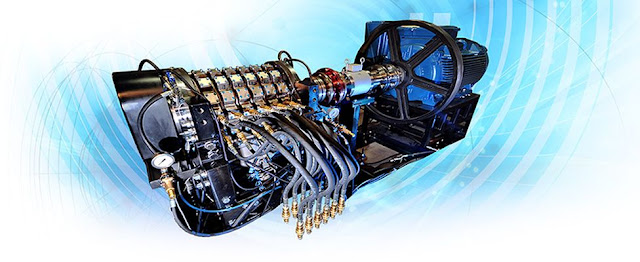
Hicor technology achieves a more efficient compression process

Compression Basics

Compression Basics
The Hicor technology achieves a more efficient compression process by minimizing the temperature rise associated with compression, improving efficiencies over conventional compressors by 30% or more.
At its most basic, compression is a mechanism by which work is put into a fluid and results in an increase in pressure. Heat is also generated as a by-product of compression, which serves to make the process less efficient by turning some of the input work into heat instead of pressure. As the gas being compressed heats up further and further, the compression process gets less and less efficient.

Hicor’s technology achieves a more efficient compression process by minimizing the temperature rise associated with compression, improving efficiencies over conventional compressors by 30% or more.

Hicor’s proprietary compression technology provides a myriad of additional benefits as well, including fewer moving parts, less vibration and noise, and a variable pressure ratio. Finally, Hicor’s near-isothermal compression technology allows for compression ratios of 30 to 1 or higher, reducing system level complexity and resulting in lower capital and operating costs.

Positive Displacement Compression

The compression process can be displayed graphically, as in the pressure-volume (PV) plot shown below. The curves in a PV plot show how the pressure increases as volume decreases. For different compression processes, the curves will vary. The work of compression can be visualized as the area under the curve corresponding to a given compression curve.
graph
All compression processes fall between two extremes: adiabatic, where no heat is exchanged with the outside environment and the energy put into the system remains internal; and isothermal, where energy is removed from the system in the form of heat and the temperature of the gas remains constant.

In practice, all compression processes fall somewhere between adiabatic and isothermal and are known as polytropic processes. To achieve a more highly efficient compression process, it is ideal to reduce the polytropic constant to as close to the isothermal process as possible, where the polytropic constant is 1.

The Hicor proprietary compressor design is capable of achieving polytropic constants as low as 1.06, improving efficiencies over conventional, near-adiabatic compressors by as much as forty percent.


Sunday, June 16, 2013

Coal - them and us or teamwork

Research in a number of fields may make new nuclear energy technology available with little warning.
Research and development of new applications for coal in petrochemical industries in parallel with reducing reliance on coal for energy can avoid any loss of jobs and State government mining royalties. If the new applications increase the value of coal then the interest groups that rely on coal can share growing revenues, wages and royalties over the period in which cleaner energy sources gradually replace coal in the energy industry.

The development of a widely acceptable transition plan for the coal industry is a good investment for the future of the industry regardless of lobbying for clean energy. Research in a number of fields has the potential for breakthroughs that make new energy technology available with little warning.

Physicists add another element to table

Dani Cooper | ABC Science News | 2 May 2014

A new superheavy element looks set to be added to the periodic table with the help of Australian researchers.

"We've managed to find four atoms of the same element 117, that hopefully will be sufficient to allow it to be officially recognised and then named," says co-author Professor David Hinde, at the Australian National University.

He says the creation of element 117 "is at the absolute boundary of what is possible right now".

"That's why it's a triumph to create and identify even a few of these atoms."

Understanding the atom

The main benefit of the creation of these superheavy elements is to better understand nuclei.

"If we push beyond what is already known we can refine models and determine what are the proper physical descriptions of nuclei and the chemical properties of elements," says Hinde.


Nuclear energy technology is in its infancy.  Consider a breakthrough that commercialises an Accelerator Driven Reactor designed to smash radioactive waste nuclei into fragments which are scarce and high-valued isotopes - and produces energy as a by-product that can be distributed at no charge...

Professor Nanda Dasgupta - Nuclear Fusion: Quantum coherence and its consequences
The budgets of State and Federal Governments rely heavily on mining exports. The Queensland budget in June 2013 forecast royalties from coal mining to be $11 billion over the next 4 years. Similarly the New South Wales (NSW) budget in June 2012 (the 2013 budget is to be released in a few days) shows the extent to which the NSW government budget relies on coal mining royalties.

Year Qld
($billions)
NSW
($billions)
2012-13 $1.743 $1.878
2013-14 $2.125 $2.112
2014-15 $2.643 $2.363
2015-16 $2.961 $2.518
2016-17 $3.356 -

Employment relies too on coal mining. NSW reports that total employment in mining grew from 19,000 jobs in 2001 to 39,000 jobs ten years later in 2011. The Hunter region is most reliant on mining where jobs increased from 9,000 to 17,000 in the ten years from 2001 to 2011.

The interests of coal mining investors, the mining industry workforce and State governments are largely overlooked in lobbying to build a renewable energy industry. This lobbying is often narrowly focused on the goal of displacing fossil fuel use within Australia. Domestic use of fossil fuels is a fraction of production so this goal is wide of the mark needed to achieve a reduction in global emissions. It would however send a controversial marketing message: asking overseas customers to buy a product that Australia itself no longer uses.

There is no need to engage in a conflict between vested interests. Technology for a staged transition of energy sources can avoid loss of capital value of coal-fired power stations. See the article "Combining Technologies to Increase Usefulness and Value" for an example. Using solar/coal/gas/biomass fuel with the same gas turbine and generator minimises the capital expenditure for reliable power generation plants. An indirectly fired gas turbine can burn any fuel - even coal. The same turbine and generator can be driven by concentrated solar thermal energy - adjustable up to 100 percent coal as required for reliable power generation.

Research and development of new applications for coal in petrochemical industries in parallel with reducing reliance on coal for energy can avoid any loss of jobs and State government mining royalties. If the new applications increase the value of coal then the interest groups that rely on coal can share growing revenues, wages and royalties over the period in which cleaner energy sources gradually replace coal in the energy industry.

Related posts - 

Future Nuclear Power Reactors Must Be Safe

Driven nuclear reactions on minimum acceptable safety standards for nuclear technology.

Monday, November 12, 2012

Unexpected Binding Energies

Anything special about 124.334 MeV binding energy?

for 12 neutrons -

146 Tm + 12(  1 n) →  158 Tm + 124.334 MeV
69 0 69

and for 16 neutrons -

158  Tm + 16(  1 n) →  174  Tm + 124.334 MeV
69 0 69

and for these 12 neutrons -

99  In + 12(  1 n) →  111  In + 124.334 MeV
49 0 49

and for these 10 neutrons -

160  Ho + 10(  1 n) →  170  Ho + 124.334 MeV
67  0 67 

and for these 18 neutrons -

133  Ce + 18(  1 n) →  151  Ce + 124.334 MeV
58  0 58 

Why does 8.557 MeV binding energy occur in these 2 places?

For these 7 neutrons -

141  Sm + 7(  1 n) →  148  Sm + 7 x 8.557 MeV
62  0 62 

and for these 4 protons -

141  Sm + 4(  1  p) →  145  Dy + 2 x 8.557 MeV
62  1 66 

Sunday, July 8, 2012

Higgs boson in the history of science

Scientific knowledge has developed over centuries. The journey of discovery includes long periods of experiments and the collecting of careful measurements (empirical data). Every once in a great while important milestones occur when a pattern in this data is recognised.

Identifying chemical compounds, chemical elements and developing processes to separate mixtures of each progressed gradually over centuries. A major milestone was reached in 1869 when Dmitri Ivanovich Mendeleev proposed a Period of Table of Chemical Elements that fitted the known elements according to patterns of physical properties that many scientists and researchers had discovered and studied.

The Periodic Table of Chemical Elements originally contained gaps that suggested a number of chemical elements may exist and that remained to be discovered.
Periodic Table of Chemical Elements
Another milestone occurred at the dawn of the twentieth century when Marie Curie revealed two revolutionary ideas for which she was awarded Nobel Prizes in Physics and in Chemistry.

"Marie drew the conclusion that the ability to radiate did not depend on the arrangement of the atoms in a molecule, it must be linked to the interior of the atom itself. This discovery was absolutely revolutionary."
"For the first time in history it could be shown that an element could be transmuted into another element, revolutionizing chemistry and signifying a new epoch."

Together with her husband, she was awarded half of the Nobel Prize for Physics in 1903 for their study into the spontaneous radiation discovered by Henri Becquerel in 1896, who was awarded the other half of the Prize. Marie Curie was awarded a second Nobel Prize, in Chemistry, in 1911.

This type of scientific milestone is different in character to the work of Mendeleev. It occurs when completely new and previously unknown features of the natural world are revealed. It built on Mendeleev's work - Marie Curie's insights were gained after she discovered two new chemical elements, polonium and radium and devised techniques to isolate radium in sufficient quantities to study its properties. Polonium is named after her homeland, Poland.

Radium's radioactivity was so great that it could not be ignored. It seemed to contradict the principle of the conservation of energy and therefore forced a reconsideration of the foundations of physics. On the experimental level the discovery of radium provided men like Ernest Rutherford with sources of radioactivity with which they could probe the structure of the atom.

Rutherford conducted experiments with alpha radiation and as a result in 1910  introduced a new model of an atom that contained a minute nucleus possessing almost all the atom's mass.

The first half of the twentieth century was a period of remarkable scientific advances including Niels Bohr's atomic model (1913), Erwin Schrödinger's development of quantum mechanics (1925) and Albert Einstein's theory of mass-energy equivalence (1905) among numerous others.

It was also remarkable for an "embarrassment of riches" of fundamental sub-atomic particles that were discovered. At first each discoverer of a new sub-atomic particle was almost guaranteed a Nobel Prize in Physics. Later, each new discovery was greeted with dismay at the growing complexity of what was originally thought to be a simple quest to identify and characterise a limited number of fundamental particles.

The identification of new sub-atomic particles continued and eventually in the mid 1960s a model to fit all this empirical evidence into a coherent framework was more-or-less settled. This model known as The Standard Model of Fundamental Particles and Interactions parallels the breakthrough that Mendeleev's Periodic Table of Chemical Elements achieved in 1869.
The Standard Model of Fundamental Particles and Interactions

Like Mendeleev's model of one century earlier, The Standard Model of Fundamental Particles and Interactions also identified a number of missing pieces that, if the model was correct, should be able to be found.

Of the missing pieces, the Higgs boson was predicted and its existence was crucial in checking the validity of the Standard Model.

See more information on the hunt for the elusive Higgs Boson at How Stuff Works:

What exactly is the Higgs boson?