Latest Buzz...
                  

Translate

Tuesday, July 30, 2013

Making natural gas cheap

Australian natural gas consumers concerned about natural gas prices set to soar to $9 per gigajoule need to look carefully at the following table.

Replace Natural Gas at $9 per GJ with SNG at $3 to $4 per GJ


The table here shows the results of converting any solid fuel (coal, crop residue, waste plastic, etc ...) with an energy content of 25 gigajoules per tonne into synthetic natural gas ("SNG") with a conversion efficiency of 80 percent. That is, converting each 100 gigajoules of solid fuel into 80 gigajoules of natural gas.

Coal or Biomass
(per tonne)
Energy Cost
(per gigajoule)
Natural Gas Cost*
(per gigajoule)
$40 $1.60 $2.00
$60 $2.40 $3.00
$80 $3.20 $4.00
$100 $4.00 $5.00
* Natural gas produced from coal with 80 percent conversion efficiency

"Gasification has been reliably used on a commercial scale for more than 75 years..." - Read more at the Gasification Technologies Council website.

"... Countries have been building coal gasification plants for years. ..." - Read more at the World Coal Association website.

See for example - Synthesis Energy Systems' website -

SES is the provider of a highly efficient, cost effective, and commercially proven coal and biomass conversion technology based on the U-GAS® gasification technology that was developed over the last 40 years. The U-GAS® process was the result of a Department of Energy (DOE) and Gas Technology Institute (GTI) joint development program that began in the early 1970s to convert coal into synthetic natural gas during the first US energy crisis. The U-GAS® gasification technology was piloted, demonstrated, and commercially operated on a wide range of feedstocks including bituminous coal, sub-bituminous coal, lignite, biomass, coal char and wastes, and metallurgical coke. Since SES has begun to commercially deploy the U-GAS® technology, we have advanced the technology through modifications to improve conversion, efficiency, and cost competitiveness through an expanding intellectual property estate.  Our technology enables customers to realize higher project returns through greater fuel flexibility, higher efficiency, lower operating costs, and lower capital investment.

A single-stage, fluidized-bed gasification process

Our gasification process accomplishes four important functions: it decakes, devolatilizes and gasifies the feedstock, and if necessary, agglomerates and separates ash from the reacting coal or biomass. The syngas is then further processed for use in many applications such as power, synthetic natural gas ("SNG"), ...

Thursday, July 18, 2013

Give away coal to keep clean energy at bay

Malcolm Maiden's article in The Age yesterday "Carbon switch won't stop price rise" says "Coal-fired power stations that have their capital cost fully depreciated can produce power here for less than $10 per megawatt hour".
Coal-fired Power Station Model

This is a very tall order considering:
  • Coal mines in NSW are struggling to cover costs of production with export prices for thermal coal falling to $80 per tonne. 
  • A reasonably modern, efficient coal-fired power station buying coal at $80 a tonne has a fuel bill of about $20 per megawatt hour. Labour and maintenance would add more.
Can Australian coal-fired power stations really afford to produce electricity at less than $10 per megawatt hour?

Are renewable, natural gas and geothermal power generators disadvantaged by coal-fired power stations being sheltered from free-market forces?

How much lower could an effective carbon price be if coal-fired power stations paid export-parity market prices for coal, just as natural gas power generators will be required to do when the Gladstone LNG facilities begin exporting next year.

NSW electricity consumers may not have to wait much longer to learn the answer to this mystery of coal being supplied at taxpayer-subsidised prices to State-owned coal-fired power plants.

"NSW power sale to hit energy prices"

Negotiations with Whitehaven coal for coal supply are in the price range of $55 to $66 per tonne, which is an increase of around 33% over the majority of current supply contracts.

Recently Centennial Coal who supplies about 50% of the NSW generators has accepted a $2.4 billion takeover by Thailand’s Banqu. The bid allows Banqu to acquire the 80 per cent of the Hunter Valley thermal coal producer it doesn’t already own. Centennial Coal’s long term contracts with the generators are due to expire shortly and Banqu has the option to increase prices for coal supply to the generators or export the thermal coal. Either option will increase the cost of generation in NSW. (Read more at Elemental Power Industries ...)

Monday, July 15, 2013

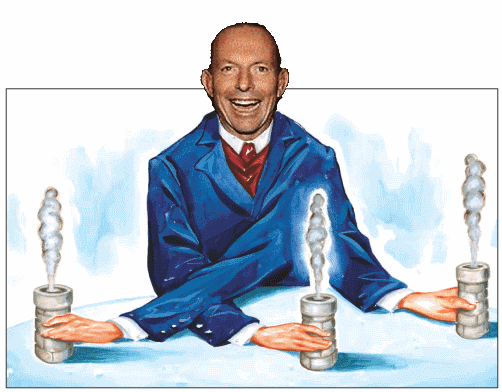
Tony Abbott really is an economic illiterate

A carbon price per tonne of carbon dioxide must be an unfathomable enigma to Tony Abbott. How can carbon dioxide, if it is weightless as Tony Abbott believes, weigh even one gram, let alone a whole tonne?


In a speech to the House of Representatives on 8 February 2010 Malcolm Turnbull said "an Australian emissions trading scheme, with a carbon price set by the market, would improve business investment certainty.
Market-based approaches have the potential to deliver least-cost abatement by providing incentives for firms to reduce emissions where this is cheapest, while allowing the continuation of emissions where they are most costly to reduce.
This ETS allows Australian businesses to make their own decisions as to how to reduce their emissions. Government sets the rules and, in particular, sets the cap on total emissions and then lets the market work out the most efficient and effective outcome. Schemes where bureaucrats and politicians pick technologies and winners, doling out billions of taxpayers’ dollars, neither are economically efficient nor will be environmentally effective. For those reasons, I will be voting in favour of this legislation."
Tony Abbott - an economic illiterate

In February 2010 journalist Mark Schapiro wrote in Harper Magazine CONNING THE CLIMATE - Inside the Carbon-Trading Shell Game "Unlike traditional commodities,  which  sometimes  during  the  course  of their  market  exchange  must  be  delivered  to someone in physical form, the carbon market is based  on  the  lack  of  delivery  of  an  invisible substance to no one."

On 26 February 2010, a few weeks after Malcolm Turnbull's speech to the House of Representatives, Tony Abbott addressed the Menzies Research Centre Policy Roundtable, saying: "Why should Australia be in a rush to establish a $15 billion a year market in the non-delivery of an invisible substance to no one?"


Tony Abbott was really carried away with this brainless description of emissions trading a few weeks earlier when talking to the Queensland Chamber of Commerce and Industry on 12 February 2010:
"And I tell you what else the next Coalition Government will do, it will save Australia from an emissions trading scheme. It will save Australia from this great big new tax. It’s interesting, I don’t know how many of you read the Financial Review today, but I would encourage you if you do browse through that paper to look at the Review section behind the Market Wrap because there is a fascinating study about just how a carbon market might work, and if Mr Rudd has his way carbon will become the world’s most traded commodity – more traded than cars, more traded than coal, more traded than wheat, more traded than intellectual property and financial services and yet carbon, the stuff that Mr Rudd is so keen to turn into this extraordinary market, it’s about the non-delivery of something that’s invisible to no-one.

That’s what his emissions trading scheme is about. It’s about the non-delivery of an invisible substance to no-one and he wants to turn this into a $15 billion a year market in Australia.

I mean, really and truly.

My original political mentor, B.A Santamaria, had a phrase. The phrase was “a moonbeam from the larger lunacy”, and what the Prime Minister wants to do is to create a $15 billion a year market that’s about the non-delivery of an invisible substance to no-one.

Well, really and truly.

David, I want to thank you and your colleagues here in the Queensland Chamber of Commerce and Industry for being amongst the first to alert people to the con job that was being foisted on the Australian public and I want to say that the people’s revolt that you helped to ignite is going to spread right around this country."

And it gets worse. Tony Abbott explained on-air with John Laws a year later on 7 July 2011 that he has no idea how to put a price on carbon dioxide emissions:
TONY ABBOTT: See, one of the things that people haven’t quite twigged to is that carbon dioxide is invisible, it’s weightless and it’s odourless. How are we going to police these emissions...

JOHN LAWS: I don’t know.

TONY ABBOTT: …I mean, how are we going to police these emissions? This carbon cop is going to be an extraordinarily intrusive instrumentality, running around trying to make sure that all these businesses aren’t actually emitting given that you can’t actually see, smell or touch what’s going on.


It's just not fair for Tony Abbott to strain his brain trying to grapple with such imponderable and perplexing riddles.

Wednesday, July 10, 2013

Coking coal market outlook

The Business on ABC TV reports today Queensland at the coalface of the mining slowdown.
In Queensland the Bowen Basin is feeling the full force of a massive mining downturn that's reverberating through the economy.
Australian coking coal producers hit by falling demand and who may be looking to a cut in a carbon tax to help them are in for a series of rude shocks. ULCOS - Ultra-low CO2 Steelmaking - is just one.

ULCOS stands for Ultra–Low Carbon dioxide(CO2) Steelmaking.

worldsteel’s contribution

worldsteel has an important role in helping its members use each of these four building blocks and has a number of dedicated initiatives.

CO2 breakthrough programme
worldsteel provides a forum where the various national and regional research and development programmes on identifying breakthrough technologies for steel manufacture can exchange information on their projects. These include the ULCOS programme funded by the European Commission and the European steel industry; the COURSE 50 research programmes in Japan; the US steel industry and US Department of Energy programmes; the POSCO programme in Korea and many others.

Sunday, June 30, 2013

Coal and Natural Gas power plants

The World Coal Association says a 600 MWe coal-fired power station operating at 38% efficiency and 75% overall availability will consume approximately 1.5 million tonnes per annum of bituminous coal (Calorific Value (CV) 6000 kcal/kg Net As Received (NAR)).
Coal-fired Power Station Model

Using this information from the World Coal Association we can calculate how much electricity the coal power plant will produce each year (600 MWe x 24 hours a day x 365 days a year x 75% availability) which is 3,942,000 MWh.

The cost of coal will vary from time to time. For any price of coal we can calculate the yearly cost of coal and the unit fuel cost for the electricity produced.

Coal Price
($ per tonne)
Annual Cost
($million)
MWh fuel cost
(per MWh)
60 90 $14.33
80 120 $19.11
100 150 $23.88
120 180 $28.66

The same amount of electricity could be produced by a natural gas power station.

A 600 MWe combined cycle gas turbine power plant operating at 60% efficiency and 75% overall availability will consume approximately 23.85 million gigajoules of natural gas per annum.


The yearly cost of natural gas and the unit cost of the electricity produced will be the same as the coal power plant with the following prices of natural gas:

Coal Price
($ per tonne)
Natural Gas
($ per GJ)
Annual Cost
($million)
MWh fuel cost
(per MWh)
60 $3.81 90 $14.33
80 $5.07 120 $19.11
100 $6.34 150 $23.88
120 $7.71 180 $28.66

Carbon dioxide emissions from the coal power plant will be about 0.8 tonnes per MWh of electricity produced and about 0.3 tonnes from the gas power plant.

If coal costs $60 per tonne and natural gas costs $7.71 per gigajoule the information above implies that electricity from a natural gas power plant will have double the fuel cost of the coal power station.

Cheap coal can be converted into natural gas. 

Why would anyone ever build a coal power plant?

If coal that costs $60 per tonne is converted into natural gas at 80% efficiency, then the fuel for the natural gas power plant can be produced from 1.18 million tonnes of coal costing only $70.6 million a year. This is a saving of $19.4 million every year on the $90 million cost of coal that a coal power plant needs to produce the same amount of electricity as the natural gas power plant.


Further reading -

U.S. Department of Energy. Coal gasification offers one of the most versatile and clean ways to convert coal into electricity, hydrogen, and other valuable energy products.

Basin Electric, through its for-profit subsidiary, Dakota Gasification Company (Dakota Gas) owns and operates the Great Plains Synfuels Plant. The Synfuels Plant is the only commercial-scale coal gasification plant in the U.S. that manufactures natural gas. It is located five miles northwest of Beulah, North Dakota.

The Coal Can Do That article "Coal-to-Gas is Off-the-Shelf Energy Solution" from February 2009 by Dr. Frank Clemente.

Tuesday, June 25, 2013

The carbon tax is a crime

An example of media bias against a price on carbon

Further details in the article: What does media bias look like?

A post from The Telegraph blog of Piers Akerman - original at this link

The Telegraph
The carbon tax is a crime

Piers Akerman The Daily Telegraph June 23 2013 (12:00am)

HOLDEN workers meet at the company's Elizabeth plant in Adelaide this week to discuss a proposed 500 job cuts. The company has previously called the carbon tax "heavy and unfair"

The Coalition's plan to dump Labor's failed carbon dioxide tax will give the nation a boost should it put the government to rout in 82 days - but the renewable energy scam must be also be axed.

Australians are paying a huge price for nothing more than Green feel-good vanity politics that do nothing for the environment, the economy, the nation or the globe.

Last week, Maurice Newman, a former chairman of the Australian Stock Exchange and the ABC, and long regarded as one of the country's most respected business figures, told The Guardian that continuing taxpayer subsidies for the renewable energy target (RET) represented a "crime against the people".

Newman owns a property near a proposed wind farm in the NSW southern highlands and may be considered to have a conflict. But his argument against the expensive subsidies relies also on their effect on poorer households, and the apparent collapse of the scientific argument.

"When we look at the experience of Germany, they have not been successful in reducing emissions; when we look at the science it no longer supports the global warming theory; and when we look at the health and economic effects of wind farms and the obscene wealth transfer from poor to rich we have to ask: 'why are we persisting with them?' I think it is a crime against the people," he said.

The view of Newman, who would chair the opposition's proposed Business Advisory Council, is important.

"It is inevitable energy prices will be one of the issues that will be of concern to business," he said.

"Low energy prices are what has always made Australia internationally competitive and because of the RET and the carbon tax we have lost that advantage."

Newman wants to get Australian business back on its feet and so does Nationals Senator Ron Boswell, who last week spoke at a Canberra rally against renewables.

Boswell, one of the hardest working senators, will retire at the election, but he is going to fight renewables until his last day in office.

Wind power, which costs up to four times as much as coal or gas-fired power, can generate electricity only 30 per cent of the time, he told me.

"Those times are impossible to predict; wind has a reliability factor of a very low 8 per cent or less. Yet we are funnelling billions to set up unreliable wind turbines across Australia: money not from out of government's coffers but from the hip pockets of every energy user in Australia."

He then rattled off the names of some of the businesses endangered or killed because of the Green fetishists.

"This week, it was Simplot sending out a warning shot that its food manufacturing plants in Bathurst and Devonport are on the brink," he said. "Their energy costs have risen 80 per cent. "Last week, it was SPC Ardmona saying that unless it received emergency safeguards, more of its jobs would go. Its energy costs have risen. It is struggling to compete with home brand imports."

"Last month, it was farmers up in Bundaberg saying they couldn't afford to turn on irrigation pumps. The cost of electricity to pump water to their farms is set to jump 17.5 per cent a year for the next seven years.

"And we have already seen Heinz move its food processing operations to New Zealand, where it is 50 per cent cheaper to do business. Golden Circle closed its Northgate facility, costing 160 jobs, while Rosella closed all together," he said.

In parliament on Thursday, Opposition Leader Tony Abbott highlighted the absurdity of Labor's position by asking Prime Minister Julia Gillard to confirm that the carbon tax would increase to more than $24/tonne on July I and up to $25/tonne next year if the government is re-elected.

He wanted to know why her government kept raising the price when the European tax fell to $6/tonne and just 75c in New Zealand. Per usual, Prime Minister Gillard blustered about climate change and failed to provide a clear answer to a straightforward question.

Senator Boswell says farming and manufacturing in Australia are going under before our eyes. According to his figures, these policies are penalising Australians $13 billion a year, with the carbon tax costing $8 billion and the RET $5 billion.

Our food processing and manufacturing sectors are being annihilated. In 2011-12 alone, 7000 food processing jobs disappeared and 355 businesses closed or moved overseas. Since 2008, 110,000 manufacturing jobs have been lost.

Across Australia, food processors and manufacturers are cutting back to save costs: BlueScope Steel in Victoria, 170 jobs gone; Boral, 790 jobs gone; Penrice Soda in SA, 60 jobs gone; Pentair in western Sydney, 160 jobs; and Amcor, 300 jobs gone. Goodman Fielder will shut 15 factories, costing 600 jobs. Norsk Hydro aluminium smelter near Newcastle is closing, costing 350 jobs. Caltex is shutting its Kurnell refinery, costing 330 jobs.

Other companies are shifting overseas: Kerry Foods, 100 jobs gone; Kresta Blinds, 72 jobs; Cussons soaps, 75 jobs; Aerogard, 190 jobs; Harley-Davidson, 212 jobs; and Bosch, 380 jobs. Golden Circle has moved processing lines and jobs to New Zealand, while our second-last Australian-owned cannery, the Windsor Farm at Cowra, closed in March, costing 70 jobs.

The flow-on effects when a processor like Golden Circle or SPC Ardmona shuts its doors are devastating. Two years ago business warned Climate Change Minister Greg Combet that the carbon tax threatened the future of oil refinery investment in Australia, with Shell saying it would "break the camel's back". That same year, Holden said the carbon tax was a "heavy and unfair cost", since 85 per cent of the vehicles imported to Australia have no carbon tax associated with them.

The carbon tax has added around $412 to the price of a local car, while renewables have added about $200. That's twice Europe's car manufacturing costs and four times Asia's costs. Now Holden has shed 500 jobs and is asking those left to take pay cuts.

The Gillard government and unions have tried to put the blame for rising costs on other factors like the high Australian dollar. The truth is that Labor has given away our natural advantage of cheap and abundant energy in favour of expensive and unreliable renewables.

Sunday, June 23, 2013

Australian power prices among highest in world

In June 2012, retail electricity prices paid by Australian households were among the highest in the world. 

No carbon price contributed to these prices - the carbon price did not take effect until 1 July 2012. It is a very small component of the price households pay for electricity. 

Tony Abbott simply ignores this fact. 


Australian power prices among highest in world

Tanya Nolan reported this story on Wednesday, March 21, 2012
Retail electricity prices

ELEANOR HALL: Research commissioned by Australia's top 100 power users suggests that Australians pay some of the highest electricity prices in the developed world.
...
TANYA NOLAN: In many ways this report confirms what many households already know, electricity bills are soaring and there's little end in sight.

But what is revealing is that in a comparison of 91 international jurisdictions and including all states and territories, Australia's energy costs are among the highest in the developed world.
...
The Federal Government acknowledges that electricity prices are likely to keep growing due to large amounts of investment required to maintain network infrastructure ...

The draft Energy White Paper released in December predicted that as much $240 billion worth of investment would be needed to be spent on generation, transmission and distribution in the period to 2030.

Can carbon tax explain power price hikes?

Australian Broadcasting Corporation
Broadcast: 19 June 2012
Reporter: Greg Hoy

Electricity prices are on their way up around the country, but how much of that is the carbon tax and how much is due to other factors?