Latest Buzz...
                  

Translate

Showing posts with label Electric Vehicles. Show all posts

Sunday, January 26, 2025

Dispatchable power and dispatchable internet of things

The National Electricity Market in Australia experiences periods where more electricity is supplied than is needed, and periods where demand exceeds the available supply. 

"Dispatchable power" has been mentioned as a partial remedy to the latter periods.

The ability to remotely turn off rooftop solar PV systems and air conditioners has been mentioned as a partial remedy to the former periods. 

A more flexible solution is available, one echoes a feature in operating systems design, where hundreds of concurrent processes queue to use scarce resources and relinquish them when finished or surrendered.

Appliances and devices can be equipped with smart switches that send one of several status signals to distributed National Electricity Market management systems: 

  • "I am not currently consuming electricity, but can if requested."
  • "I am currently consuming electricity, but can pause if requested."
  • "I am not currently sending electricity to the grid, but can if requested."
  • "I am currently sending electricity to the grid, but can pause if requested."

The appropriate subset of status signalling, and the ability to respond to a request, can be incorporated into existing devices, including:

  • Hot Water Storage systems,
  • Home Battery Energy Storage systems,
  • Pool pumps and heaters,
  • Air conditioners,
  • Rooftop solar PV systems, and
  • Electric Vehicles.

There is a substantial cost in not having this approach to managing the National Electricity Market. 

In November 2024, over $700 million was paid by retailers in NSW for electricity used in just 7 hours and 40 minutes. This was more than the total paid for ALL the electricity the retailers purchased for the entire remainder of the month.

This pushed to average electricity price for NSW in November 2024 to $263.46 per megawatt hour (MWh). 

In December 2024, with fewer extreme price periods, the average wholesale price for NSW was only $164.72 per megawatt hour (MWh).

The National Electricity Market compels consumers to pay exorbitant prices for electricity

It would have helped if any electricity consumed in those 7 hours and 40 minutes with exceptionally high prices in NSW in November 2024 could have been postponed by just 5 or 10 minutes. 

There were also far more periods when the National Electricity Market price was exceptionally low. 

If more electricity had been consumed in those periods, avoiding the need to consume in other periods with higher prices, the average cost of electricity could be further reduced.

See "How to lower the price of electricity" for more analysis of data from the National Electricity Market.


Monday, September 4, 2023

Helping the switch to Electric Vehicles

Accelerating the uptake of electric vehicles in Australia is needed to reduce transport emissions that are increasing since the end of COVID19 restrictions. 

This could however add to concerns about the reliability of electricity supplies: 

  • AEMO has expressed the concern that new generation capacity may not be brought online fast enough to replace the planned retirement of aging coal-fired generation, and
  • Additional electric vehicles will transfer demand for imported petrol and diesel transport fuels onto the electricity grid - further increasing the pressure to bring new generation capacity online more quickly.

There are two programs that can accelerate the uptake of electric vehicles and ease any concerns about increased demand on the electricity grid. 

Any workplace where say 6 or more employees drive to work each morning and leave their cars parked all day at the workplace could have their vehicles recharge from a solar PV system installed just for the needs of vehicles parked at the workplace. 

Any school where at least half a dozen teachers drive to school would be a suitable example. 

In the case of a school car-park for teachers vehicles, a large carport covered with a solar PV system would provide additional generation capacity that would avoid extra demand on the grid to supply electricity for these electric vehicles. 

See some example by "Solar Carpark Shade Structures". 

Solar PV Carpark Shade
by Solar Carpark Shade Structures

Because the cars are expected to be parked for many hours, there is no need to install a costly recharge unit for each vehicle. A single recharge module with 6 ports - one port for each vehicle to be charged would be sufficient. It would need to have software to rotate charging between the plugged-in vehicles so that each battery was charged by the end of the day.

The above facility would avoid these electric vehicles adding to demand on the electricity grid. 

A further facility would allow these electric vehicles to REDUCE demand on the electricity grid, alleviating AEMO's concerns about the pace of introduction of new generation capacity.

Suppose each of the electric vehicles leaves the school parking area each evening with a fully-charge 40 kWh battery and uses about 5 kWh for the commute home and back the following morning. 

It would be practical to use 10 - 20 kWh from the battery to power the teacher's home with renewable energy overnight. 

See the Electric Vehicle Council's web page where a similar idea is discussed: "BATTERY ON WHEELS – ROLE OF EVS IN SHAPING THE ENERGY GRID OF THE FUTURE – EV Summit 2022 panel"

Friday, January 3, 2020

Phasing-out-fossil-fuels

Scott Morrison has failed to develop a plan for phasing out thermal coal exports and for phasing out vehicles running on fossil fuels.

Simply claiming "you can't shut these down overnight" is a nonsense answer.

IEA - World Energy Outlook, 2019 - Thermal Coal Demise


A plan for phasing out both thermal coal exports and vehicles running on fossil fuels is straightforward.

Australia has seen how such plans work. It implemented one in phasing out vehicles that ran on leaded petrol.
  1. Announce a date for the ban on new vehicles that use leaded petrol. 
  2. Announce a date for the ban of the supply of leaded petrol. 
The period to the date of the first ban sees a burst of investment for the supply of fuel and of vehicles to use the new energy source.

The period to the date of the second ban allows for the gradual retirement of all vehicles using the fuel being replaced, and for winding down the supply chain for that fuel.
 
From a paper by Troy Whitford, Fuel Mandates have a History of Success and a Lesson for Bio Fuels Implementation. Australian Policy and History, April 2010.
URL: http://aph.org.au/fuel-mandates-have-a-history-of-success-and-a-lesson-for-bio-fuels-implementation/
"In 1981, Australian state and federal transport ministers met to address pollution problems. Driving the shift towards unleaded petrol were vast environmental and health concerns.

During the 1980s, automobile associations were critical of the introduction of unleaded fuel. The RACV opposed the implementation believing it was too costly. The oil industry was cynical, too, arguing the introduction of unleaded fuel did not follow from a technological breakthrough but rather a decision by ministers. Without doubt, the position taken by oil companies, automobile associations and other stakeholders regarding unleaded fuel changed over time.

Despite opposition to unleaded fuel, the Transportation Council adopted a program to mandate unleaded petrol by 1985. The implementation policy for unleaded fuel was undertaken in stages. Initially, regulations were made calling for all new motor vehicles made after January 1986 (manufactured within Australia or imported) to meet the new fuel requirements. The policy then called for a complete phase out of leaded fuel by 2002. Prior to the national mandate, states had led the way on unleaded fuel of which NSW took the lead. The decision to mandate was essential for implementing unleaded fuel. It forced car manufacturers, oil producers and consumers to make the transition."

Friday, June 15, 2018

Electric vehicles make solar power mobile

Solar PV systems can reduce electricity bills for many families and businesses.

Unfortunately this isn't the case for families who rent because properties available for rent rarely have solar panels installed.

Even for families who do have solar PV systems, the savings aren't that great when everyone is at work or school during the the day when the sun is shining and the solar energy output is mostly being fed into the grid.

There is another way to supply solar energy to these households and help them cut their electricity bills.

Many businesses are saving on their power bills by installing solar panels, but the savings would be greater if they had batteries to provide power early in the day and late in the afternoon when the output of the solar system is below the midday peak output.

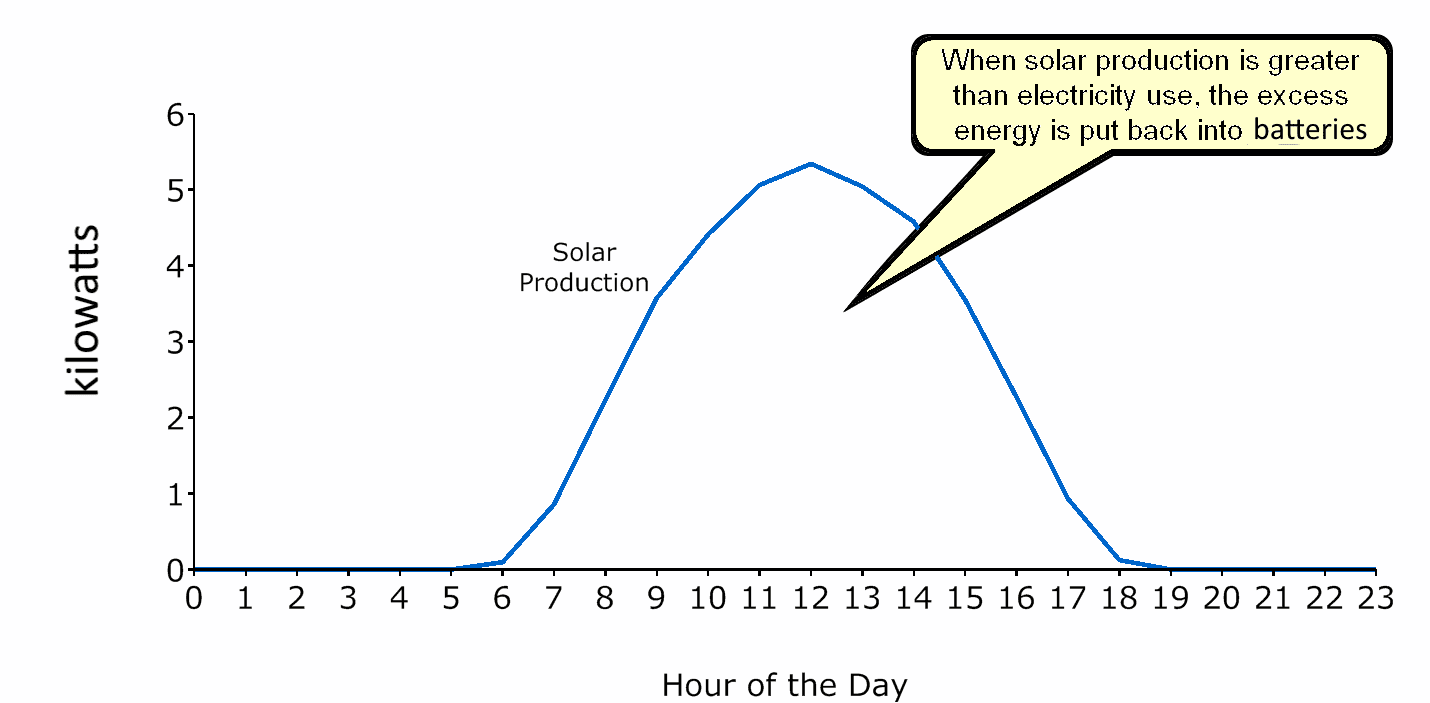
Solar PV system output varies during the day
Suppose a business with a solar PV sysytem buys 4 or 5 electric vehicles that can deliver electricity from their batteries - the Nissan Leaf with a 40 kilowatt-hour battery is one electric vehicle designed for this role -  and leases them to its workers to be used in the following way:
  • The worker drives the electric vehicle to work each morning and plugs it into a power exchange socket where it provides electricity to the business whenever electricity use is greater than the output of the solar PV system AND has its battery recharged whenever there is excess solar energy being produced. 
  • The worker drives the car home each day after work and plugs it into a power exchange socket where it powers the home - with solar energy stored during the day while at work - during the evening peak period when electricity prices are at their greatest. 
  • By late evening or early morning, if the car battery charge has fallen below the level that is needed for the morning peak period to prepare breakfast and for the commute to work, some additional energy from the grid is stored in the battery - again at off-peak rates.
  • ...and so on, each day.
This may make electric vehicles a better investment than just assessing their value as a replacement for a simple petrol-fueled vehicle. They can provide electricity as backup generators for businesses when solar energy output is less than the amount of electricity used and they can let workers take solar energy home. This is especially valuable for anyone who lives in rented accommodation and/or lives in one of the many households where all the members are away from the home during daytime.

The following video uploaded in 2013 describes the process in 2 minutes. At that time, the Nissan Leaf had only a 24 kilowatt-hour battery. The recently released model has a 40 kilowatt-hour battery. 


One application of the technology is described in Adam Vaughan's the article published in The Guardian on October 3, 2017:

Electric car owners 'can drive for free by letting energy firms use battery' 

Electric car owners will be paid for letting an energy company use their vehicle’s battery in a pioneering scheme to increase take-up of the cleaner vehicles and help power grids manage the growth in green energy.

Nissan and one of the UK’s biggest challenger energy suppliers, Ovo, will offer the “vehicle-to-grid” service to buyers of the Japanese carmaker’s new Leaf from next year.

After installing a special charger in a customer’s home, the supplier will take over the management of the car’s battery, with owners able to set a minimum amount of charge they want for driving the next day. Ovo will then automatically trade electricity from the battery, topping it up during off-peak periods when power costs about 4p per kilowatt hour (kWh), and selling it at peak times for about four times as much.