Latest Buzz...
                  

Translate

Showing posts with label save money. Show all posts

Sunday, January 26, 2025

Dispatchable power and dispatchable internet of things

The National Electricity Market in Australia experiences periods where more electricity is supplied than is needed, and periods where demand exceeds the available supply. 

"Dispatchable power" has been mentioned as a partial remedy to the latter periods.

The ability to remotely turn off rooftop solar PV systems and air conditioners has been mentioned as a partial remedy to the former periods. 

A more flexible solution is available, one echoes a feature in operating systems design, where hundreds of concurrent processes queue to use scarce resources and relinquish them when finished or surrendered.

Appliances and devices can be equipped with smart switches that send one of several status signals to distributed National Electricity Market management systems: 

  • "I am not currently consuming electricity, but can if requested."
  • "I am currently consuming electricity, but can pause if requested."
  • "I am not currently sending electricity to the grid, but can if requested."
  • "I am currently sending electricity to the grid, but can pause if requested."

The appropriate subset of status signalling, and the ability to respond to a request, can be incorporated into existing devices, including:

  • Hot Water Storage systems,
  • Home Battery Energy Storage systems,
  • Pool pumps and heaters,
  • Air conditioners,
  • Rooftop solar PV systems, and
  • Electric Vehicles.

There is a substantial cost in not having this approach to managing the National Electricity Market. 

In November 2024, over $700 million was paid by retailers in NSW for electricity used in just 7 hours and 40 minutes. This was more than the total paid for ALL the electricity the retailers purchased for the entire remainder of the month.

This pushed to average electricity price for NSW in November 2024 to $263.46 per megawatt hour (MWh). 

In December 2024, with fewer extreme price periods, the average wholesale price for NSW was only $164.72 per megawatt hour (MWh).

The National Electricity Market compels consumers to pay exorbitant prices for electricity

It would have helped if any electricity consumed in those 7 hours and 40 minutes with exceptionally high prices in NSW in November 2024 could have been postponed by just 5 or 10 minutes. 

There were also far more periods when the National Electricity Market price was exceptionally low. 

If more electricity had been consumed in those periods, avoiding the need to consume in other periods with higher prices, the average cost of electricity could be further reduced.

See "How to lower the price of electricity" for more analysis of data from the National Electricity Market.


Sunday, January 5, 2025

Energy Storage without the cost of a battery

News articles grab attention with stories that electricity utilities may want to turn off rooftop solar PV systems at times, and to turn off air conditioning systems at other times. 

What you won't find are articles on how appliances provide options for individuals and businesses themselves to adjust their energy production and consumption to best support the electricity grid. These options do not require any power for electricity utilities to interfere in how people run their own homes and businesses. 

How a Hot Water System can provide 4 kilowatt hours or more energy storage 

Many hot water systems are designed to operate as follows: 

  1. Heat water to a minimum of 60℃. This is to prevent the growth of harmful bacteria. 
  2. Ensure water is delivered from the hot water system at no more than 50℃. This is to lower the risk of scald injuries. 
  3. Optionally, heat water to a maximum of 70℃ or 75℃. This is to allow more hot water, at 50℃, to be available. 

The delivery temperature of 50℃ is achieved by mixing the stored hot water with some cold water in a Temperature Limiting Device. 

Electric Hot Water System


The amount of energy needed to heat 90 litres of water from 60℃ to 70℃ is 1 kilowatt hour.

A 360-litre Hot Water System, for instance, can be used to store 4 kilowatt hours of electrical energy by raising the temperature of water in it from 60℃ to 70℃. 

There is no need to buy a battery to store energy if you own a suitable Hot Water System. 


The Argument for Smart Switches

Time of Use charging has long been proposed to "encourage" electricity consumers to avoid using electricity at times when demand is highest. However, if you examine the National Electricity Market data, you will find that this is not especially helpful. The reason is that there are periods of extremely high wholesale (NEM) prices when demand is relatively low, and conversely, there are times when there are very low wholesale prices when demand is quite high. Moreover, these intervals do not conveniently coincide with any particular time of the day that "Time of Use" charging requires.

It is more appropriate to adjust the system so that electricity is preferably consumed when the wholesale (NEM) price is relatively low, and avoid consuming electricity at those times when the price is extremely high. This can be implemented with "smart chargers" that examine the NEM price before deciding whether to store energy - in a Hot Water System, an Electric Vehicle Battery, or a Home Battery.

Analysis of the National Electricity Market Data for NSW in November and December 2024 (see "How to lower the price of electricity") that shows that the price of electricity consumed in a small proportion of the time contributed enormously to the overall cost of electricity consumed in those months. Smart switches that help to reduce electricity consumed in such periods, and preferably store more electricity whenever the price is relatively low, can lower the total cost.

Monday, December 30, 2024

How to lower the price of electricity

The Australian National Electricity Market is a surprising source of high electricity prices.

For instance, in November 2024, households and businesses in New South Wales used electricity in just ten hours that cost electricity retailers over $672 million. 

All of the electricity used in the other 29 days and 14 hours of November costs retailers less: $615 million. 

Chart of cumulative wholesale cost of elctricity for NSW in November 2024

The retailers will recoup this cost from their customers via higher retail prices that take effect in one year's time. Note that the higher retail prices will affect all the customers of electricity retailers - even if they did not use any electricity during those ten hours in November when the wholesale cost was so extreme. 

There are some things that can be done to overcome these exorbitant wholesale electricity costs. 

If homes and businesses had energy management systems, these could have a function to reduce electricity consumption from the National Electricity Market in those brief periods that contribute so much to the retail price in the following year. 

The homes and businesses with energy management systems could enter their choices on how to deal with each 5-minute interval where the cost of electricity from the National Energy Market was extreme. 

  • If any battery storage was available, the system could be instructed to use stored electricity at those times. 
  • If an appliance did not need to run in any five-minute interval, such as a pool pump, it could be instructed to switch off for one or more 5-minute intervals - until it had to be started or the wholesale price had dropped.

UPDATE, 1 January 2025

Comparison of Electricity purchased in NSW in November and December 2024

The National Electricity Market data available for the wholesale cost of electricity in NSW in November and December shows: 

  • For November, NSW electricity consumers used a total of 5,074,855 megawatt-hours (MWh) for a total cost of $1,337 million. That is $263 per megawatt-hour (MWh).
  • For December, NSW electricity consumers used a total of 5,381,036 megawatt-hours (MWh) for a total cost of $886 million. That is $165 per megawatt-hour (MWh).

National Electricity Market data for electricity sold in NSW
The data for producing the above summary was downloaded from the Australian Energy Market Operator (AEMO) web page "Aggregated price and demand data". 

The difference in price, $263/MWh in November and $165/MWh in December is the result of there being fewer 5-minute intervals in which the price was greater than $1,000 per MWh. 

  • In November there were 92 x 5-minute intervals, which is 7 hours and 40 minutes, when the electricity price was greater than $1,000 per MWh. In these 7 hours and 40 minutes the amount of electricity sold was 70,358 MWh and the price was $706 million.
  • The electricity used in those 7 hours and 40 minutes cost NSW businesses and households $10 per kWh. How many would pay that much for so little if they were given a choice?
  • In December there were 45 x 5-minute intervals, which is 3 hours and 45 minutes, when the electricity price was greater than $1,000 per MWh. In these 3 hours and 45 minutes the amount of electricity sold was 37,498 MWh and the price was $276 million.

The National Electricity Market compels consumers to pay exorbitant prices for electricity
 

The difference in cost to the electricity retailers who bought this electricity and supplied it to their customers was $430 million. This difference is responsible for the average wholesale price of $263 / MWh in November and $165 / MWh in December.

Note that the change was not because of a change in the total demand for electricity, and it was not due to the technology used to generate electricity. There were the same coal-fired power plants operating in both months. There were the same renewable energy producers operating in both months.

These wholesale electricity costs will be reflected in retail electricity prices in a year's time. 

For information on how to lower the cost of electricity, see "Energy Storage without the cost of a battery", which includes specific specific advice at the sub-heading "The Argument for Smart Switches".

This is a list of the 45 x 5-minute intervals in December 2024 when the wholesale cost of all electricity bought from the National Energy Market in NSW cost more than $1,000 per megawatt-hour: 

REGIONSETTLEMENTDATETOTALDEMANDRRPPERIODTYPE
NSW12/12/2024 11:306651.211062.2TRADE
NSW12/12/2024 11:556915.821120.5TRADE
NSW12/12/2024 12:057108.531120.5TRADE
NSW12/12/2024 12:157217.561072.66TRADE
NSW12/12/2024 17:3511420.624438.07TRADE
NSW12/12/2024 17:4011345.361265.73TRADE
NSW12/12/2024 17:4511334.871060.61TRADE
NSW12/12/2024 17:5011419.915619.87TRADE
NSW12/12/2024 17:5511364.4715502.98TRADE
NSW12/12/2024 18:0011296.7715529.65TRADE
NSW12/12/2024 18:0511266.0315576.4TRADE
NSW12/12/2024 18:1011231.3610854.53TRADE
NSW12/12/2024 18:1511227.9514028.89TRADE
NSW12/12/2024 18:2011221.2615799.26TRADE
NSW12/12/2024 18:2511189.6314028.89TRADE
NSW12/12/2024 18:3011126.4610722.84TRADE
NSW12/12/2024 18:3511050.584308.54TRADE
NSW12/12/2024 18:4010980.054231.24TRADE
NSW13/12/2024 11:409317.2111267.8TRADE
NSW13/12/2024 11:459329.6317499.89TRADE
NSW13/12/2024 11:509440.5114100TRADE
NSW13/12/2024 11:559495.4511922.71TRADE
NSW16/12/2024 14:3011100.6917480TRADE
NSW16/12/2024 14:3511160.0617499.89TRADE
NSW16/12/2024 14:4511445.7115766.43TRADE
NSW16/12/2024 14:5511505.0614101.5TRADE
NSW17/12/2024 18:3010371.84127.15TRADE
NSW18/12/2024 18:008800.482268.8TRADE
NSW19/12/2024 14:404981.681071.59TRADE
NSW112/12/2024 17:5010089.881227.61TRADE
NSW112/12/2024 17:559949.161079.75TRADE
NSW112/12/2024 18:009944.711027.83TRADE
NSW112/12/2024 18:1510037.171257.89TRADE
NSW112/12/2024 18:2510068.364450.07TRADE
NSW112/12/2024 18:309915.421259.54TRADE
NSW112/12/2024 18:359928.091276.32TRADE
NSW112/12/2024 18:409867.521276.93TRADE
NSW112/12/2024 18:459864.791276.83TRADE
NSW112/12/2024 19:009897.331292.69TRADE
NSW112/12/2024 19:059755.561310.71TRADE
NSW112/12/2024 19:109730.424396.17TRADE
NSW112/12/2024 19:159687.34451.8TRADE
NSW112/12/2024 19:209685.149463.19TRADE
NSW112/12/2024 19:259591.381108.15TRADE
NSW112/12/2024 19:309650.851129.09TRADE

Tuesday, October 6, 2015

Investing in coal was once motivated by a desire to generate wealth

A look backwards through the Whitehaven Coal Annual Report of September 2015

A Year of Delivery - Whitehaven Coal Annual Report 2015 / page 79

DIVIDENDS

Paid During the Year
During the year the Company did not pay any dividends.
Declared After End of Year
Directors have resolved not to declare a dividend in respect of the 2015 financial year.

A Year of Delivery - Whitehaven Coal Annual Report 2015 / page 4

KEY ECONOMIC CONTRIBUTION

We contribute to the social and economic development of the communities in which we operate. The Company’s economic contribution was $470.1m in 2015. This includes:
  • $125.6m in payments including wages and superannuation to employees
  • $214.9m in payments to suppliers in the Gunnedah, Narrabri, Tamworth and Liverpool Plains shires
  • $129.6m in taxes and royalties to governments

A Year of Delivery - Whitehaven Coal Annual Report 2015 / page 2

FINANCIAL

Net loss after tax $342.7m


Investing in coal is now the way to make charitable "key economic contributions".

In 2015 shareholders very generously chipped in a lazy $342.7m towards the $470.1m Whitehaven Coal paid for "key economic contributions".
Whitehaven Coal Annual Report 2015 - Financial

Wednesday, October 24, 2012

Having your air conditioner and low peak demand too

Thermal Energy Storage - Phase Change Materials (PCM)
Thermal Energy Storage
Suppose you run an air conditioner that uses 4 kilowatt-hours electrical energy in peak periods and it moves 20 kWh of heat energy from inside your home to outside.

This result can also be achieved if the same air-conditioner "freezes" a liquid at, say, 15 degrees Celsius overnight and in peak period you melt the frozen chemical with 20 kWh of heat energy from inside our home. (eg. By using about 140 kg of potassium fluoride converted to 214 litres of potassium fluoride tetrahydrate.)

ABC TV's Catalyst aired a program in 2007 "Council House Two" on similar Phase Change Material (PCM) technology that is installed in an office building in Melbourne.

Extract from Transcript of a guided tour of this amazing building with the host of Catalyst, Dr. Graham Phillips:
Dr Graham Phillips: The air conditioning in this building is very different. We’ve all seen radiators, of course, that radiate heat. Well these things on the ceiling essentially do the opposite of that. Through the copper piping there runs chilled water cooled down to about 15 degrees Celsius and as that circulates around it essentially sucks the heat out of the room.
...
The system they use to chill the water for the air conditioning is ingenious. They’ve got three giant tanks like this filled with 10,000 stainless steel balls.

Here’s one of the balls. They’re normally sealed and inside there’s a special substance. They wouldn’t tell me what it was – a trade secret apparently. But it’s some sort of salt mixture that freezes at 15 degrees Celsius not zero like water ice. That means these balls are very easy to freeze: they require a very small amount of energy. So, on a hot day, water is flushed through the tanks, as the balls melt, they chill the water and that’s used in the air conditioning system.

Do "Time Of Use" (TOU) tariffs work?

Industry and business have had TOU tariffs for several years. A peak period cost of 26 cents per kWh can be cut by 20 cents per kWh to just 6 cents per kWh by moving the peak load required by air conditioning and refrigeration to off-peak periods.

The option for saving 20 cents per kWh, a whopping 75 percent of peak period energy costs, has not created any discernible action let alone excitement among Australia's business managers to date.

Example of Commercially Available Energy-Storage Air Conditioner System

The following animation is from the web site of Phase Change Products Pty Ltd (PCP).

Content on this page requires a newer version of Adobe Flash Player.


What is Thermal Energy Storage (TES)?

TES is a simple technology based on storing thermal energy in a liquid, solid or phase change material (PCM). Stored energy in PCMs can come from a variety of sources: waste heat, excess refrigeration capacity, night-time refrigeration or co-generation facilities.
Energy is released when needed for air conditioning, process cooling, or process/space heating.

PCMs solidify inside a PCM-filled vessel with a heat exchanger, or PCM-filled spheres or cylinders contained installed in large tanks.

Thermal Energy Storage systems generate energy cost savings and environmental benefits by using low cost off-peak electrical energy. TES vessels can be installed in schools, hospitals, airports, office buildings, churches, sport facilities, government offices and industrial plants.

Thermal Energy Storage with Phase Change Material

A volume of material is used to store thermal energy while it changes from the solid phase to the liquid phase at a specific temperature. The phase change material (PCM) stores heat during the melting process and stores cold during the solidification process. A thermo fluid transfers the energy from the storage tank to a load (process, HVAC unit, etc.). The phase change Thermal Energy Storage unit may charge and discharge at the same time: the melting and solidification processes of the material may happen simultaneously.

Thursday, August 9, 2012

Save the Date! 2nd Australian Summer Study on Energy Efficiency

Following on from the Australian Decentralised Energy Roadmap, launched 15 December 2011 by the Honourable Martin Ferguson, Australian Government Minister for Resources and Energy, addressing rapidly rising energy costs -

 
A2SE Logo SAVE THE DATE!


2nd AUSTRALIAN SUMMER STUDY
ON ENERGY EFFICIENCY & DECENTRALISED ENERGY


| 27 FEB - 1 MARCH, 2013| SYDNEY


MARK YOUR DIARY FOR THE 2013 SUMMER STUDY:
27 FEB – 1 MARCH, SYDNEY

Building on the success of this years' Summer Study, the Australian Alliance to Save Energy looks forward to welcoming you to an even bigger program in 2013.

The Summer Study is a three day, residential event that brings together a cross-sectoral group of influential, highly engaged individuals that are open to sharing information.

This years' results speak for themselves: 91% of attendees rated their experience ‘very good’ to 'excellent’ and 87% said they were exposed to new information. 


In 2013, the Summer Study will offer unparelleled access to global energy efficiency best practice. With four themes, 20 sessions and eight informal roundtables, the program will provide a rich environment for information sharing.

New in 2013:


• An entire track focussed on international perspectives which will include thought leaders from the U.S., Asia Pacific and Europe

• The program has a strong focus on energy users with a track dedicated to best practice, improving energy management and opportunities in industry

• The number of  informal sessions has been doubled providing lots of opportunities to participate in the program.

SPONSOR THE SUMMER STUDY AND GAIN HIGH PROFILE EXPOSURE AT THIS LANDMARK EVENT.

Date:
Wed 27 Feb - Fri 1 March, 2013

Location: Novotel Sydney Brighton Beach
Link to online map


We will be announcing a Call for Papers and sending out invitations to attend soon. In the meantime be sure to save these dates!

Download Sponsorship Prospectus

Download Program

Make an Enquiry

2012 Summer Study at a Glance:
* 275 attendees

* 18 countries
* 100+ speakers
* Senior, cross- sectoral audience

Watch 2012 presentations by:

* Steve Nadel American Council for an Energy Efficient Economy

* Dr Wanxing Wang, The China Sustainable Energy Program


* Lara Ettenson, Natural Resources Defense Counsel


Follow us on Twitter

This email was sent by The Australian Alliance to Save Energy,
Level 11, UTS Building 10, 235 Jones St, Ultimo, NSW, 2007, Ph: 02 9514 2044

Monday, May 21, 2012

Fuel Cells Feed in Tariff

Victorian Government review supports feed in tariffs for fuel cells 

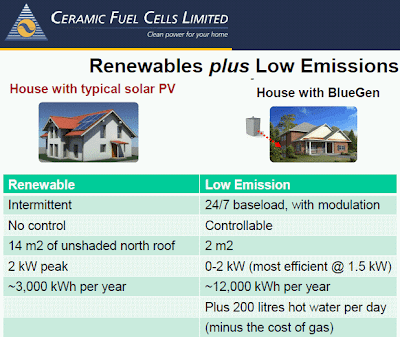
Fuel Cells - Renewables plus Low Emissions

Ceramic Fuel Cells Limited (AIM / ASX: CFU) – a leading developer of high efficiency and low emission electricity generation products for homes and other buildings – is pleased to announce that the Victorian Competition and Efficiency Commission (VCEC) has recommended that feed in tariffs be extended to include small scale low emissions generators like fuel cells.

The draft report by VCEC, released on Friday 18 May, recommends that Victoria’s solar PV feed in tariff be broadened to include all low-emissions and renewable technologies, with a requirement that electricity retailers must offer a wholesale price based feed in tariff for distributed generation of 100 kilowatts or less.

Feed-in tariffs are payments to distributed generators for electricity generated at their premises and fed back into the power grid. VCEC recommends that the feed in tariff be based on the wholesale price for electricity.

Fuel Cells - Displace coal-fired power
A report commissioned by VCEC notes that this value varies depending on time, location, and the type of generation technology. The report estimates that currently this value is approximately seven cents per kilowatt hour.

Ceramic Fuel Cells’ BlueGen gas to electricity generator would be eligible for this feed in tariff, making Victoria the first State in Australia to provide a feed in tariff for fuel cells. BlueGen customers already receive feed in tariffs in Germany and the United Kingdom.

The VCEC draft report adopts several recommendations made by Ceramic Fuel Cells in our submission and consultation with VCEC, including:

  • Extending the standard feed in tariff regime to include small scale low emissions technologies;
  • Defining ‘small scale’ as 100 kilowatts or less;
  • Defining ‘low emission’ as 50 percent or lower than the emissions intensity of the national electricity network;
  • Simplifying the process for connecting small scale generators to the power grid.

Read the full CFCL Market Announcement ...

Read the related Fuel Cell post  Cell company fuelling feed-in tariff debate ...

Friday, December 23, 2011

AGL no Fan of Energy Efficiency

Limited-form dynamic pricing: applying shock therapy to peak demand growth
Paul Simshauser and David Downer
AGL Energy Ltd
Level 22, 101 Miller Street
North Sydney, NSW 2060.
February 2011

"...one aspect of energy policy that is gaining increasing traction at the federal level is ...[an] energy efficiency scheme, primarily as part of the suite of policies aimed at greenhouse gas abatement. Under such a scheme, efficiency targets would be imposed upon [electricity] retailers to reduce electricity consumption of their respective customer base via changing out lights, appliances and installing other energy saving devices. Ergas (2010) observed that this should only occur where benefits exceed the cost. In relation to a federal taskforce report on implementing such a scheme, he noted that:
A policy is effective if it does what it sets out to do. It is economically efficient if what it sets out to do is worth doing. The [federal government energy efficiency taskforce] report's premise is that we should reduce our energy consumption; what it fails to show is that reducing energy consumption would make Australians better off. The clear implication of this is that our levels of energy use are inefficient. But for this proposition, there is no evidence [presented in the report] whatsoever...
Ergas, H. (2010), “Saving energy will tie us in green tape”, The Australian, 15 October 2010."

Electricity Bill Shocks and Smart Meters

The above report is enclosed with a submission by Tim Nelson, AGL's Head of Economic Policy & Sustainability on 26 August 2011 to the Australian Energy Market Commission.

AGL is not in favour of reducing consumption of the product it sells (electricity). It does however support increasing the price for product it sells (electricity).

Tim Nelson's submission on Power of choice – giving consumers options [and electricity bill shocks] ... says:
Muted price signal – unless consumers are exposed to price signals that inform consumption behaviour and purchasing decisions, empowering users to be more energy efficient is unlikely to be fully obtained [sic].
Most importantly, the continued regulation of retail prices prevents retailers from developing innovative dynamic pricing structures which aim to overcome the allocative inefficiency [sic] which results from variable demand.

It is not realistic to talk about reforms to the electricity system involving new technologies (e.g. smart meters) when the very value they provide cannot be extracted [sic] due to rigid pricing structures enforced through ongoing retail price regulation

(Submission, 26 August 2011, page 2)
Tim Nelson enclosed a report that expands on this idea:
Above trend-growth investment across the energy supply chain is now driving retail prices to levels that triggered the sectoral assault in the first place. This pressure should initiate the last piece of the reform puzzle; removing price regulation, installing smart meters and implementing limited-form dynamic pricing to halt the primary cause of the problem [sic]; rapidly rising peak demand. 
(Report Abstract)

With smart meters and a mobilised education campaign, limited-form dynamic pricing could then commence, although crucially, outside the summer period to minimise the incidence of initial bill shock. 
(Report at page 19)

Saturday, September 17, 2011

"Who will be First to Cop the Carbon Chop?"

What, No Beer???
The Climate Sceptics Blog, "Carbon Sense Newsletter from Carbon Sense Coalition"
(11 September 2011)
"It is not possible to achieve the government's planned cuts to the production of carbon dioxide without significant shrinkage of our main industries. The destructive but honest way is to allow the shrinking targets and rising taxes to force closures or relocation for our backbone industries."
"It's not possible to make cement or brew beer without generating carbon dioxide."

Money going out the CO2 emission stack

 Sell Food Grade Carbon Dioxide for $20 to $40 per Kilogram!!!

Capture Carbon Dioxide from beer brewing (save $23 per tonne in carbon tax) then sell it for $20-$40 per kilogram as food-grade Carbon Dioxide....
"Logichem has more than 10 years experience in Carbon Dioxide (CO2) Collection Plants. This is essentially a CO2 Recovery Plant. The CO2 is recovered from fermenting and CO2 rich chemical processes. Logichem offers the most cost effective and latest technology to our clients.
Carbon dioxide (CO2) is naturally formed in fermentation processes commonly found in the beer and alcohol production industries.
CO2 is essential in the production of carbonated alcoholic beverages such as beers and ciders.
Studies have indicated that a CO2 collection ratio of 27.3 kg/kl brewed is typical. In theory for high gravity Beer up to 45 kg/kl CO2 are generated, this figure is dependent on the actual brew.
The CO2 gas stream is then compressed and purified to produce high quality food grade CO2."

"In Tassie food-grade CO2 refills costs $40.00 for 2kg and $20.00 for 500grams."

Save $12.8 million a year

In "Another brick in the wall for carbon tax"
Tony Abbott visited Austral Bricks.
Tony Abbott visits Austral Bricks

Austral Bricks managing director Lindsay Partridge said the Brickworks had reduced carbon emissions by 40 per cent in the past decade, but the introduction of the carbon tax would cost his company $12.8 million a year.
After his hands-on experience, Mr Abbott shared a sausage sandwich and a few words with the employees.

“This is one of the many businesses in one of the many industries which is going to be badly hit by the Prime Minister’s toxic tax,” Mr Abbott said. “The thing about the carbon tax is that it’s going to be very tough for Australian families, it’s going to be particularly tough for Australian homebuyers.” 

(See the related post: Tony Abbott does "Hanrahan" for Doorstop Interview...)

Friday, August 26, 2011

Power Station operator gets great value for investors

Building a new power station is a high risk investment.Getting it right

HRL is currently fighting a legal challenge from Environment Victoria to its current plan to build a new power station in Victoria. HRL might find this challenge provides a completely unexpected and unintended benefit.

HRL's proposed power station has a design that is well below the performance that can be achieved with technology first offered for sale earlier this year by Siemens and GE.

This is not just a case of amazing good luck for HRL. It can now build, own and operate a power station with world-record efficiency. It is also a last-minute reprieve for investors who came very close to funding an obsolete power station with relatively low rates of return.

For example, the new high efficiency gas turbine from Siemens produces 12 MWh with the same fuel needed to generate 10 MWh with old gas turbines. For investors, that is 20% more revenue for the same fuel cost.

Even better, the new technology creates a mere 330 kilograms of carbon dioxide for each MWh, instead of the whopping 780 kilograms of carbon dioxide for the power station HRL was about to build. It is about 1000 kilograms below the current Latrobe Valley brown coal fired power generation! For investors, the carbon tax is slashed by nearly 60%!!!

HRL and its investors have been given a second chance to build the cleanest, most efficient and most profitable base load power station in Australia - using the cheapest coal in Australia.

Read all about the best carbon energy technology in a submission on the Clean Energy Legislation Package. A brief summary with a link is in this blog entry ++>

Some of the steps on the path show how HRL and its investors only narrowly escaped missing out completely on this opportunity:

September 24, 2009HRL propose $750m dual gas power plant for Victoria
The CO2 emissions intensity of the demonstration project is expected to average 0.78 tonnes CO2 per megawatt hour over the life of the project. This is about 40% lower than the current Latrobe Valley brown coal fired power generation annual average CO2 emissions intensity of about 1.3 tonnes CO2 per megawatt hour.
Read more ++>

May 21, 2011Big banks 'no' to coal plant

AUSTRALIA'S four major banks have rejected funding a coal-fuelled power plant proposed for Victoria, raising doubts about its viability despite its controversial approval by the Environment Protection Authority.

The EPA has cleared the way for Melbourne coal technology company HRL to build what would be Victoria's first new coal plant in nearly 20 years.

Under yesterday's ruling, HRL can build a plant at Morwell using new gasification technology, which is claimed to reduce greenhouse gas emissions from brown coal power by about a third, to roughly the level of modern black coal stations.
Read more ++>

August 26, 2011Environment Victoria in court over new coal-fired power plant
Environment Victoria was back at the Victorian Administrative Appeals Tribunal this afternoon, for the next step in our legal challenge to the EPA’s decision to approve a new coal-fired power station for Victoria.

In a shocking move, HRL Ltd, the company behind the new polluting power station, is making a legal challenge against Environment Victoria’s rights to stand up for our environment in the courts.

HRL’s lawyers are arguing that Environment Victoria shouldn’t be allowed to appeal to VCAT against the EPA’s decision. They also challenged the legal standing of community climate group LIVE, Doctor’s for the Environment Australia, and a Brunswick based individual.

Trying to have environmentalists and doctors struck out of the proceedings before they’ve even begun raises a very serious question – why is HRL trying to avoid scrutiny of their project? What have they got to hide?
Read more ++>

Thursday, August 4, 2011

GE's Solution for Carbon Tax, Electricity Prices AND CO2 emissions

GE Jenbacher

Option 1: Generate electricity efficiently, cheaply, and with low CO2 emissions


GE’s Super-Efficient Jenbacher Gas Engines Bring Energy Independence and Economic Opportunities to French Greenhouses

MILAN, ITALY—June 8, 2011—Since the beginning of the year, two of GE’s (NYSE: GE) flexible, high-output and efficient Jenbacher J624 two-stage turbocharged gas engines have enabled French grower Serres Vinet to generate all of the hot water and electricity required for its extensive tomato and lettuce greenhouse operations in Machecoul, in the Loire-Atlantique region. These are the first two-stage turbocharged gas engines in France, and they are the heart of two cogeneration plants powering Serres Vinet’s existing greenhouse operations plus a recent 17-hectare (42-acre) expansion. GE presented the innovative installation this week at the POWER-GEN Europe show in Milan.

No other gas engine manufacturer currently offers such a super-efficient two-stage turbocharged unit. Each Jenbacher J624 engine offers about 4.4 MW of electrical output and 4,014-kilowatts (kW) of thermal output at 44.4 percent electrical efficiency and 47 percent thermal efficiency. The units at Serres Vinet operate on natural gas and are key to the ability to configure Serres Vinet’s cogeneration plants to achieve an overall energy efficiency of more than 90 percent, with NOx emissions continuously below 350mg/Nm³. GE also has provided the control systems.

Option 2: Buy electricity that is expensive, creates high CO2 emissions, and attracts high carbon tax
(Source: Independent Pricing and Regulatory Tribunal)
Table 1.3 Indicative annual bill for business customers in each standard supply area ($ nominal)


2010/11 (current)
2011/12
Change
EnergyAustralia
2,006
2,365
359
Integral Energy
1,982
2,289
307
Country Energy
2,917
3,445
528
Note:
Bills exclude GST but include climate change levy. Bills calculated using 10,000 kWh per annum and EnergyAustralia’s General Supply All-time tariff, Integral Energy’s General Supply tariff and Country Energy’s Urban Business tariff (5740). Inflation is 3.3%.

(Electricity at a price of $2,289 for 10,000 kWh is equivalent to $63.60 per GJ of electrical energy.)

Option 3: Buy gas to generate electricity that is cheap, creates low CO2 emissions, and attracts low carbon tax
(Source: Independent Pricing and Regulatory Tribunal)
Table 1 Indicative annual bill for AGL regulated retail customers ($ incl GST)


Type of Customer
2010/11
2011/12
$ Increase
Typical business -
184 GJ per year
3,289

3,350
61

(Gas at the price of $3,350 for 184 GJ is equal to $18.20 per GJ of thermal energy.)

Using gas that costs $18.20 per GJ to generate electricity in one of GE’s Super-Efficient Jenbacher Gas Engines - at 44.4 electrical efficiency - produces electricity for $41.40 per GJ.

This electricity is 1/3 cheaper than paying $2,289 for 10,000 kWh - electricity for $63.60 per GJ.

This electricity creates 60 percent less carbon dioxide emissions.
  • (400 kg per MWh instead of 1,000 kg per MWh for coal-fired electricity generation.)
This electricity attracts 60 percent less carbon tax.

It's easy to save electricity and reduce carbon tax

The Hon Barry O’Farrell MP
Premier of NSW
MEDIA RELEASE

“Small business will have little choice but to pass on these massive hikes in electricity prices to their customers - dealing a double whammy to families and seniors across NSW,” Mr O’Farrell said.


Whether you work for a local, state or federal government agency, there are simple ways that you can save power and cut down on carbon pollution at work.

Everything we do to reduce power will make a difference. For a few tips to get you read more ...

Explore the business section and power saving tips for business to find simple actions you can do in your workplace to reduce electricity use and find out about business programs to make your organisation more sustainable.

Sunday, July 24, 2011

Ted Baillieu - Many Quick and Simple Ways to Save Energy

Victorian Premier Ted Baillieu was on the attack, claiming his government's analysis shows gas and electricity bills under the planned carbon tax will cost the state's public hospitals an extra $13.6 million for the 2012/13 financial year.


There are many quick and simple ways to start saving energy now

Visit ResourceSmart online for ideas on how to save energy IN VICTORIA
as well as other ways to shrink your impact on the environment.

Energy

... energy use is a major contributor to Victoria's greenhouse gas emissions. But by making a few simple changes to your habits, ... to your electricity provider, you can make immediate and dramatic cuts to your ... emissions.

  • Electricity and gas bills

    If your bills are higher than you expect, look at your energy use ...

  • Energy and Water Taskforce

    Free ... assessments and retrofits are available ...

  • Energy saver incentive

    To help combat climate change and encourage Victorians to undertake energy saving actions, the Victorian Government has launched the Energy Saver Incentive.

  • Find a trained ...sustainability assessor

    Get ... assessed by a qualified ... sustainability assessor who can provide advice on how to reduce your ... impact on the environment.

  • ResourceSmart Retail Program

    When it comes to buying energy and water efficient products ..., for the right advice at the right place visit one of the participating ResourceSmart retailers.


Australia's largest solar thermal cooling system now running at Echuca Hospital in regional Victoria read more...