The cost of storing energy and meeting peak demand can be cut dramatically with a good combination of technologies and judicious use of available assets.
Depleted gas fields in South Australia have provided a return on investment over a number of years and when reused for new purposes, save the need for investment in locating and tapping similar geological structures.
Subsurface geological conditions which may be suitable for underground gas storage have been identified in the Two Wells - Port Wakefield area of the Northern Adelaide Plains. This area is within 100km of Adelaide. (See "Underground Gas Storage", Department of the Premier and Cabinet, South Australia)
A cutaway view of Solar Turbines' Taurus 70 engine,
which is similar to a jet engine, but is used to generate electricity in power plants on the ground.
In a solar thermal turbine compressed air is heated by concentrated solar energy...
CSIRO Solar Air Turbine Project
Heat energy in a solar thermal turbine can be supplemented with natural gas when there is partial cloud cover. At night natural gas can take over from solar thermal heating.
Whether a turbine engine is run on natural gas or solar thermal energy, about half the energy available from the turbine is used to power the compressor, leaving the other half to run a generator to supply electricity.
That is, a gas turbine power station with a nameplate rating of 100 MW is actually able to produce 200 MW of energy - if it did not have to drive a compressor.
Energy from renewable energy generators may be stored by driving compressors to compress air that is stored in depleted gas fields.
The compressed air energy storage can deliver electricity to the grid when it is required by supplying it to a gas turbine generator, relieving the generator of the need to drive a compressor while it is being supplied with compressed air.
A solar thermal power station can store energy in a compressed-air energy store and use the compressed air at night to significantly reduce the amount of stored thermal energy or natural gas needed for operation.
During peak demand periods, output from existing gas turbine generation plant can be quickly increased by reducing the energy used to drive compressors while supplying them with compressed air from storage.
Natural gas power is increasingly unreliable in Australia.
A simple law of physics explains why natural gas power stations are unreliable:
6 gigajoules of natural gas are needed to generate 3.6 gigajoules of electrical energy in a combined-cycle gas turbine power station.
Each 3.6 gigajoules of electrical energy (which is 1 megawatt-hour or 1 MWh) has a price of about $50 in the Australian Energy Market Organisation's National Electricity Market.
The natural gas used to generate this electrical energy costs about $9 per gigajoule in the Australian Energy Market Organisation's Wholesale Gas Market.
The result:
It costs about $54 for the natural gas used as fuel to generate each megawatt-hour of electricity. This has a wholesale price of only $50.
Renewables helped keep Sa powered while a fire knocked out the switching of gas generators at Torrens island. We are asked to reduce use
In terms of production costs, over the last decade the finding and development costs for the petroleum industry have increased six-fold. And, in the three years to 2013, total Australian finding and development costs averaged $4.16/GJ, which was 2.7 times the average for the three years to 2007. These rising costs are partly explained by the fact that unconventional gas production involves significantly higher capital expenditure than that of conventional off-shore wells, given that CSG requires multiple wells to be drilled in order to access equivalent volumes of gas.
The projected US exports of around 7 trillion cubic feet of natural gas, or about 140 million tonnes of LNG is almost double the projected Australian exports of 85 million tonnes of LNG per year.
1 metric ton liquefied natural gas (LNG) = 48,700 cubic feet of natural gas.
1 trillion cubic feet of natural gas is about 20 million tonnes of LNG.
Given the much higher cost of producing coal seam gas in Australia, the ramping up of US LNG exports to 2020 is likely to bring the enthusiastic expansion of coal seam gas in Australia to a sudden end.
New German technology converts 2 gigawatt-hours of off-peak electricity from wind turbines into hydrogen in its first year of operation. (See E.ON Wind Energy Gas Storage GmbH)
For private households the “Wind-to-Hydrogen” product can be obtained as a mix of 90 % natural gas and 10 % regenerative hydrogen.
This technology competes with battery energy storage. The commercial value of hydrogen and oxygen from off-peak wind energy has to be weighed up by investors against the cost of storing this off-peak energy in batteries for resale at a higher price during peak periods.
There are opportunities to expand the market for hydrogen and oxygen from low-cost off-peak electricity generated by wind farms:
Oil refineries consume a vast amount of hydrogen to produce transport fuels. At present refineries use natural gas to make hydrogen.
Oxygen from wind turbine electrolysis units can cut the reliance on air separation plants making oxygen for use in coal gasification. (The process of gasifying coal and municipal or crop waste with pure oxygen also lowers the cost of separating carbon dioxide - itself a valuable product in the emerging algae-oil industry and traditional markets such as fertiliser manufacture.)
Air may be cheap but from a thermal-efficiency perspective it's expensive because only one fifth of air is oxygen with nitrogen forming the remaining four fifths. Gasifiers that use air as the oxidizing gas have to heat up five times as much air than one using pure oxygen as the oxidizer and separating carbon dioxide from large volumes of nitrogen is an expensive process.
In the mid-1970's pure oxygen was produced by the fractional distillation of liquid air, a process which is energy intensive and technologically challenging.
Natural gas prices on way up. It's time to find other sources of hydrogen for manufacturing fertiliser.
Natural gas is used as a source of hydrogen in the manufacture of ammonia - to make fertiliser for farming. Natural gas is also used as a source of energy in manufacturing fertiliser.
The price of natural gas is expected to double next year. This will lead to much higher costs to farming.
Other sources of hydrogen for manufacturing fertiliser need to be found to keep farming costs in check.
Hydrogen production from surplus renewable wind energy
"Hydrogen from surplus wind energy."
On August 28, 2013 E.ON inaugurated commercial operations at its Power-to-Gas (P2G) facility in Falkenhagen, Germany. The plant uses surplus wind power and Hydrogenics' electrolysis equipment to transform water into hydrogen. The facility which has a capacity of two megawatts produces 360 cubic meters of hydrogen per hour.
(Read more ...)
Hydrogenics Industrial Hydrogen Generators by Electrolysis
"Hydrogenics units have been adapted specifically to meet the requirements of higher capacity installation in excess of 500Nm3/h. Thanks to our standardized approach, we can expand our capacities to meet your hydrogen demand, offering you additional redundancy and supply reliability.
Indoor large capacity hydrogen generator
The hydrogen generator installation can be completed with additional options like a compressor system, online purity measurement and backup storage.
Whichever setup you need, Hydrogenics will offer you a stress–free equipment to provide your process with a reliable supply of on-site hydrogen. When we talk about hydrogen generators at Hydrogenics, we want to deliver a safe and reliable unit the best you can find on the market and the most competitive for that quality."
Natural gas prices on way up. It's time to review other sources of fertiliser and hydrogen.
Natural gas is used as a source of hydrogen in the manufacture of ammonia - to make fertiliser for farming and explosives for the mining industry. Natural gas is also used as a source of energy in these manufacturing processes.
The price of natural gas is expected to double next year. This will lead to much higher costs to farming and mining.
Alternate sources of hydrogen and fertiliser need to be examined to keep farming and mining costs in check.
Incitec Pivot's Anhydrous Ammonia, Queensland, Australia
"Ammonia is manufactured by
combining hydrogen extracted from natural gas..."
Anhydrous Ammonia is manufactured by
combining hydrogen extracted from natural gas and nitrogen from the air
to form liquid ammonia.
Incitec Pivot's ammonia plants are located at Phosphate Hill and Gibson Island in Queensland.
(Read more ...)
Incitec Pivot's Ammonium Nitrate, Queensland, Australia
"long-term
competitively priced gas supply..."
Incitec Pivot Limited’s new Dyno Nobel ammonium nitrate plant at
Moranbah in Queensland is in the heart of Australia's largest
metallurgical coal region, the Bowen Basin. Close to some of the
largest coal mines in Australia, the plant’s entire output is committed
to Dyno Nobel customers under long-term contracts.
The Moranbah project is a fully integrated ammonium
nitrate plant with an annual capacity of 330,000 tonnes. As a result of
its strategic position, integrated processes and long-term
competitively priced gas supply from local coal producers, the
world-scale plant is expected to operate at the bottom of the cost curve
in comparison with its international competitors.
(Read more ...)
Incitec Pivot's Ammonia Plant, Louisiana, U.S.
"The new plant will upgrade natural gas to value-added chemicals."
The ammonia plant, with a production capacity of 800,000t per year, is expected to start production in 2016. The feasibility studies for the project commenced in May 2012 and construction works commenced in May 2013
The new plant will upgrade natural gas and natural gas liquids to value-added chemicals. The project is a result of the growth in the production of shale gas in the US and increased global demand for ammonia, which stands at about 3.3 million tonnes of new capacity since 2002.
(Read more ...)
Incitec Pivot Phosphorus Fertilisers
Ammonia Molecule
DAP (Diammonium Phosphate) is manufactured by reacting ammonia with phosphoric acid. Because it has a high nitrogen and phosphorus content, DAP allows savings to be made in storage, freight and application. It is a very economical nitrogen and phosphorus fertiliser and is widely used throughout the world. In Australia, DAP is used in cropping and on grass pastures, both on its own and in blends, e.g. for sugarcane and horticulture.
A $40 a tonne increase in the US in December has led Australian farmers paying up to $200 a tonne more for DAP.
(Read more ...)
U.S. natural gas ends above $6 after hitting five-year high
U.S. natural gas futures
sprinted past $6 on Wednesday to their highest price in more
than five years, ending up nearly 11 percent on forecasts that
more late winter cold weather across the United States will
increase heating demand and deplete increasingly thin supplies.
(Read more ...)
Santos confident gas prices will rise
SANTOS says it is so confident Australian east coast gas prices will rise that it is using prices close to $9 a gigajoule - which is two or three times current gas prices - to assess its gas reserves.
(Read more ...)
Struvite (magnesium ammonium phosphate) Recovery
"Ostara’s Pearl® technology created at the University of British Columbia recovers ammonia and phosphate from nutrient rich fluids."
Ostara’s proprietary wastewater treatment technology, called the Pearl® Nutrient Recovery Process, recovers phosphorus and other nutrients from sludge liquids preventing the buildup of struvite scale in plant infrastructure and converting the recovered nutrients into a premium commercial fertilizer (Crystal Green®)
The pellets are then harvested from the reactor and formulated to become Crystal Green®, a high-quality environmentally friendly, slow-release, commercial fertilizer that provides revenue for the system’s operator.
Ostara’s Pearl® technology is based on a proprietary fluidized bed reactor that recovers ammonia and phosphate from nutrient rich fluids. The technology, created at the University of British Columbia, uses a proprietary fluidized bed reactor design which removes approximately 85% of the influent phosphorus, but also results in the formation of a fertilizer in granular form consistent with that used in the fertilizer industry.
(Read more ...)
Hydrogen Production by Solar Reforming of Natural Gas
"Hydrogen from natural gas by the use of solar energy."
A hybrid process with the use of fossil and solar energy: the solar steam reforming of natural gas. It comprises the production of hydrogen from natural gas by the use of solar energy. Using the solar reformer technology for generation of hydrogen, we expect fuel savings of up to 40 percent compared to a conventional plant.
(Read more ...)
Hydrogen production from surplus renewable wind energy
"Hydrogen from surplus wind energy."
On August 28, 2013 E.ON inaugurated commercial operations at its Power-to-Gas (P2G) facility in Falkenhagen, Germany. The plant uses surplus wind power and Hydrogenics' electrolysis equipment to transform water into hydrogen. The facility which has a capacity of two megawatts produces 360 cubic meters of hydrogen per hour.
(Read more ...)
The Audi e-gas project demonstrates how large amounts of green electricity can be stored efficiently and independently of location by transforming it into methane gas and storing it in the natural gas network, the largest public energy storage system in Germany.
The e-gas plant utilizes a two-step process: electrolysis and methanation. First, the plant uses surplus green electricity to break water down into oxygen and hydrogen in three electrolyzers. While the hydrogen could one day power fuel-cell vehicles, in the absence of an area-wide infrastructure, a second process step is carried out directly: methanation. The hydrogen is combined with carbon dioxide (CO2) to produce synthetic methane, or Audi e-gas.
Audi said the efficient use of energy flows was the top priority in the plant’s production sequence: The waste heat given off during methanation is used as process energy in the adjacent biogas plant, significantly increasing overall efficiency. In return, the biogas plant supplies the highly concentrated CO2 required as a basic building block for e-gas. This CO2 thus serves as a raw material and is not emitted to the atmosphere.
The US National Renewable Energy Laboratory (NREL) in partnership with Xcel Energy launched a wind-to-hydrogen (Wind2H2) demonstration project at the National Wind Technology Center in Boulder, Colorado.
The Wind2H2 project links wind turbines to electrolyzers, which pass the wind-generated electricity through water to split it into hydrogen and oxygen. The hydrogen can then be stored and used later to generate electricity from an internal combustion engine or a fuel cell.
Extract of Figure 1-1 Overall Wind2H2 system design
Storing Energy in Hydrogen. “The larger the share of electricity production accounted for by
renewable sources such as the wind and sun, the greater will be the
fluctuations in the amount of energy available,” says Dr. Manfred Waidhas from the new Hydrogen Electrolyzer Division at Siemens’ Industry Sector.
Waidhas believes hydrogen offers the best energy storage solution. “You could set up an electrolyzer at a location where electricity from an offshore wind park reaches land, for example,” he says. “If the wind park were to produce too much electricity, you could use it to produce hydrogen, which could then be stored in a cavern.”
If demand for power rises, the energy-rich gas could then drive a turbine to supply CO2-neutral electricity to the grid.
If you combine the efficiency of the electrolysis (approx. 75 percent) with that of a gas turbine (around 60 percent in combined cycle operation with a steam turbine), the resulting “energy-recirculation” process would still exploit up to 45 percent of the original energy. “That’s not as good as a pumped-storage plant, but it’s better than shutting down windmills when demand isn't there,” says Waidhas.
E.ON is developing a pilot plant in Falkenhagen in the north east of Germany to convert power from wind energy into hydrogen which can then be stored in the country’s gas grid. The company is investing over EUR5 million on the pilot plant and further research into this innovative technology.
Using power from renewable energy sources, the plant will produce about 360 m³ of hydrogen per hour from 2013 onwards through electrolysis. The hydrogen will be fed into the Ontras gas pipeline system and be used like normal natural gas. This makes the gas grid a storage system for power from weather-dependent renewables.
And now, for something completely different -
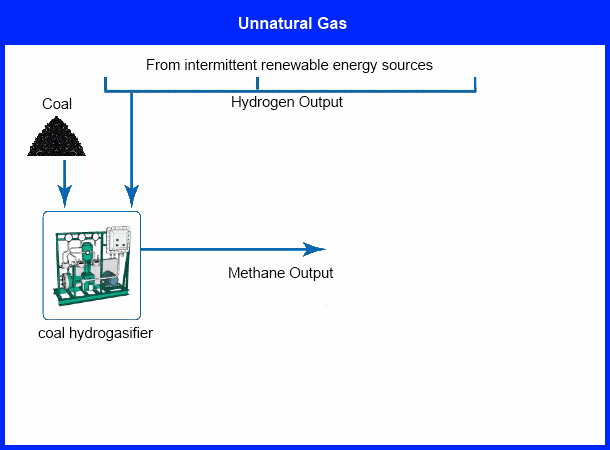
"Unnatural Gas"Methane that contains 50 percent fossil fuel energy (from coal) and 50 percent renewable energy (from wind and/or solar).
Methane from Coal and Hydrogen
Add 2 molecules of hydrogen to an atom of carbon and you have a new fuel (methane) that:
possesses TWICE the energy content of the hydrogen molecules,
can be transmitted through natural gas pipelines,
can be used in any appliance that runs on natural gas, and
can be used as fuel in any engine, fuel cell, trigeneration power system or power station that runs on natural gas to generate electricity.
In comparison, coal is far more limited. For example, natural-gas fueled power stations can achieve 60 percent efficiency. Coal-fired power stations can achieve little over 35-40 percent efficiency. Coal cannot be transmitted through natural gas pipelines so it cannot be easily distributed for fuel in trigeneration power systems.
Coal gasification technology can convert coal to methane and carbon dioxide. With carbon capture and storage, this carbon dioxide could be stored. The methane that is produced possesses about the SAME amount of energy that the coal contained before
being gasified.
However, if coal is converted into methane by combining it with hydrogen, no carbon dioxide is produced during conversion. There is no need for carbon capture and storage technology. The methane that is produced possesses about TWICE the energy that the coal contained before being gasified.
Dr
Waidhas of Siemens' Industry Division notes about hydrogen from renewables: "If you combine the efficiency of the electrolysis (approx. 75 percent) with that of a gas turbine (around 60 percent in combined cycle operation with a steam turbine), the resulting “energy-recirculation” process would still exploit up to 45 percent of the original energy."
By combining that hydrogen with coal to form methane then using this methane in a trigeneration power system, the result is a little different -
Combining the efficiency of the electrolysis (approx. 75 percent) with that of a
trigeneration power system (around 80 percent), the resulting “energy-recirculation” process would exploit up to 60 percent of the original energy.
Converting the coal to methane and using it in a trigeneration power system (approx. 80 percent efficient) instead of a coal-fired power station (about 40 percent) would exploit 200 percent of the original output energy.
The overall effect is that total energy delivered is equal to the output of the coal from a coal-fired power station plus 90 percent of the original renewable energy.
An example illustrates these results: 10 KWh original renewable energy will directly contribute about 6 KWh after the electrolysis, hydrogasifier and trigeneration cycle. The coal added in the
hydrogasifier will deliver about the same amount of energy - another 6 KWh. Had this coal been used as fuel in a coal-fired power station, it would have delivered only 3 KWh.
Thus, the total output of 12 KWh is equivalent to the original 3 KWh from the coal plus 9 KWh of the original 10 KWh from the renewable energy source.
The real energy debate is not over climate change or carbon taxes or emissions trading. The real energy debate is about MONEY -
Recent ABC coverage such as "The quest to capture carbon", 16 March 2012, deceives the public with misinformation by two opposing
and equally unreliable vested interests.
Green groups spruiking renewable energy
technology - solar and wind - that do not wish to see competing energy sources
maintain market share.
The coal industry and the operators of centralised
coal-fired power stations that do not wish to see dramatic efficiency gains in
using coal energy resources in a way that cuts demand for coal by 50 per cent
and dramatically reduces their revenues.
Ian Nethercote, Loy Yang Power Chief Executive
Craig Dugan, Process Group Managing Director
Mark Wakeham, Environment Victoria
Cr. Ed Vermeulen, Latrobe City Mayor
Matthew Wright, Beyond Zero Emissions
Michael O'Brien, Victorian Energy Minister
Dr Lincoln Paterson, CSIRO Carbon Capture and Storage Research Leader
The Victorian Energy Minister Michael O'Brien
hinted at knowledge of the available high-efficiency technology in the above ABC
7:30 report on 16 March 2012 when challenged with a statement to the effect that
Carbon Capture and Storage technology has not been "proven" [to be commercially
viable] (at 7 mins 0 secs):
GUS GOSWELL: "You are speaking as though the
technology has been proven. It hasn't." MICHAEL O'BRIEN: "Well carbon capture
and storage has worked in other circumstances."
What countries around the world have done and
increasingly are doing is converting low-value carbonaceous energy resources,
including brown coal, into high-quality methane ("synthetic natural gas"),
separating carbon dioxide in this process, and storing it underground. Read more at Three Sides to Climate Debate, Not Two.
Synthetic natural gas can be used in
high-efficiency Combined Cycle Gas Turbine power stations, in very
high-efficiency tri-generation distributed energy systems, as low-emissions
transport fuel in road, rail and marine applications, and as a feedstock to the
petrochemical industry. Read more and see list of examples at A Tale of Two Shopping Centres.
As stated above, the coal industry and the
operators of centralised coal-fired power stations have a vested interest in
concealing this commercially-proven technology.
The suggestion that the industry needs another 15
years to research technology (the statement by Ian Nethercote, Loy Yang Power
Chief Executive - at 2 mins 5 secs in the above ABC 7:30 report on 16 March
2012) is a blatantly misleading tactic to allow the profligate inefficient use
of an energy resource to continue with large sums of money being paid for coal
and energy that are vastly in excess of what is necessary.
Inspired by the turbulence created by fish schools, a group of aeronautical engineers in 2010 were testing whether it's possible to position wind turbines so that they help each other – and so boost a farm's energy output. (read more...)
Mariah Power of Reno Nevada has introduced a new wind generator called the Windspire.
Standing at only 30 foot and with a footprint of 2 foot in diameter, makes this wind generator an attractive option for those living in a more confined area. The big plus for me is it doesn’t take a crane to put the Windspire up nor does it require guide wires. The Windspire is hinged so you can assemble it on the ground then raised with the use of a hand winch.


 Ammonia Molecule