
|


The Australian Alliance to Save Energy,
Level 11, UTS Building 10, 235 Jones St, Ultimo, NSW, 2007, Ph: 02 9514 3675 
|

The Australian Alliance to Save Energy,
Level 11, UTS Building 10, 235 Jones St, Ultimo, NSW, 2007, Ph: 02 9514 3675
|
 |
| Australia energy innovation jobs |

|
UltraBattery®: High Efficiency and Long Life in Partial State of Charge ApplicationsUltraBattery® technology works in Partial State of Charge with high efficiency, long life and low lifetime costs. It’s safe and virtually 100% recyclable. UltraBattery® has been tested by major independent labs and installed in grid and HEV applications worldwide. It’s been called, “remarkable”, “a leap forward for low emission transport” and “an attractive and cost-effective alternative to other advanced battery chemistries”. UltraBattery® gives lead-acid technology a very bright future.
Ecoult delivers complete energy storage solutions and modules powered by the breakthrough UltraBattery®
technology - a hybrid lead-acid energy storage device containing both
an Ultracapacitor and a battery in a common electrolyte. Our storage
solutions manage variability, smooth power and shift energy in a safe,
reliable and environmentally sound way - the energy storage of choice
for grid ancillary services, wind and solar farms, remote microgrids,
multi-purpose datacenter backup and diesel microgrid efficiency
applications.
|
 |
| Global warming deniers - crispy |

Dakota Gasification Company plans urea from #coal facility at its Great Plains Synfuels Plant http://t.co/AhD5drBRYd #nswpol #agchatoz #csg
— Askgerbil Now (@Askgerbil) May 2, 2014

 |
| Professor Nanda Dasgupta - Nuclear Fusion: Quantum coherence and its consequences |
| Year | Qld ($billions) |
NSW ($billions) |
|---|---|---|
| 2012-13 | $1.743 | $1.878 |
| 2013-14 | $2.125 | $2.112 |
| 2014-15 | $2.643 | $2.363 |
| 2015-16 | $2.961 | $2.518 |
| 2016-17 | $3.356 | - |
Future Nuclear Power Reactors Must Be Safe
Driven nuclear reactions on minimum acceptable safety standards for nuclear technology.

|
| Turrum, tuna and kipper fishing |

|
| Esso's Kipper Tuna Turrum Project, Bass Strait |
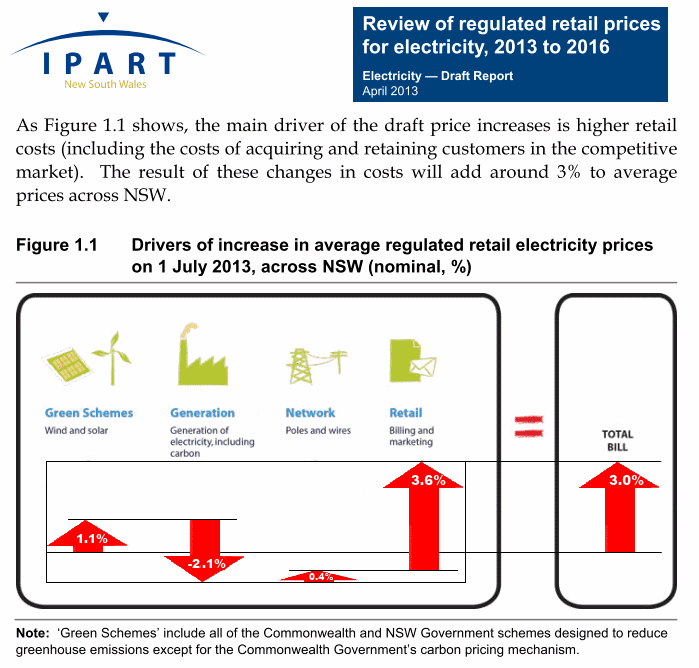
"NSW electricity bills will continue to show the cost of Labor’s carbon tax following the release of the Independent Pricing and Regulatory Tribunal’s (IPART) draft pricing determination that estimates the carbon tax and green schemes component will increase to $330 for the typical household bill.What Mr Hartcher conceals is that personal income tax cuts averaging $520 per year were made to cover the cost of the carbon price. The Federal Coalition has promised to remove these income tax cuts.
...
Energy Minister Chris Hartcher said that with the Government capping network price rises at CPI or below, the carbon tax and green schemes continue to drive up the price of electricity for NSW households.
“IPART estimates that NSW electricity bills would be $171 cheaper from 1 July if Labor scrapped its disastrous carbon tax,” Mr Hartcher said. "
|
| Regulated electricity prices NSW, July 2013 |
News blackout on carbon tax relief

|
| Plants - Nature's Solar Energy Collectors and Renewable Energy Stores |
| Date | Step |
|---|---|
| 17 Jul 2007 | The Prime Minister, John Howard, today committed his government to introducing an emissions trading scheme. Howard said the government would set a long-term emissions target in 2008. Read more ... |
| 08 Feb 2010 | Malcolm Turnbull said an Australian emissions trading scheme, with a carbon price set by the market, would improve business investment certainty. Market-based approaches have the potential to deliver least-cost abatement by providing incentives for firms to reduce emissions where this is cheapest, while allowing the continuation of emissions where they are most costly to reduce. This ETS allows Australian businesses to make their own decisions as to how to reduce their emissions. Government sets the rules and, in particular, sets the cap on total emissions and then lets the market work out the most efficient and effective outcome. Schemes where bureaucrats and politicians pick technologies and winners, doling out billions of taxpayers’ dollars, neither are economically efficient nor will be environmentally effective. For those reasons, I will be voting in favour of this legislation. Read more ... |
| 20 Aug 2010 | JULIA Gillard says she is prepared to legislate a carbon price in the next term. It will be part of a bold series of reforms that include school funding, education and health. In an election-eve interview with The Australian, the Prime Minister revealed she would view victory tomorrow as a mandate for a carbon price, provided the community was ready for this step. Read more ... |
| 15 Sep 2010 | The chief executive of Australia’s biggest electricity and gas retailer, AGL, on Wednesday called for the prompt introduction of an emissions trading system restricted only to the power generation sector. Read more ... |
| 16 Sep 2010 |
BHP boss Marius Kloppers: It's time for carbon tax Mr Kloppers's call for a carbon tax undermines the passionate objections of Tony Abbott to setting a price on carbon before there is a global consensus. "We do believe that such a global initiative will eventually come and, when it does, Australia will need to have acted ahead of it to maintain its competitiveness," Mr Kloppers told a packed Australian British Chamber of Commerce lunch in Sydney. Read more ... |
| 15 Nov 2010 | The Australian Government has asked the Productivity Commission to undertake a study on the effective carbon prices that result from emissions and energy reduction policies in place or committed in Australia and other key economies. Read more ... |
| 16 Feb 2011 | A "HYBRID" model of a fixed carbon price leading to an emissions trading scheme is likely to be agreed by the multi-party climate committee on Friday as the foundation for a new greenhouse reduction policy. Read more ... |
| 24 Feb 2011 | Australia will set a carbon price from July 1, 2012, as an interim measure until a full emissions trading scheme can be introduced ..., Prime Minister Julia Gillard says. But Ms Gillard said no decision had yet been made on what the price would be, ... "Every cent raised from pricing carbon will go to assisting households, helping businesses manage the transition and funding climate change programs," she said. Read more ... |
| 1 Mar 2011 | TONY Abbott has vowed to scrap Labor's carbon tax and oppose emissions trading if he wins the next election. However, he was undermined by former opposition leader Malcolm Turnbull, who yesterday said he still supported an emissions trading scheme. Read more ... |
| 11 May 2011 | THE energy retailer AGL has urged the Gillard government to stick to its July 2012 start date for putting a price on carbon. Despite fears that a carbon price could dramatically force up household power bills, AGL said many of these claims were erroneous, and the impact of the price rises could be offset by the types of electricity efficiency schemes already in place in NSW, Victoria and SA. Read more ... |
| 20 Mar 2013 | The UK Government is acting to give private investors the confidence to invest in the UK’s energy sector. From April 2013 the carbon price floor announced at Budget 2011 will come into effect, providing a clear and credible long-term signal to support investment in low carbon electricity generation. [The carbon price floor starts at £16 ($AUD23.30) per tonne and has a target price for carbon of £30 ($AUD43.75) per tonne of carbon dioxide in 2020.] Read more ... |
"Combined-cycle" gas power plants can reach efficiencies of 60% or more, compared to heat efficiencies of nuclear power plants of 35% or coal plants of 40%.
It gets even better than that. Gas-fired electricity generation is essentially non-polluting and user-friendly, and it can be placed in close proximity to wherever power is needed, making distributed generation economically feasible.
For example, a large apartment building of 1,000 units could use its own 10-megawatt power plant. But once installed, it becomes possible to consider co-generation, with the waste heat used for space heating, air-conditioning, hot water, laundry, and other process-heat applications -- and even desalination.
One can imagine energy efficiencies of as much as 80%, more than double what is achieved today. It would also simplify the problem of waste-heat disposal.
Cheap gas will encourage the petrochemical industry to invest $30 billion in new U.S. plants over the next five years, according to Chevron-Phillips Chemical Co. Plastics producers will get a double-boost -- from cheaper feedstock gas, the raw material for their product, and lower electricity costs. ...
So what needs to be done? The first step is to have a White House that strongly believes in the need for low-cost energy to promote economic growth, increase prosperity, and fight poverty. Electricity costs should "skyrocket" downward, not upward.
Coal-to-Gas is an Off-the-Shelf Energy Solution, by Frank Clemente.
Update 17 March 2014
The coal lobby has removed the web pages for "Coal Can Do That".
A cached copy of this article by Frank Clemente is available from Google - as it existed on 23 February 2014 - Coal-to-Gas is an Off-the-Shelf Energy Solution
Update 2 April 2014
The coal lobby has removed the cached copy of the web pages for "Coal Can Do That". You may still read a copy of the "Coal Can Do That" article "Coal-to-Gas is Off-the-Shelf Energy Solution" from February 2009 by Dr. Frank Clemente.
Substitute natural gas (SNG), the product of a coal-to-gas process, is an established technology that has been around for a century and is currently in use throughout the world.
Substitute natural gas technology produces pipeline quality natural gas equivalents that can be used to fuel power plants, heat homes and manufacture a wide range of goods.
It removes 95% of the mercury and virtually 100% of the sulfur. The captured sulfur can be used to make fertilizer.
It provides fuel for the hundreds of natural gas power plants, ...boosts the economy of local communities and provides well paying jobs. A planned Muhlenberg County substitute natural gas state-of-the-art facility in Kentucky, for example, will create 1,200 construction jobs for four years, 500 permanent jobs and pump over $100 million into the economy of host Muhlenberg County and surrounding communities.
On Tuesday, March 27 2012, the U.S. Environmental Protection Agency (EPA) announced new performance standards limiting carbon dioxide emissions from power plants. The standard, which applies only to new power plants, limits CO2 emissions to 1,000 lbs (454 kilograms) per megawatt-hour (kg CO2/MWh).
The proposed rule is significant because it would be the first explicit limit on CO2 emissions in the United States. It effectively brings to an end new construction of conventional coal-fired power plants, which cannot meet the standard.
Typically, new coal plants generate about 1,800 lb (815 kg) CO2/MWh (or between 1,600 to 1,900 lb (725 to 860 kg) CO2/MWh). This means any new coal plants will have to adopt new technologies to reduce emissions, namely carbon capture and storage (CCS).
Natural gas plants, on the other hand, emit around 800-850 lb (360-385 kg) CO2/MWh, well within the standard.
In fact, the EPA based the emission limit on “the performance of widely used natural gas combined cycle (NGCC) technology” and predicts that NGCC will be the predominant choice in new fossil-fuel powered electricity generation.

|
| Figure 10. Deaths between 26 Jan and 1 Feb: Mean deaths in 2004–08 vs 2009 |
"There is no reason for developing countries to burden themselves with out-dated power generation technology that is a great handicap to developed countries."

|
| This Garrett portable steam engine was made in England in 1923 |
According to the IEA report, developing nations will largely drive future coal growth. China and India combined are expected to account for more than 90 percent of the increase in global coal use over the next five years.
The IEA report–like WRI’s recent coal analysis–offers troubling projections of an increasingly coal-dependent future. Energy producers need to decide–soon–if they are going to lock-into this course or opt for a lower-carbon future. (New Coal Report Underscores The Urgent Need For Global Clean Energy Development, Ailun Yang | December 20, 2012)
and
Mr Clegg, the Deputy Prime Minister, blamed China and other developing countries, that have huge reserves of coal and want to continue using fossil fuels to grow, for failing to back plans for the green economy. (Rio+20: Nick Clegg blames China for 'disappointing text', Louise Gray | June 21, 2012)
China Increases Asbestos Restrictions by Laurie Kazan-Allen, International Ban Asbestos Secretariat
China adopted a new industry standard in November 2010 prohibiting the use of asbestos in siding and wall materials for construction. This follows China banning the use of asbestos in automotive friction materials in 2003 and its banning in 2005 of the import and export of amphibole asbestos, including amosite and crocidolite. (Read more ...)
Defence, pollution to dominate Chinese parliament by Stephen McDonell, ABC News
In the run up to this congress, pollution has been a major issue for everyday Chinese citizens.
Air quality in the Chinese capital, Beijing, seems to be deteriorating again after some improvements following the 2008 Olympics. (Read more ...)

|
| Coal / Biomass conversion to Substitute Natural Gas by Greatpoint Energy process |
...climate change 'has little to do with the state of the environment and much to do with shackling capitalism and transforming the American way of life in the interests of global wealth redistribution.' "Larry Bell also wrote "U.S. Policies And Economic Doldrums Fuel Chinese Energy and Tech Grabs" in which he laments even greater challenges to the way of life of American coal magnates:
"Government regulatory actions, a weakening dollar, and an ailing economy, are providing bargain asset shopping opportunities for Chinese investors. ...
State-owned Export-Import Bank of China is likely to become the sole lender for a 400-megawatt “clean coal” power plant near Odessa, Texas to be developed by the Seattle-based Summit Power Group, LLC. Construction of the $2.5 billion project will be managed by Sinopec, the China Petroleum and Chemical Company. ...
The Texas deal applies a tried-and-true Chinese model: providing competitive financing through a state-owned bank…then negotiating participation for other state-owned companies.
Synthesis Energy Systems of Houston which holds a license for a coal gasification process that upgrades efficiency of low-quality coals while reducing toxic emissions, recently got an $84 million investment from Zhongjixuan Investment Management ( ZJX) of Beijing in exchange for 43 percent ownership in the company. Synthesis President Robert W. Rigdon has admitted awareness of the history of Chinese companies use of foreign technology without regard to patents ..."

"World Resources Institute identifies 1,200 coal power plants in planning across 59 countries, with about three-quarters in China and India.
...New coal power plants have largely been financed by both commercial banks and development banks. JP Morgan Chase has provided more than $16.5bn for new coal plants over the past six years, followed by Citi ($13.8bn). Barclays ($11.5bn) comes in as the fifth biggest coal backer and the Royal Bank of Scotland ($10.9bn) as the seventh.
The Japan Bank for International Co-operation was the biggest development bank ($8.1bn), with the World Bank ($5.3bn) second."
"Coal producers across the nation have been wounded by a sharp drop in demand in the United States — down 16.3 percent in the period from April through June, compared with the same period in 2011, to the lowest quarterly level since 2005...
That has made coal exports, which have increased this year in every region of the country except the West, according to federal figures, even more crucial to the industry than they were when the six terminals on the Pacific Coast were first proposed.
Jason Hayes, a spokesman for the American Coal Council, said that with coal-producing nations like Australia and Indonesia competing for Asian markets, a roadblock on the West Coast is an issue for the entire American economy. "
"The pressure to send more coal on trains through British Columbia's Lower Mainland is coming because the U.S. coal industry needs to tap new markets in Asia but has run into serious opposition in northwestern states.
Eric de Place, a researcher with the Seattle-based Sightline Institute, said six large coal export terminals have been proposed in Washington or Oregon but activist opposition has already killed one of them.
"There's something like an insurrection going on in Oregon and Washington," he said. "People are extremely angry."
The world's biggest coal producers are in the eastern U.S., de Place said, while the biggest consumers are in Asia.
"The road between those two goes through Washington and British Columbia," he said, noting domestic U.S. coal demand has sagged as U.S. buyers shift to cleaner energy sources."
