Latest Buzz...
                  

Translate

Showing posts with label Fuel Cells. Show all posts

Wednesday, March 4, 2020

Japanese clean coal project


JAPANESE ‘CLEAN COAL’ DEMONSTRATION PROJECT TAKES A STEP FURTHER

By Tetsuo Satoh | 

Construction has begun on the third step of a project to demonstrate the world’s first integrated coal-gasification fuel-cell (IGFC) combined cycle power plant with CO2 capture. The five-year, $73.3-million project is a collaboration of the New Energy and Industrial Technology Development Organization (NEDO; Kawasaki City; www.nedo.go.jp) and Osaki CoolGen Corp. (Hiroshima Prefecture, both Japan; www.osaki-coolgen.jp). IGFC technology has the potential to reach a 55% thermal efficiency (higher heating value; HHV).
The IGFC demonstration project is composed of three steps (diagram): (1) the demonstration of oxygen-blown integrated coal-gasification combined-cycle (O2-blown IGCC), which was completed in March 2019; (2) the demonstration of O2 -blown IGCC with CO2 separation and capture, which started in December 2019; and (3) the demonstration of IGFC with CO2 separation and capture.
clean coal
For the first step, a 170,000 kW-class demonstration test facility was constructed within the grounds of the Osaki Power Station of The Chugoku Electric Power Co. During the demonstration tests, coal particles were used to operate a 1,300°C-class gas turbine, while using the heat generated to operate a steam turbine for combined-cycle power generation. The performance, operability, reliability, and economic feasibility as a coal-fired power generation system was verified. The targeted thermal efficiency of 40.5% HHV was achieved for an O2-blown IGCC using a 100°C-class gas turbine. They are forecasting a net thermal efficiency of approximately 46% will be achieved for a commercial plant that uses a 1,500°C-class gas turbine. Based on these results, they are expecting to reduce CO2 emissions by about 15% compared to ultra-supercritical (USC) pressure pulverized-coal-fired power generation.
To demonstrate the second step, construction work on the CO2-capture unit was completed last summer, and testing started in December 2019 and will continue through 2020. Meanwhile, construction has also begun on the third step, in which the fuel cell will be added to the O2-blown IGCC to demonstrate the complete IGFC with CO2 capture, which should begin late 2021 and run through 2022. Ultimately, the project aims to achieve a net thermal efficiency of approximately 47%, while capturing 90% of the CO2, and a 40% of transmission end efficiency when applied to a 500-MW-class commercial unit.

Wednesday, July 18, 2018

Australian energy exports

Japan intends to establish a "hydrogen pipeline" to replace its existing imports of energy from Australia and elsewhere.
Hydrogen is the key to energy security and the fight against global warming

To speed up the development of a "hydrogen pipeline" for Japan, Australia may be able to adapt existing energy infrastructure for the purpose.

Hydrogen produced by renewable energy creates a number of challenges for special-purpose overland transport and shipping. An interim processing strategy can skip over these challenges and re-use existing infrastructure, saving time and money. A little chemistry explains how this can work...

When hydrogen is combined with carbon dioxide to form methane and water, the energy content in the methane is about the same as the energy that was present in just the hydrogen:

CO2 + 4H2 → CH4 + 2H2O

In the above reaction half of the hydrogen combines with oxygen from the carbon dioxide to form water. The other half of the hydrogen combines with the carbon from the carbon dioxide to form methane. This is known as the "Sabatier reaction". It is used commercially by Audi to create "e-gas" for its Compressed Natural Gas vehicles.


Natural gas is essentially methane with smaller amounts of other gases such as carbon monoxide and ethane. Methane made from hydrogen can be transported through natural gas pipelines and shipped as LNG - liquefied natural gas - from Australia to Japan using existing LNG terminals and LNG tankers.

When methane is combined with water to form hydrogen and carbon dioxide, the energy content in the hydrogen is about the same as the energy that was present in just the methane:

CH4 + 2H2O → 4H2 + CO2

In the above reaction oxygen from the water combines with carbon from the methane to form carbon dioxide. All the hydrogen that was part of both the methane and water is separated. This is known as "Steam Methane Reforming". It is widely used in industry to manufacture hydrogen from natural gas.


The carbon dioxide produced in the above reaction may be liquefied in Japan and returned to Australia on the empty LNG ships that delivered the methane.

This allows the carbon dioxide to be re-used indefinitely in Australia to convert hydrogen to methane for shipping to Japan using existing natural gas pipelines, LNG terminals and tankers.


Monday, January 18, 2016

Power stations, Engines, Air Conditioners Fuels Cells, Batteries and more

Innovative design can be spurred by scientific understanding of energy storage and transformation.

This diagram represents current scientific understanding of how energy may be stored and transformed.
Power stations, Engines, Air Conditioners Fuels Cells, Batteries and more

A power station can theoretically convert 10,000 joules of thermal energy at 1200 degrees Kelvin into 7,500 joules of electrical energy and 2,500 joules of thermal energy at 300 degrees Kelvin.

It is also theoretically possible to decompose some chemical compound into its constituent elements with 10,000 joules of thermal energy at 1200 degrees Kelvin and produce 7,500 joules of electrical energy and 2,500 joules of thermal energy at 300 degrees Kelvin in a fuel cell that recombines those elements into the original chemical compound.

If it is cheaper and more reliable to construct a machine that operates at a temperature of just 900 degrees Kelvin instead of 1200 degrees Kelvin, then this machine could theoretically decompose the chemical compound into its constituent elements with 2,500 joules of electrical energy and 7,500 joules of thermal energy at 900 degrees Kelvin.

It is not necessary to view batteries as the only type of device that can store electrical energy:
At some later time the decomposed elements could be used to produce 7,500 joules of electrical energy and 2,500 joules of thermal energy at 300 degrees Kelvin in a fuel cell that recombines those elements into the original chemical compound.
The graph above is a representation of scientific knowledge from which these observations can be made.

Mathematics permits this simple geometric model to be created from three separate scientific models:
  • Carnot's equation for efficiency of heat engines.
  • Nernst's equation for electrochemical reactions.
  • Gibbs-Helmholtz's equation for chemical reactions.


Saturday, October 3, 2015

Planning to phase-out fossil fuels in Australia

Australia has over-invested in electricity generation and distribution infrastructure. It has not invested adequately in building strategic reserves of transport fuels.

"One version of electric vehicles might use a battery for short trips and activate a hydrogen fuel cell on longer trips after the battery charge is depleted." A plan for transitioning the economy to zero reliance on fossil fuels could take advantage of the first of these issues and overcome the second issue at the same time. The plan would increase the use of electricity generation and distribution that is presently not being effectively used for the benefit of the economy and reduce the reliance on transport fuels for which there are inadequate strategic reserves.

The transition from leaded to unleaded transport fuels begun in 1981 with a target end-date of 2002 is a good example of how the adoption of a long-term policy simplifies the making of investment decisions of stakeholders for new plant and equipment.

Vehicle manufacturers at present face considerable uncertainty in predicting which of the emerging clean fuel transport systems will win out in the long run.
Fuel cell electric vehicle with battery for short trips

Adopting a policy for the introduction of electric vehicles would reduce that uncertainy. Allowance can still be made for competing technologies that are quickly evolving. Fuel cells for instance that produce electric power from, say, hydrogen, are not that dissimilar from batteries that store and recharge electrolyte in situ. Vehicles using either, or both, of these energy supply systems would be powered by electric motors regardless of which these two evolving technologies provides the electricity. One version of electric vehicles might use a battery for short trips and activate a hydrogen fuel cell on longer trips after the battery charge is depleted.

Both renewable and fossil fuel investments for generating and distributing electricity can be utilised at close to full capacity to provide electricity for recharging electric battery powered vehicles.

Both of these investments can also be used to manufacture hydrogen for fuel-cell powered electric vehicles.

This plan would encourage continuing expansion and technological advances in renewable energy without the need to immediately write off substantial capital invested in fossil fuel power plants.

It would give this existing investment (or excess investment) in fossil fuel plants both an extended life and a definite expiry date. Rather than keeping them running at partial capacity to supply a diminishing share of fixed energy needs, they could begin to take over demand for transport fuels. The expiry date for these power plants would be extended to the date by which ongoing investments in renewable energy are planned to take over 100 percent of both fixed energy and transport energy needs of the Australian economy.

Update, 29 February 2016

Budget savings of $150 billion by eliminating dependence on imported transport fuel

The Australian Government's 2016 defence white paper reveals the economic impact of relying on imported transport fuel.

THE cost of Australia's new fleet of submarines could blow out to $150 billion after the defence white paper confirmed the price tag. 

The strategic importance of this military hardware is explained in a number of documents. This is a typical example:

ASPI Future Submarine Conference
The Role of Submarines in a Maritime Strategy
VADM Ray Griggs, Chief of Navy
9 April 2014
"Good Morning Minister for Defence, Senator the Honourable David Johnston, Mr Stephen Loosley, Mr Peter Jennings, Former Chiefs of Navy, Ladies and Gentlemen. I’m delighted to be able to speak to you about submarines in Australia’s maritime strategy.

My intention today is to provide as objective a view as possible of the strategic rationale for submarines in Australia’s defence forces. More than anyone else, I understand it’s about much more than the platform but I do want to focus on the role of the platform because, let’s not kid ourselves, along with the people, the platform is the key component in the capability.


The recent NRMA Study on Australia’s liquid fuel security is for me a significant case in point. Who here is really comfortable that a serious interruption to our liquid fuel supplies to this country would, within a month, have significant impacts on our economy and society?

That is why Navy’s contribution to the effective operation of the maritime global trading system is so important. Those contributions are needed around the system, not just in a tight set of concentric rings drawn around Darwin. These contributions are more sophisticated than traditional notions of SLOC protection and that is something we need to explore. So, as we discuss the role of submarines in our national maritime strategy, it’s important to keep in mind the stakes we are considering."


From a paper by Troy Whitford, Fuel Mandates have a History of Success and a Lesson for Bio Fuels Implementation. Australian Policy and History, April 2010.
URL: http://aph.org.au/fuel-mandates-have-a-history-of-success-and-a-lesson-for-bio-fuels-implementation/
"In 1981, Australian state and federal transport ministers met to address pollution problems. Driving the shift towards unleaded petrol were vast environmental and health concerns.

During the 1980s, automobile associations were critical of the introduction of unleaded fuel. The RACV opposed the implementation believing it was too costly. The oil industry was cynical, too, arguing the introduction of unleaded fuel did not follow from a technological breakthrough but rather a decision by ministers. Without doubt, the position taken by oil companies, automobile associations and other stakeholders regarding unleaded fuel changed over time.

Despite opposition to unleaded fuel, the Transportation Council adopted a program to mandate unleaded petrol by 1985. The implementation policy for unleaded fuel was undertaken in stages. Initially, regulations were made calling for all new motor vehicles made after January 1986 (manufactured within Australia or imported) to meet the new fuel requirements. The policy then called for a complete phase out of leaded fuel by 2002. Prior to the national mandate, states had led the way on unleaded fuel of which NSW took the lead. The decision to mandate was essential for implementing unleaded fuel. It forced car manufacturers, oil producers and consumers to make the transition."

Wednesday, March 13, 2013

Energy All-Star Awards Winners

All Star Energy Award Winners and Thank You
 
    Energy All-Star Awards Winners and Thank You!


Thank You!

A big thank you to everyone who contributed, supported, and attended our 2013 Summer Study.

To our 320 attendees, we hope you found the event relaxing, informative, and valuable.

To our panel leaders and speakers, thank you for your contributions to our sessions and for sharing your insight and knowledge.

To our sponsors and supporters, we could not have done it without you.

We are already looking forward to planning the 2014 Summer Study to be held in Melbourne!


Congratulations to the Energy All-Star Awards Winners

Thank you to the Hon. Yvette D’Ath, Parliamentary Secretary for Climate Change and Energy Efficiency (pictured below with the Award Winners) and The Chaser’s Craig Reucassel for speaking at and presenting this year’s Energy All-Star Awards. It was evening to remember, even more so for our Energy All-Star Awards Winners:

Energy Efficiency All Star Winner: Rod Sheppard, Carbon Reduction Industries 

Rod won for his dedication and passion in striving for a more sustainable and energy efficient future,  and more specifically, his product, the EcoSwitch (www.ecoswitch.com.au).The EcoSwitch has been used to reduce standby power in thousands of households, businesses and educational institutions across Australia helping 'average' people to reduce their carbon footprint and also for the savings on electricity bills!
While the EcoSwitch has gone on to win many awards for it's simplicity and innovation, Rod himself remains an unsung hero. He has persevered in taking the product to market (despite the many challenges) and his belief in real-world sustainable change is an inspiration.


Peak Demand Management All Star Winner
: Mark Lendich, Energex  

Mark set up the Energex Energy Conservation and Demand Management group for Energex, which is delivering the largest Demand Management program in Australia. The program delivers services to both residential as well as commercial and industrial customers and is well ahead of our targets.


Distributed Generation All Star Winner
: Ric Brazzale, Green Energy Trading  

Ric won for his unwavering commitment to reducing Australia's greenhouse gases by employing distributed generation as a methodology. Not only does he talk the talk, but walks the walk. After forming and leading the Australian Business Council for Sustainable Energy (now known as the Clean Energy Council), Ric used his depth of knowledge and business acumen to build a substantial group of businesses' concentrated on distributed generation/energy efficiency. He deserves recognition from his peers as a fierce advocate for the uptake of distributed generation in this country.


Joint Rising Stars Winners
: Nicky Ison (pictured) and Jarra Hicks, Community Power Agency  

Nicky and Jarra are the co-founders of the ground-breaking Community Power Agency (CPA). Both have strong backgrounds in advocacy for a sustainable energy future.

CPA was established to grow the community renewables sector in Australia. CPA aims to ‘decarbonise, decentralise and democratise’ the energy system, based on the premise that an energy revolution must encompass social and political concerns. To set up CPA, both Nicky and Jarra undertook self funded study tours of community renewable energy projects around the world.

CPA works with communities around Australia to set up renewable energy projects, and has created a consortium (government, community renewables developers, research institutions, NGOs and community groups) to explore and address the systemic barriers to such projects in Australia. CPA’s advocacy was also instrumental in establishing the recently announced NSW Government funding program for community renewable projects.


Congratulations to Meg Argyriou - Winner of trip to ECEEE Summer Study in the French Riviera

Meg (of ClimateWorks) was the lucky Summer Study delegate to win a trip to attend the 2013 European Council for an Energy Efficient Economy Summer Study at Belambra Les Criques, France! Congrats, Meg! We wish we could join you!  


Coming Soon: Summer Study presentations, videos, and photos!


We will soon have the presentations and select video and photos from the Summer Study on the website for you to enjoy and refer to. In the meantime, here are a few photos to start with:


The 2nd A2SE Summer Study on Energy Efficiency and Decentralised Energy was a not for profit event
run by the Australian Alliance to Save Energy (A2SE).  The A2SE is an independent, not-for-profit coalition of business, government and environmental leaders. It supports the widespread introduction of the world’s best practices and technologies in energy efficiency. The organisation informs public and policy discussions on energy efficiency, demand management, environmental protection and sustainability through high quality, unbiased research. A2SE’s key research partner is the Institute for Sustainable Futures at the University of Technology, Sydney, and it has established links with global leaders in energy efficiency and decentralised energy including The American Council for an Energy Efficient Future, The Alliance to Save Energy (USA), The Energy Saving Trust (UK), The World Alliance for Decentralised Energy (WADE), European Alliance to Save Energy, the European Council for an Energy Efficient Economy and the Alliance for an Energy Efficient Economy (India).
www.a2se.org.au

The Clean Energy Council is the peak body representing Australia’s clean energy and energy efficiency sector. It is an industry association that provides a unified voice for over 550 member companies involved in the development or deployment of technologies such as solar, wind, geothermal, hydro, wave, bioenergy, cogeneration, storage and energy efficiency.  The Clean Energy Council provides a variety of services to members but its primary role is to develop and advocate effective policy to accelerate the development and deployment of all clean energy technologies. The council also promotes awareness of the industry, thought leadership and clean energy business opportunities through industry events, meetings, newsletters, directorates and the media.  For more information visit www.cleanenergycouncil.org.au

Follow A2SE on Twitter

The Australian Alliance to Save Energy,
Level 11, UTS Building 10, 235 Jones St, Ultimo, NSW, 2007,
Ph: 02 9514 2044

Saturday, March 9, 2013

Australian energy innovation jobs

The UltraBattery™, developed by CSIRO Energy Technology in Australia

The UltraBattery™ in a hybrid electric vehicle is able to deliver and absorb charge rapidly during vehicle acceleration and regenerative braking, respectively. In wind turbine applications it can also absorb the noise generated by the variation in wind speed, delivering a smooth power output.
Australia energy innovation jobs

For both advanced automotive applications, and grid-connected wind energy applications, UltraBattery™ has shown excellent performance and has the potential to remarkably improve the economic viability, and therefore the 'uptake rate' of HEVs and better utilisation of renewable energy. This, in turn, will reduce the global consumption of fossil fuels and the production of greenhouse gas emissions.

The UltraBattery™ technology has been licensed to the Furukawa Battery Co., Ltd, Japan and the East Penn Manufacturing Co., Inc., USA.

Ceramic Fuel Cells Ltd, the name behind BlueGen


Formed in 1992 in Australia from the CSIRO and a number of industry consortium partners, Ceramic Fuel Cells Ltd.  (CFCL) is now leading the world in the development of fuel cell technology for stationary power generation.

CFCL has made a significant investment in its future manufacturing capabilities with a € 9.5 million fuel cell assembly plant in Heinsberg, Germany and a ceramic powder plant in Bromborough, United Kingdom.


University of New South Wales, Sydney, Australia (UNSW) - Photovoltaic Engineering

Photovoltaic companies linked with UNSW-developed technology form an amazing 4 of the top 6 manufacturers in 2010.
Suntech was the first of the UNSW-linked photovoltaic companies to commence production in China.
It claimed the number 1 position in the rapidly expanding market with close to 1.6 GW of photovoltaic product manufactured during the year.
Number 2 on the list of manufacturers with over 1.4 GW produced in 2010 was JA Solar.
Number 4 on the list was Trina Solar with 1.1 GW produced.
Number 6 on the list and another member of the “gigawatt” club with just over 1 GW produced in 2010 was Yingli Green Energy Holding.


Suntech manufacturing sites, located in China, Japan and the United States, follow the strictest production guidelines and are staffed by highly-trained manufacturing experts.
JA Solar designs, manufactures, and sells monocrystalline and polycrystalline silicon solar cells primarily in China. It also sells the solar cells it produces to solar module manufacturers in Germany, Sweden, Spain, South Korea, and the United States.
Trina Solar is based in Changzhou, China.
Yingli Green Energy production facilities are located at Baoding, Haikou, Tianjin and Hengshui in China.

University of New South Wales, Sydney, Australia (UNSW) - Vanadium Redox Flow Batteries

The original vanadium battery patents were bought by an Australian company in 1998, which sold them to a Canadian company.
They were subsequently acquired by Prudent Energy in a firesale during the global financial crisis. Prudent started out as a Chinese company but is now based in US and has secured a huge amount of investment from venture capital companies and the US government stimulus package.

Prudent Energy, is the designer, manufacturer, and integrator of the patented Vanadium Redox Battery Energy Storage System (VRB-ESS®) – a large-capacity energy storage system delivering high performance with low operating costs. Founded in 2007, the Prudent Energy group of companies maintains corporate offices in Bethesda, Maryland in the United States and Beijing, China, with research, development, and assembly facilities in the United States, Canada and Asia.

Tuesday, June 12, 2012

Look Mr Abbott-No Carbon Tax

Look Mr Abbott-No Carbon Tax For My Business

VitoBloc CHP unit Module EM-401/549
VitoBloc CHP unit
Module EM-401/549
Tony Abbott visited another Australian business, Aaron's Linen Service, today Tuesday June 12, 2012 and declared the carbon tax would put it under more pressure:
Liberal Chicken Little - Tony Abbott's fear campaign It’s great to be here at Aaron’s Linen Service. I want to thank Vic Stolar and his family for making Bert van Manen and myself so welcome. This is one of the thousands and thousands of businesses right around Australia that is nervously waiting for the carbon tax.

Vic’s business has got a power, gas and electricity, bill of about $1.2 million every year that’s going to go up and up and up - $120,000 just for starters - and that makes it so much harder to employ people. There are about 120 people working here in this factory and laundry.
Liberal Chicken Little
Tony Abbott's fear campaign

Estimate of energy requirement: $120,000 carbon tax for CO2 emissions priced at $23 per tonne implies emissions of about 5,200 tonnes per year.

Allowing about 800 kilograms of CO2 per megawatt-hour implies energy use of about 6,500 megawatt-hours per year.

This is equal to continuous energy use of 750 kilowatt-hours every hour, 24 hours per day, 7 day per week, 365 days per year. Note that some energy is required as electricity and some as heat.


 Using this figure of 750 kilowatt-hours every hour as an indicative guide for in-house power generation, a VitoBloc CHP unit Module EM-401/549 is about the right size.

By generating power in-house the high-cost Australian electricity distribution grid is avoided. This represents the greatest saving. This saving is perhaps 25-40 percent of the $1.2 million annual power bill.

As an added bonus, total emissions will be less than 25,000 tonnes of carbon dioxide per year. As a result NO carbon tax will be payable. This is a further saving of 100 percent of the estimated carbon tax of $120,000 per year.

Coopers Brewery's Cogeneration Plant

Most of Coopers Brewery’s electricity and steam requirements are drawn from a 4.4 megawatt (MW) natural gas-powered co-generation plant located on site. (Source: Generating Smarter Energy)

The co-generation plant was built in 2002 in partnership with AGL, as part of a 20-year energy supply agreement. A dedicated 4 km natural gas supply line was also negotiated to supply the necessary gas at high pressure, which is burned in a gas turbine to drive the electrical generator. Waste heat from the gas turbine is harnessed to produce steam used in the brewing process.

Eighty percent of the fossil fuel energy is converted in the co-generation plant into useful energy of power and steam, approximately 2.5 times greater than a conventional coal-fired power station. This has reduced carbon dioxide emissions by up to 15,000 tonnes per annum compared with using grid electricity and conventional gas-fired boilers.

While the co-generation plant produces 24,000 megawatt hours (MWh) of power per year, the brewery itself only uses about 6,500 MWh. The excess power is fed into the South Australian power grid through a high voltage underground power line.

The plant also generates 50,000 tonnes of steam a year, used for heating in the brewing, evaporation and packaging processes. Steam was previously generated at the brewery by standalone gas fired boilers.

An absorption chiller unit has also been installed, which uses surplus steam from the cogeneration plant to produce chilled water for brewing.

Look Mr Abbott-No Carbon Tax For My Home -
Ceramic Fuel Cell's BlueGen

Ceramic Fuel Cells developed BlueGen, a biomethane or natural gas driven generator that small enterprises and households can buy and install that silently generates electricity and hot water at a cost way under the majors. You can imagine how much opposition the incumbents have created when faced with this threat. (Source: Lights on for an energy minnow)

BlueGen CHP unit garage installation
Ceramic Fuel Cell’s BlueGen micro combined heat and power (mCHP) unit
Garage installation

It’s not often that a small Australian company gets to look at an enormous market and find it is the leading global player. Overseas institutions, a few individuals and Australian self-managed funds are its main shareholders. No large Australian institution is involved.

US based giant – the $4 billion capitalised Jabil – believes this is a product that, one way or another, is going to be manufactured on a massive global scale.

Update Tuesday, June 19, 2012

The BlueGen product uses ceramic fuel cells to turn natural gas into electricity and heat for hot water.
The units generate electricity with the highest electrical efficiency of any small scale generating technology in the world, reducing energy bills and cutting carbon emissions. (Source: BlueGen units to be used in Virtual Power Plant Project in The Netherlands)

Monday, May 21, 2012

Fuel Cells Feed in Tariff

Victorian Government review supports feed in tariffs for fuel cells 

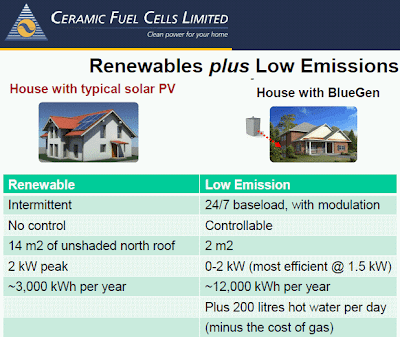
Fuel Cells - Renewables plus Low Emissions

Ceramic Fuel Cells Limited (AIM / ASX: CFU) – a leading developer of high efficiency and low emission electricity generation products for homes and other buildings – is pleased to announce that the Victorian Competition and Efficiency Commission (VCEC) has recommended that feed in tariffs be extended to include small scale low emissions generators like fuel cells.

The draft report by VCEC, released on Friday 18 May, recommends that Victoria’s solar PV feed in tariff be broadened to include all low-emissions and renewable technologies, with a requirement that electricity retailers must offer a wholesale price based feed in tariff for distributed generation of 100 kilowatts or less.

Feed-in tariffs are payments to distributed generators for electricity generated at their premises and fed back into the power grid. VCEC recommends that the feed in tariff be based on the wholesale price for electricity.

Fuel Cells - Displace coal-fired power
A report commissioned by VCEC notes that this value varies depending on time, location, and the type of generation technology. The report estimates that currently this value is approximately seven cents per kilowatt hour.

Ceramic Fuel Cells’ BlueGen gas to electricity generator would be eligible for this feed in tariff, making Victoria the first State in Australia to provide a feed in tariff for fuel cells. BlueGen customers already receive feed in tariffs in Germany and the United Kingdom.

The VCEC draft report adopts several recommendations made by Ceramic Fuel Cells in our submission and consultation with VCEC, including:

  • Extending the standard feed in tariff regime to include small scale low emissions technologies;
  • Defining ‘small scale’ as 100 kilowatts or less;
  • Defining ‘low emission’ as 50 percent or lower than the emissions intensity of the national electricity network;
  • Simplifying the process for connecting small scale generators to the power grid.

Read the full CFCL Market Announcement ...

Read the related Fuel Cell post  Cell company fuelling feed-in tariff debate ...

Saturday, July 9, 2011

Cell company fuelling feed-in tariff debate

By Victoria Bruce
As Australia's carbon debate heats up, one company says it has a solution to offset growing energy demands.

Ceramic Fuel Cells group general manager Andrew Neilson says a box the size of a bar fridge could save up to 75 per cent of household power bills and significantly reduce carbon emissions.

The Melbourne company's BlueGen fuel cell unit converts natural gas and renewable fuels into power and heat.

Ceramic Fuel Cells supplies to governments and energy companies in Australia and overseas, including Germany, France, Britain, Japan and the United States.

In Germany, one of the company's biggest customers, utility firms supply the BlueGen unit free of charge to households, which then pay for the natural gas they use.

In Australia, solar energy technology can be connected to energy grids and owners paid a feed-in tariff. This isn't allowed for fuel cell technologies.

Mr Neilson says this restriction makes it difficult to crack the residential market in Australia.

"It's something we're lobbying the state governments about at the moment. So far, we've seen lots of nodding heads, but no action."

Mr Neilson says a carbon tax will encourage the switch to gas as grid electricity becomes more expensive. "It will become more economically attractive to make the switch away from grid power towards other sources.

And it does this with the highest electrical efficiency of any generating technology in the world."

Ceramic Fuel Cells has called for reviews of feed-in tariffs in NSW and Victoria to extend to low-emission technologies such as fuel cells.

Meanwhile, Mr Neilson said the company was focussing on exports.

The CSIRO says a two-kilowatt BlueGen unit, currently retailing at $45,000, can save up to 33 tonnes of carbon dioxide a year when replacing power derived from brown coal.

Ceramic Fuel Cells recently won a contract to supply 25 BlueGen units to Ausgrid for installation in Australia's largest grid project, based in Newcastle.

Other domestic customers included the Victorian Government, Adelaide City Council and Canberra Institute of Technology.

Ceramic Fuel Cells began selling BlueGen units in May 2009, and posted a loss of $8.4 million for the six months to last December 31, due to a 37 per cent drop in sales revenue and the impact of a stronger Australian dollar.

"We're in the process of starting to ramp up sales and that will deliver revenue to get us cash-flow positive and then ultimately profitable," Mr Neilson says.
AAP