Latest Buzz...
                  

Translate

Showing posts with label Agenda 21. Show all posts

Monday, April 1, 2013

Old plays won't save coal but a carbon tax could

Attempts to access this story had been unsuccessful throughout April. 
(Error message: Oops! Google Chrome could not find www.kentucky.com)
The original can be accessed (on May 3, 2013): Old plays won't save coal but a carbon tax could

The cached copy is reproduced below -

Published: March 31, 2013 Updated 6 hours ago


Bob Inglis, who directs the Energy and Enterprise Initiative, is a former Republican member of Congress from South Carolina.
Bob Inglis, who directs the Energy and Enterprise Initiative,
is a former Republican member of Congress
from South Carolina.


Coal built our economy but its future is grim — unless we find an alternative to EPA regulation of heat-trapping gases like CO². If we can clean it up, coal can be a useful resource for years to come. If we can't, it will ultimately become much less valuable.

Strange as it may sound, that's why the CEO of one of the world's largest coal companies is in favor of a carbon tax. Marius Kloppers figures that BHP Billiton has hundreds of years of coal in the ground in Australia. The problem is that his biggest customer, China, may tire of breathing dirty air. If they do and if the Chinese innovate around coal, BHP's inventory could be reduced to a 20- or 30-year salable commodity. So BHP wants to push coal up the technology curve.

Some U.S. coal companies are also investing in the long-term viability of America's most abundant energy resource. They're rightly asking for and are conducting research on carbon capture and sequestration (CCS). If CCS could be combined with coal gasification technologies, it's possible that water vapor would be the only emission from coal-fired plants. That's a bold future — the kind of future that CEOs like Kloppers want to bring about.

The standard play is to try to slow the inevitable. And nowhere is it more standard than in Washington, D.C. The Environmental Protection Agency is under orders from the Supreme Court to regulate CO² as a pollutant under the Clean Air Act. The EPA has drafted CO² regulations for new coal plants. Soon, EPA plans to regulate CO² from existing coal plants. When it does, coal will lose, quickly, to competitors like natural gas. This regulatory scenario gives coal no time to innovate.

The standard line from coal state representatives is, "Let's get together and try to stop those regulations." It's the same play textile states attempted when the rest of the country decided it liked cheaper, imported clothes. It's the same play tobacco states tried when the rest of the county decided to quit subsidizing smoking.
When something becomes inevitable — like the pricing of carbon — there's little to be gained from simply slowing government regulation. Endless litigation and aggressive congressional oversight may delay the onset of regulations but, like textiles and tobacco, the writing's on the wall.

Bluster may provide some cover to elected officials representing coal-dependent constituents, but it won't secure their constituents' future. Coal needs a different series of plays.

For coal, the right kind of CO² tax would be far better than pending CO² regulation. A well-planned and fair carbon tax would give coal time — time to try CCS, time for domestic users of coal-fired power to continue manufacturing here rather than moving production to non-CO² regulated countries, and time to continue exporting coal, tax-free.

The very different play for coal might look like this: Tax carbon upstream at the mine and at the pipeline. Pair that new carbon tax with a dollar-for-dollar reduction in other taxes so we don't grow the government and families have more money to cope with higher energy prices. Repeal Clean Air Act regulations that would be made redundant by the price on carbon. Make the new carbon tax border-adjustable so that it's removed on exports and imposed on imports.

The border-adjustable feature is critical in two ways. First, coal from the U.S. wouldn't be priced out of foreign markets because the U.S. carbon tax would be removed on export. Second, manufacturers who use coal-fired power in the U.S. would have level CO² costs with their foreign competitors. CO² pricing here wouldn't cause them to move their factories to a non-CO²-priced countries because imports would be taxed equally on CO² content.

Sometimes we find that something we've been doing for years has consequences we never envisioned. Years ago, who knew smoking caused cancer? Tobacco companies fought the inevitable conclusion of the research, but they ultimately lost. Now, some of the same people — literally some of the same people — are fighting the inevitable conclusion of chemistry and physics and the effects of greenhouse gasses. They will lose. Coal could lose with them.

Coal states have the opportunity to call the next series of plays. There's something better than "Up the middle, up the middle, up the middle, punt."

Related links:


Ex-GOP rep talks climate change solutions

Bob Inglis’ plan proposes market-based climate change solutions, like fuel taxes and subsidy cuts

Monday, December 17, 2012

China slashing carbon dioxide emissions

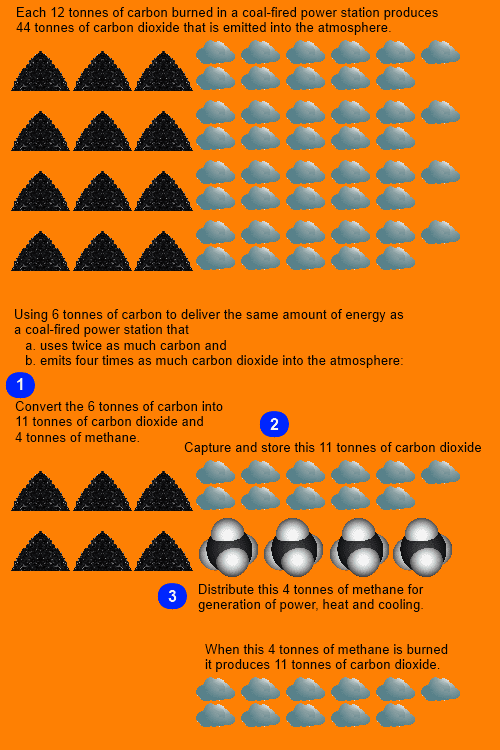
How to Halve Coal Demand and Cut Emissions by 75 per cent  
while Saving Money
Halve coal demand and cut emissions by 75 percent - hydromethanation


China adopts advanced U.S. technology


"Wanxiang believes that GreatPoint Energy’s Bluegas technology is currently the world’s most advanced, lowest cost and most environmentally friendly technology for transforming coal into natural gas."

The Bluegas hydromethanation technology developed and owned by GreatPoint Energy directly converts coal into pipeline quality natural gas, the cleanest commercial fuel in use globally. GreatPoint Energy’s proprietary technology operates at the highest efficiency with the least environmental impact, and produces natural gas at the lowest cost in the industry.

Inherent in the technology is the ability to capture nearly all emissions, including carbon dioxide, which can be sequestered and used for oil production through Enhanced Oil Recovery.

The technology is especially well suited for arid regions and where low-quality, concentrated coal resources are available, such as in Xinjiang. Together, Wanxiang and GreatPoint Energy also plan to develop large-scale Bluegas projects at other locations in Xinjiang and in other regions of China using the Bluegas technology.

Read more about Wanxiang and GreatPoint Energy Announce $1.25 Billion Investment and Agree to Construct World’s Most Efficient Coal-to-Natural Gas Production Facility in China


Case Studies - Natural Gas Cogeneration / Trigeneration

Castle Hill RSL

- Energy conversion efficiency over 80 percent possible with coal-to-natural gas technology

Carbon Training International Case study on Australia’s Castle Hill RSL Club’s cogeneration system.


Rooty Hill RSL

- Emissions cut 50 percent overnight

A Tri Generation system reduces Rooty Hill RSL's carbon emissions by more than 50 percent.


GE supplies gas turbine to industrial cogeneration plant in Nanxun

GE and its manufacturing partner, Nanjing Turbine & Electric Machinery (NTC) agreed to supply two gas turbines to Guodian Dianli's Nanxun industrial cogeneration power plant in China's Nanxun development zone.

Guodian Dianli is a Chinese power company. China Guodian Corporation is a state owned enterprise which is among the nation's five largest producers of electricity.

The new combined-cycle plant, which will generate to provide electricity and industrial heating for the Nanxun development zone, uses natural gas from China's West to East Pipeline II.

Both turbines will be shipped by December 2013 and the plant will begin operation in the second quarter of 2014.

Read more: ...

Tuesday, September 18, 2012

Coal leads EPA regulations

Coal does not want to do that?

In February 2009 the coal industry lobby published the following post on the blog "Coal Can Do That"

Coal-to-Gas is Off-the-Shelf Energy Solution

Dr. Frank Clemente

The Question: “How can we obtain enough NG at affordable prices to (1) power over 400,000 MW of NG based generation capacity, (2) heat tens of millions of homes and buildings, (3) meet the needs of manufacturing and agriculture, and (4) make ethanol, fertilizer and other energy related products?

The Answer: We can’t.

Enter substitute natural gas (SNG), the product of coal gasification, an established technology that has been around for a century and currently in use throughout the world. SNG facilities can now be made “carbon storage ready” to take advantage of emerging technologies in CO2 capture, leading the way to a virtually emission free use of coal. The captured CO2 can then be stored indefinitely or more productively, be utilized to recover “stranded” oil in depleted fields throughout the nation. Texas alone, for example, has over 35 billion barrels of potentially recoverable oil using CO2 injection.

In addition, SNG technology:
  • Produces pipeline quality NG equivalents that can be used to fuel power plants, heat homes and manufacture a wide range of goods.
  • Removes 95% of the mercury and virtually 100% of the sulfur. Further, the captured sulfur can be used to make fertilizer and the ash from combustion of coal can be used to make roads and related infrastructure.
  • Provides fuel for the hundreds of NG dependent power plants we imprudently built over the past decade based on erroneous predictions of NG price and production. In short, prices have escalated and production has stagnated leaving many NG power plants too expensive to operate.
  • Boost the economy of local communities and provide well paying jobs. A planned SNG state-of-the-art facility in Kentucky, for example, will create 1,200 construction jobs for four years, 500 permanent jobs and pump over $100 million into the economy of host Muhlenberg County and surrounding communities.
SNG is a prime example of how off the shelf clean coal conversion technologies can improve our quality of life and fully unlock the socioeconomic value of our greatest energy resource – coal. And the ability to remove just about all the sulfur will open up new vistas for use of coal resources in many states. Missouri, for example, has substantial coal resources that are relatively high in sulfur. SNG will open the door to these resources and significantly benefit economic growth in such states.


In August 2012 the coal industry lobby published the following post to oppose EPA regulations asking that it deliver on what it said in 2009 - "Coal Can Do That" (cut mercury emissions).
Go figure.

New EPA Rules Cost Jobs and Growth

A wave of U.S. EPA regulations would reduce coal use and cost families an average of $270  every year -- at a time when millions are struggling. Low-cost energy from coal is an engine of economic growth, responsible for nearly 7 million jobs and $1 trillion in GDP. Take action to keep costs low and jobs at home.
Go to the site
...

Four new rules from the Environmental Protection Agency would further regulate the operation of coal-fueled power plants. The most expensive of these is called the Utility mercury and other hazardous emissions (MACT) rule. We asked National Economic Research Associates (NERA), an independent research firm, to model the potential economic impact if all four rules are implemented. Using data from many sources, including the EPA itself and the U.S. Energy Information Administration, its models paint a very sobering picture.

Every family will lose an average of $270 a year of disposable income through 2020 under these new rules.

Potential Impacts of EPA Air, Coal Combustion Residuals, and Cooling Water Regulations


...
This report evaluates the potential energy and economic impacts of four major environmental regulations that would affect the electricity sector. The regulations include two major air emission policies—the Cross-State Air Pollution Rule (CSAPR) and regulation of mercury and other hazardous emissions (Utility MACT)...

Tuesday, July 24, 2012

New Paths out of the Agenda 21 Impasse

The Square Kilometre Array (SKA - around 3,000 dishes each 15 metres in diameter
The Square Kilometre Array (SKA)
- around 3,000 dishes each 15 metres in diameter
Keith Orchison wrote last December on the UN climate policy debate in Durban.
"A leading Indian media commentator on carbon policy development noted on Sunday: 'When negotiations began 20 years ago, it was well understood that the industrialised world had to vacate (emissions) space for the emerging world to grow. Money and technology transfer would enable emerging countries to avoid future emissions growth. But none of this happened. Meagre targets were set. The US and other big polluters walked out of the agreement. The funds never came.'

This was the real point of biff in the Durban debate."
Source: Nuancing on the platform | December 12th, 2011 | Keith Orchison

A group of people who hold extreme views on personal freedom over social responsibility regard proposals for action on green-house gas emissions with great suspicion. Those inclined to this extremist political ideology fear that any coordinated global response intended to lower the level of carbon dioxide in the atmosphere amounts to a conspiracy to transfer wealth from the United States to developing countries.

The fears held today by these extremists reflect the perception the commentator gave of the start of negotiations 20 years ago: "the industrialised world had to vacate (emissions) space for the emerging world to grow. Money and technology transfer would enable emerging countries to avoid future emissions growth..."

Time and technology marches on. The perception of what seemed necessary 20 years ago no longer holds true. Those fears still held today can be overcome by smarter development in the emerging world.

This outcome is by the way a vindication of the economic philosophy of Adam Smith that rational action in the pursuit of self interest will foster innovations that address resource shortages. The alternate economic ideology that Thomas Malthus described sees finite economic resources as an absolute barrier to economic development. If you look again at the statement "the industrialised world had to vacate (emissions) space for the emerging world to grow. Money and technology transfer would enable emerging countries to avoid future emissions growth..." you can see that it contains the implicit assumption that the Malthusian economic ideology is inescapable.

Twenty years ago energy generation was economical when accompanied by emissions of large quantities of carbon dioxide. The rate of emissions was about 1 tonne of carbon dioxide for each megawatt-hour of electrical energy. That is about 1 kilogram (2.2 pounds) for each kilowatt-hour.

The developing world is no longer limited to using old technology with which much of the industrialised world is saddled.

Innovation and creativity has helped advance technologies for the developing world to generate affordable and reliable energy in new ways with little or no emissions of carbon dioxide.

A very broad range of alternate options are now available and even more are the subject of advanced research projects.

Coal / Biomass Gasification with Concentrated Solar Thermal Energy


High Temperature Solar Furnace

Design of a high temperature solar furnace that can achieve a concentration ratio of 20,000 suns. The furnace consists of three optical elements: a primary mirror, a secondary mirror, and a compound parabolic concentrator (CPC).
High Temperature Solar Furnace
Source: College of Optical Sciences, University of Arizona  | 16 July 2010 | High Temperature Solar Furnace

The mass production of large parabolic mirrors will rapidly reduce the cost of solar furnaces. The manufacture of 3,000 parabolic dishes each 15 metres in diameter for the Square Kilometre Array project in Africa provides the opportunity to roll-out solar furnaces at a lower cost than has been possible until now.

3M has developed a reflective polymer film that can be applied to parabolic dishes to create highly reflective mirrors at a much lower cost than mirrors made from glass or metal.


Africa celebrates SKA bid outcome

"Since the announcement that South Africa, along with its eight SKA partner countries in Africa, will host the mid-frequency dish array and dense aperture array of the iconic SKA telescope congratulatory messages have been pouring in from around the globe praising the hard work of the South African SKA team and the unwavering support for Africa's site bid from the South African government."
Source: SKA AFRICA | 28 May 2012 | SKA Africa - Square Kilometre Array
Dishes will form a substantial part of the SKA; around 3000 dishes, each 15 m in diameter, are currently planned. Many aspects of the SKA dish-design challenge are without precedent, not only because of the large numbers of dishes required, but also because of the huge sensitivity that will result.

The manufacture of composite reflectors for this size of antenna has been done in the past.  These were for military applications however, and the history of prior manufacturing is such that the reflectors were one-off, very heavily invested in materials and manual labour costs, and not designed to have the serial manufacturing requirements of the scale envisioned for this project.  Given the unique nature of the requirements, the SKA manufacturing program was approached from a standpoint of optimization of the production capability of the reflectors, while retaining the baseline requirements for performance and durability.  All aspects of reflector manufacture were examined for achieving optimal production and cost of delivered reflectors.

A detailed analysis of the potential production costs of delivery of the SKA Phase 2 requirements, 3,000 reflectors over 4 years is presented here. ...The cost of a complete composite reflector assembly (surface and backing structure) was determined to be $US45,000 ($US398 per square metre) for Phase 2.
Source: SKA AFRICA | 4 September 2009 | Feasibility and Cost Study of Manufacturing Composite Parabolic Reflectors for the SKA

See the related posts: Good Energy, Bad Energy; Why choose between solar and coal when you can use both?; Energy for Life

Tuesday, June 19, 2012

Energy for Life

More than three billion people still burn wood, dung, coal and other traditional fuels inside their homes. The resulting indoor air pollution is responsible for more than 1.5 million deaths a year – mostly of young children and their mothers. Millions more suffer every day with difficulty in breathing, stinging eyes and chronic respiratory disease.

1.5 billion people have no access to electricity, and 85% of the population in Africa don't yet have electricity. 400 million in India have no access to power.

Collecting Firewood
Collecting Firewood

There is enormous unmet demand for access to electricity and clean energy.

In its annual Human Development Report, the UN Development Programme (UNDP) said the UN has designated 2012 as the international year of sustainable energy for all.

Energy is essential to meet our most basic needs: cooking, boiling water, lighting and heating. It is also a prerequisite for good health – a reality that has been largely ignored by the world community.

One of the greatest energy needs across the world is for cooking, something which we take for granted. Without a decent energy supply, people are forced to rely on biomass - wood or animal dung - for cooking. Women and children can spend hours every day searching for increasingly scarce resources. Once they start burning biomass, the thick acrid smoke cause's serious lung diseases turning kitchens into death traps.

Children and their mothers are most at risk, choking, retching and gasping to get air to their lungs which are being attacked and destroyed by smoke. More people die from smoke inhalation than malaria.

According to the World Health Organisation, diseases associated with indoor air pollution claim 1.5 million lives every year - that's one person every 20 seconds.

Green Climate Fund


Source: What the Australian Government is doing > Shaping a global solution

At Cancún in December 2010, countries agreed to establish a new Green Climate Fund to support mitigation and adaptation activities in developing countries, including capacity-building, technology development and transfer. Australia anticipates that, over time, a significant portion of long-term financing to support climate change activities in developing countries will be channeled through this Fund.

Throughout 2011 Australia joined 39 other countries on the Transitional Committee which was tasked with the design of the Fund. The Transitional Committee's recommendations, including the draft governing instrument of the Green Climate Fund, were approved by the Conference of the Parties to the UNFCCC in December 2011 at Durban.

As a result, concrete steps are now being taken to operationalise the Fund to ensure the appropriate arrangements are put in place so it can commence operations including allocating funds to support action on climate change in developing countries as soon as possible. Australia, like other developed countries, is providing some financial assistance to support the initial administrative operations of the Fund.

Finance

A central element of bringing developed and developing countries together in an international climate change agreement will be financing to assist developing countries in their transition to climate-resilient and low-carbon economies.

It is in Australia's interest to assist developing countries to build their capacity to reduce emissions and to take urgent adaptation actions while maintaining a priority focus on development, in particular the eradication of poverty. Early action on both adaptation and mitigation will reduce global costs and the costs to individual countries.

To this end, Australia is working to build a coordinated approach that will deliver financing where it is needed most, as soon as possible.

Related links
AusAID - Climate Change
"Australia's funding for 2012/2013 - $172.07 million.
...
Our total climate change expenditure over the fast start period (2010–11 to 2012–13) is expected to exceed the $599 million fast start commitment."

Monday, May 7, 2012

Threat to Secular Government in Australia

What is Catholicism?

Tony Abbott says "he cannot recall" consulting a Catholic bishop during an election campaign

TONY JONES, JOURNALIST (ABC TV, Lateline, 2004): Have you met Archbishop Pell during the election campaign?

TONY ABBOTT: Not that I can recall.

TONY JONES: Not that you can recall, because we believe that you've had at least one meeting with him quite recently.

TONY ABBOTT: Well, when? Where?

TONY JONES: You don't recall that? At the Presbytery in Sydney.

TONY ABBOTT: Actually, now that you mention it, I did meet with Cardinal Pell. So what?


Tony Abbott talks about Coalition Climate Change Policy, July 2009


Source: David Speers Sky News Interview with Tony Abbott, July 2009

TONY ABBOTT: If you want to put a price on carbon why not just do it with a simple tax. Why not ask motorists to pay more?
Why not ask electricity consumers to pay more?

And then at the end of the year, you can take your invoices to the tax office and get a rebate on the carbon tax you paid.

It would be burdensome, all taxes are burdensome, but it would certainly change the price on carbon, raise the price of carbon without increasing in any way the overall tax burden.


Tony Abbott talks about Coalition Climate Change Policy after Labor adopts his proposal, March 2011


Source: Sydney Morning Herald, February 24, 2011 "Carbon price to start July 2012"

JULIA GILLARD: This is an essential economic reform, and it is the right thing to do. Carbon pollution is a threat to our country, and a threat to our future prosperity.

I do not believe that Australia needs to lead the world on climate change, but I also don't believe that we can afford to be left behind. That is why the time is right and the time is now.

Every cent raised from pricing carbon will go to assisting households, helping businesses manage the transition and funding climate change programs.


Source: Courier Mail, March 1, 2011 "Abbott will scrap carbon tax if PM"

TONY ABBOTT: We will oppose this in opposition. We will rescind it in government.


Cardinal George Pell talks about Climate Change Policy, October 2011

Extract of -
The Global Warming Policy Foundation
2011 Annual GWPF Lecture
Westminster Cathedral Hall | 26 October 2011

One Christian Perspective on Climate Change
Cardinal George Pell
Archbishop of Sydney

Let me begin by thanking the Global Warming Policy Foundation for the invitation to deliver this lecture.

Why might a Catholic bishop comment?

We might ask whether my scepticism is yet another example of religious ignorance and intransigence opposing the forward progress of science as is alleged in the confrontations between Galileo and the Papacy in the early seventeenth century, when the Church party on the evidence of scripture insisted that the sun moved around the earth.

I first became interested in the question in the 1990s when studying the anti-human claims of the “deep Greens”, so I had long suspected that those predicting dangerous and increasing anthropogenic global warming were overstating their case. During the years 2008-09 it was dangerous for an Australian politician to voice dissent unless he was from a country electorate. Opponents were silenced.

As I was not up for re-election and I suspected the Emperor had few if any clothes, I made a few more small public statements.

In my view the evidence is insufficient to achieve practical certainty on many of these scientific issues.

The cost of attempts to make global warming go away will be very heavy. They may be levied initially on “the big polluters” but they will eventually trickle down to the end-users. Efforts to offset the effects on the vulnerable are well intentioned but history tells us they can only ever be partially successful. Will the costs and the disruption be justified by the benefits?

We must be sure the solutions being proposed are valid, the benefits are real and the end result justifies the impositions on the community, particularly the most vulnerable. You will gather that I have concerns on all three fronts.

Are there any long term benefits from the schemes to combat global warming, apart from extra tax revenues for governments and income for those devising and implementing the schemes? Will the burdens be shared generally, or fall mainly on the shoulders of the battlers, the poor? Another useful Latin maxim is “in dubio non agitur”: don’t act when in doubt. There is no precautionary principle, only the criteria for assessing what actions are prudent.

Monday, April 23, 2012

QandA Climate Debate Special

Updated June 7, 2012

Q&A Climate Debate

Take Part in the Q&A Climate Debate on ABC TV    On Thursday 26 April -  a special Q&A climate debate followed the screening of the documentary I Can Change Your Mind About Climate on ABC TV. 

Tony Jones was joined by Anna Rose, Nick Minchin, Clive Palmer and Rebecca Huntley to answer your questions.
Update: Saturday 28 April 2012

THE CLASH OF IDEOLOGIES on Q&A

Marc Morano's objections to scientific evidence of anthropogenic global warming and the risks it creates are underpinned by an ideology that is crucial to those who subscribe to it.

In speaking with Anna Rose, Marc Morano said:
"You are the face of one of the greatest threats of our liberty, and that is intellectual, international bean-counters trying to control average people's lives because they think they know better how people should live, because people left to their own devices will somehow destroy the planet."
Compare this statement with Adam Smith's  "invisible hand" - that rational self-interest in a free-market economy leads to economic well-being, and is THE central justification for the laissez-faire economic ideology.

Adam Smith never contemplated an "invisible hand" to mean scientific knowledge was to be dismissed when it suggested rational self-interest was best served by a change in economic behaviour. Innovation and economic growth is driven by scientific knowledge.

Marc Morano's diatribe in which he asserts Anna Rose is the face of a threat to "liberty" has confused irrational and uninformed action with the rational self-interest of the "invisible hand" of which Adam Smith wrote.

Misguided Climate Sceptics
Climate sceptic Dr Fred Singer said "The Kyoto Protocol [is] part of the anti-technology, anti-energy, anti-growth philosophy of the extreme 'greens.'"
And also "When you have a particular point of view ...you become selective in the way you present your observations."

What are the Q&A panelists thoughts on Dr Singer's mistaken observation: "We're being asked to reduce energy use [sic], not just by a few percent but, according to the Kyoto Protocol, by about 35 percent within ten years."?

Note: The Kyoto Protocol describes reductions in EMISSIONS. It says nothing about reducing ENERGY USE as Dr Fred Singer mistakenly observed. "The Kyoto Protocol aims to reduce the collective greenhouse gas emissions..."


Coal industry delaying CO2 cuts for another 15 years

Why is Australia to spend over $1 billion on CarbonNet and take 15 years developing new Carbon Capture technology ----
 ---- when proven technology has existed for decades in the USA?


A Possible Reason for the Coal Industry to Delay Pre-Combustion Carbon Capture

Post-combustion Carbon Capture and Storage (CCS)  provides a justification to continue construction of coal-fired power stations. It holds out a promise of one day being able to reduce emissions of such power plants.

Once a coal-fired power plant is constructed, the coal industry is guaranteed a customer for at least 40 years.

Gasification of coal with pre-combustion Carbon Capture eliminates the reason for constructing any new coal-fired power stations. Once converted to gas, the fuel can be used in high-efficiency combined-cycle gas turbine (CCGT) power stations. In addition a number of toxic components of coal such as mercury can be economically removed when the coal has been converted to gas.

The demand for coal would go down when natural gas prices fall. There would be no guaranteed demand to provide fuel for new coal-fired power stations.

A gas-fired power station achieves 60 percent thermal efficiency, much higher than the 40 percent for advanced coal-fired power stations. This difference also results in lower demand for coal.

China Adopting More Efficient (and Cleaner) Coal Technology

Block diagram with major units of the SNG plant
From coal to clean energy - Topsoe

China has built 50 coal gasification plants in the last 10 years and has another 40 in planning or under construction. On 21 May 2012 the article "China to Invest in Coal Gasification - with GEs help" by John Daly reported:

With more than 50 licensed facilities in China, GE’s gasification technology is one of the most widely deployed in the industry, while Shenhua is one of the world’s largest coal and energy companies, with integrated coal production, power generation, railway, port and shipping infrastructure.
...
Putting the final seal of approval on the project GE Energy Thermal Products president and CEO Paul Browning concluded, “Coal plays an important role in the economies of both the U.S. and China, and gasification technology allows us to use this abundant and low-cost resource in a much cleaner way.
...
The emphasis shift in coal power generation from thermal plants to utilizing IGCC technology is a key element in the Chinese leadership’s efforts to maintain its economic momentum by providing its vast industrial base uninterrupted power supplies.


New technology is increasing efficiency of converting coal to gas. China is building commercial-scale plants as new technology becomes available. For example:

India to Follow China's Lead with More Efficient (and Cleaner) Coal Technology


On 29 May 2012 the Economic Times reported in the article "India needs to master the coal-gasification technology":

India needs to master the coal-gasification technology so as to boost both energy efficiency and attendant security.
...
...Integrated coal-gasification combined-cycle (IGCC) power plants, which incorporate both gas and steam turbines, vastly improve the conversion of coal energy into usable electricity.
...
Note that while the efficiency rate is just about 30% in standard coal-fired stations and 40-odd per cent using super-critical technology, the mavens hold that, in future gasification plants, the ratio could touch 70-80%. We clearly need to adopt IGCC in a big way. 
The likely impact on Australia's coal export industry can be seen from an earlier article on 12 March 2012. Reuters reported in its article "India's coal-to-gas dream takes baby steps":
NEW DELHI, March 12(Reuters) - India is at least a decade behind China in embracing technology that could convert its coal reserves into enough gas and oil to surmount chronic power shortages and halve its energy import bill of $110 billion a year

Tony Abbott Warns Minerals Council of Impact of above Changes


In an Address to the Minerals Council of Australia at Canberra on 30 May 2012, coincidentally just one day after the above article on India's need to follow the example set by China to embrace more efficient energy-from-coal technology, Tony Abbott said:
...We all know what the carbon tax is designed to do: it is designed to reduce our use of coal and our use of gas [sic]. In other words, it is designed to limit the production, ultimately, of the minerals upon which our country so critically depends [sic]...The government’s own documents say that Australia’s energy production from coal, absent carbon capture and storage, will fall from over 70 percent right now to 10 percent by 2050.

So, the carbon tax is designed to damage the very things on which our country's wealth depends 
[sic]. The only way our country's wealth can survive the carbon tax is if other countries don't do what we're doing. If China and India took the same attitude to coal and gas that we are taking, our export industries would be in diabolical trouble...

Cheap Natural Gas in the U.S. replacing Coal-Fired Power Generation


In the U.S. plans for the construction of a number of coal gasification plants have recently been put on hold. The reason: a massive over-supply of natural gas in the U.S. has dramatically lowered the price and the continued use of coal is for the time-being at least, not competitive.

On 13 March 2012 the article "Coal’s Share of U.S. Electricity Generation Falls to 35-Year Low" by Moran Zhang reported:

The share of U.S. power generation that comes from coal has fallen to near a 35-year low, as electric power plants shift to cheaper natural gas.

Although coal is still the main fuel for electricity generation, its share of monthly power generation in the U.S. dropped below 40 percent in the last two months in 2011, according to the Energy Department. The last time coal's share of total generation was below 40 percent for a monthly total was March 1978.
...
"Natural gas combined-cycle units operate at higher efficiency than do older, coal-fired units, which increases the competitiveness of natural gas relative to coal," the Energy Department said in a statement.

Natural gas prices have continued their downward trend this winter as a result of warmer-than-normal temperatures, ample natural gas in storage and growing natural gas production, which has been boosted by companies tapping so-called shale reservoirs using a technique called hydraulic fracturing, also known as "fracking."


Saturday, February 18, 2012

Clean Energy 24/7 Made Easy

Sick of hearing myths like: "You can't run a car factory with renewable energy..." ?

Renewable energy CAN provide 24/7 power and it can provide it at a lower cost than large centralised power stations.
Plants - Nature's Solar Energy Collectors and Renewable Energy Stores

Plants have had millions of years of evolution to perfect collecting and storing solar energy. They remove carbon dioxide from the atmosphere and produce oxygen at the same time.

100 tonnes of biomass is created by combining 150 tonnes of carbon dioxide, 60 tonnes of  water and a large quantity of sunlight (aka Solar Energy). 110 tonnes of oxygen are released.
We do not need to grow special energy crops. The most efficient plant is one we call a weed.

Water hyacinths can grow 90-180 tonnes of biomass (dry weight) per hectare in a year.  It clog rivers and removes excess nutrients from polluted waterways.

100 tonnes of water hyacinths (dry weight) stores 1,600 gigajoules of solar energy.
(Equivalent to the energy in about 40,000 litres (10,500 US gallons) of diesel)
Genifuel - Gasification Unit and Harvesting water hyacinth

US developers and Swiss researchers have built and evaluated the technology needed to convert wet biomass into renewable natural gas: Each 100 tonnes of biomass is converted into 25 tonnes of renewable natural gas. 75 tonnes of carbon dioxide is released that can be cheaply captured and stored. We can easily go beyond Carbon Neutral energy production and Zero Emissions. Plants give us the option to use affordable technology to be Carbon Negative.
Biomass                      (100 tonnes)
        produces
Renewable Natural Gas  (25 tonnes)
+ Carbon Dioxide          (75 tonnes) 
For every 100 tonnes of biomass collected and converted into renewable natural gas, 75 tonnes of carbon dioxide can be permanently removed from the atmosphere.

Security of CO2 storage in Norway

Sunday, January 8, 2012

Agenda 21

A New Group of Extremists

Given the extracts of opponents to UN Agenda 21 below extreme conduct of carbon tax opponents is not  surprising.

The potential for violence from those who subscribe to such a conspiracy theory cannot be ruled out.

Your Town and Freedom Threatened

By Freedom Advocates
Tuesday, 04 August 2009

Right now, in your town and neighborhood, policies are being implemented that will ultimately eliminate your freedoms and destroy your way of life....
...
The false premise and outright lies of anthropogenic global warming to change our way of life, for the worse!
Local Governments for Sustainability promotes ... Local Agenda 21 and other United Nations programmes ...


Introduction to Sustainable Development

The new process is to by-pass elected officials and put  policy-making into the hands of selected individuals who agree with the objectives of Agenda 21...
...
The bedrock principle on which America is founded is the belief that government is empowered by the consent of those who are governed.
...
Public policies that are enacted by elected officials are, therefore, ultimately subject to the approval (or consent) of those who are governed.
...
Perhaps the greatest danger of sustainable development is the transformation of the process through which public policy is created.
...
It is difficult for Americans to comprehend a system of governance in which the government is omnipotent and ordinary citizens are subject to whatever whims may be imposed by whomever happens to be in power.  Nevertheless, sustainable development requires such a system of governance to manage the affairs of individual citizens to insure that social equity and environmental protection are integrated into all economic activity.
...
Social equity means that "...all citizens share equally in the benefits of natural resources."
America is said to be home for only five percent of the world's population which uses 20 percent of the earth's resources.  Therefore, America's consumption of natural resources must be reduced while providing access to the world's resources to the people in the rest of the world.  The Framework Convention on Climate Change, with its Kyoto Protocol, will force a 40% reduction in energy use in America and in 33 other developed countries.  The resulting increased cost of everything that uses energy will force a reduction of consumption in America.  But since no energy use restrictions are imposed on the remaining 137 developing nations, industry will move to China, Mexico, Brazil, and Asia to produce their goods for the people in developing nations.

The process will force the redistribution of wealth to achieve "social equity" in the name of protecting the environment.


Agenda for the 21st Century Invades Australia

By Diane Ross
Monday, 07 January 2008

Australian leaders enforce Agenda 21 Sustainable Development by restricting private property use...
...
Environmental groups sanction and aid Agenda 21 policies. They are funded by organizations such as the Rockefeller Foundation. Unsuspecting citizens are misled by buzz words such as:     
  • Sustainable Development
  • Smart Growth
  • Taking Care of the Planet
  • Climate Change
  • Global Warming
  • And other similar language
"Earth Dialogues" was held in Brisbane Australia in July 2006.  ...Children were encouraged to denounce national sovereignty and embrace a global government.

New Treaty In the Making

Covenant on Environment and Development

Few people in America have seen Agenda 21. Even fewer have read it.  ...This is the UN Treaty that will move the world into the clutches of global governance.
 ...
Part IV (Articles 16 through 22) says States "shall restrict human activities which modify, or are likely to modify..." ...global climate...
...
The "Precautionary Principle" ... of Agenda 21... is the idea that policy action should not wait on scientific justification if "government" decides that a "threat" to the environment exists.
...
Article 48 - State Liability
"Each State Party is liable for significant harm to the environment of other States or of areas beyond the limits of national jurisdiction, as well as for injury to persons resulting therefrom, caused by acts or omissions of its organs or by activities under its jurisdiction or control."
...
Article 54 - Sovereign Immunity
"Parties may not claim sovereign immunity in respect of proceedings instituted under this Covenant."

Carbon Tax

Making sense of the bizarre and dangerous

A tweet about a carbon tax elicited these responses:
  • "I'm Opposed to handing soverignty over to the Pope's United Nations..."
  • "How profitable does Carbon Tax need to be to justify treason thru loss of sovereignty?..."
  • "Its called treason/sedition, its in our law. Our soverign is the rightful heir of UK not the UN..."
  • "TREASON is rewarded with a noose from a tall tree. Careful , Australia is alot bigger than your Canberra herd..."
Curious about the introduction of the concepts "sovereignty", "Pope's United Nations", "treason" and "noose", some research identified a number of extremist websites promoting these within conspiracy theories. Read some extracts of these dangerous websites on Agenda 21.

The earliest discussion of these bizarre ideas is in a 1993 Los Angeles Times article on the beliefs of a group called The John Birch Society. It expressed fears including:
"Birchers preach that the United Nations wants socialism to rule the world and that global warming caused by pollution is a hoax foisted on gullible Americans to gain control over their land and businesses."

"Our feeling is that over a long period of time, they (communists) have taken control of the federal government of the United States," said Mark Walsh

Fred Koch founded the Koch Oil Corporation and was an early member of The John Birch Society's National Council, an advisory group to JBS founder Robert Welch.

Earlier this year The John Birch Society said it was pleased to announce that Nelson Bunker Hunt of Texas will again serve as a member of its National Council. Nelson Bunker Hunt is an American oil company executive.

This is the list of tweets exchanged:

9:40 PM - 7 Jan 12 via web

9:52 PM - 7 Jan 12 via web

9:54 PM - 7 Jan 12 via web

9:57 PM - 7 Jan 12 via web

10:03 PM - 7 Jan 12 via web

10:23 PM - 7 Jan 12 via web

10:34 PM - 7 Jan 12 via web