Latest Buzz...
                  

Translate

Showing posts with label Climate Scientists. Show all posts

Saturday, December 19, 2015

Global warming and climate change news

Monday, March 16, 2015

Gambling on climate change - no safe bets

Gambling on Climate Change

Lectures on the Global Warming Gamble 

Extract of -
The Global Warming Policy Foundation
2011 Annual GWPF Lecture
Westminster Cathedral Hall | 26 October 2011

One Christian Perspective on Climate Change
Cardinal George Pell
Archbishop of Sydney


Let me begin by thanking the Global Warming Policy Foundation for the invitation to deliver this lecture.

Why might a Catholic bishop comment?

We might ask whether my scepticism is yet another example of religious ignorance and intransigence opposing the forward progress of science as is alleged in the confrontations between Galileo and the Papacy in the early seventeenth century, when the Church party on the evidence of scripture insisted that the sun moved around the earth.

It is not generally realized that in 2001 at least, one of the IPCC Third Assessment Report’s Working Groups agreed: “In climate research and modelling, we are dealing with a coupled, non-linear, chaotic system, and therefore that the long-term prediction of future climate states is not possible”.

Arnold helped to explain why the systems around us work, how fluids flow. Like Lorenz, he found that small changes had an immense impact on outcomes. For him long-range weather forecasting was effectively impossible, because small events could have dramatic, unforeseen consequences.


A small event - dramatic, unforeseeable consequences

Changes in Carbon Dioxide and Temperature
Changes in Carbon Dioxide and Temperature (EPA)
Fluctuations in temperature (red line) and in the atmospheric concentration of carbon dioxide (yellow) over the past 649,000 years.
"SMALL" Change: The vertical red bar at the end is the increase in atmospheric carbon dioxide levels over the past two centuries and before 2007.
From "A brief history of the universe"

  • Human beings first arrived in Europe about 35,000 years ago.
  • The first cities were only built 8,800 years ago.

An observation on Cardinal Pell's Lecture

Cardinal Pell highlights key attributes of climate science that give little reason for comfort:
  • "In climate research and modelling, we are dealing with a coupled, non-linear, chaotic system, and therefore that the long-term prediction of future climate states is not possible" and
  • "small events could have dramatic, unforeseen consequences."
The implications of this description are perhaps a little obscure.

An example of a non-linear system is a house-of-cards. It is susceptible to sudden collapse when a single card is moved even though it is seemingly stable when other small changes are made. That is, small events can have dramatic, unforeseen consequences.

There are three unfortunate characteristics of such systems -
  • Very small changes can create completely unexpected and seemingly disproportionate changes with little warning.
  • Predicting behaviour of the system will be very difficult. 
  • Removing a "trigger" that seemingly precipitated a disproportionate change will most likely fail to restore the system to its previous state.

Thursday, August 14, 2014

Maurice Newman caught changing the facts

Maurice Newman is the Australian Prime Minister Tony Abbott’s most senior economic advisor.

Tony Abbott appointed him to chair the government's Business Advisory Council.

In an article published by The Australian today Maurice Newman misquotes a research paper in a blatant attack on climate science.

We’re ill-prepared if the iceman cometh


What if the warmth the world has enjoyed for the past 50 years [emphasis added] is the result of solar activity, not man-made CO2?

In a letter to the editor of Astronomy & Astrophysics, IG Usoskin et al produced the “first fully ­adjustment-free physical reconstruction of solar activity”. They found that during the past 3000 years the modern grand maxima, which occurred between 1959 and 2009 [emphasis added], was a rare event both in magnitude and duration. This research adds to growing evidence that climate change is determined by the sun, not humans.

Maurice Newman's statement that the warmth the world has "enjoyed" (sic) for the past 50 years is coincidentally the same period climate science has in its sights. A NASA web page "How Do We Know The Climate is Changing?" says of this period that "Earth has warmed twice as fast in the last 50 years as in the 50 years before that."

Maurice Newman claims a letter to the editor of Astronomy & Astrophysics found a record of solar activity had a grand maxima which occurred between 1959 and 2009 was a rare event both in magnitude and duration.

This is not correct.

The "evidence" Maurice Newman incorrectly quotes actually refers to a 60 year period of high solar activity that began in 1950 and NOT in 1959.

Maurice Newman's error that happens to show a 50 year period for unusually high solar activity - 1959 to 2009 - is more likely to be deliberate rather than his inattention to detail.

Maurice Newman undoubtedly wanted to avoid trying to explain his theory that "the warmth of the earth" from 1959 is the result of solar activity and yet this solar activity did not produce warming from 1950 to 1959.

Tuesday, January 28, 2014

Boom Chica Boom

Big Bang Theory a conspiracy say former climate science denier cult members.

Global warming deniers - crispy

Don't continue the embarrassment of your climate science denial.

Try this brand new anti-science movement rejecting the Big Bang Theory.

Here is a group of enthusiastic former climate science deniers promoting their challenge to the Big Bang Theory:


Big Bang Alternatives, anyone?


Image credit: grandunificationtheory.com. Click for full-size where available.

Tuesday, June 4, 2013

Qing-Bin Lu revives debunked claims about cosmic rays and CFCs


(Copy of Post by Climate Science Watch)

Link to debunking 2011 peer-reviewed paper has been disabled in original


A new paper by Qing-Bin Lu in the International Journal of Modern Physics B is gaining coverage for its claim that chlorofluorocarbons (CFCs), not CO2, is causing global warming. This sensationalist headline is often repeated with little mention that Lu’s claims are not new, and have not held up to scientific scrutiny in the past. 

The following is a guest post by Climate Nexus. Text in PDF format here.

Qing-Bin Lu Revives Debunked Claims About Cosmic Rays and CFCs

A new paper by Qing-Bin Lu in the International Journal of Modern Physics B is gaining coverage for its claim that chlorofluorocarbons (CFCs), not CO2, is causing global warming. This sensationalist headline is often repeated with little mention that Lu’s claims are not new, and have not held up to scientific scrutiny in the past. In fact, Lu has been promoting his theories about CFCs for years, and mainstream scientists have found no merit in them. Critics have said Lu makes a fundamental scientific error by confusing correlation with causation, and does not effectively challenge the physical evidence of the warming effects of CO2, a body of knowledge built up over 150 years.

The claim:

Lu argues that CFCs are responsible for causing global warming. He uses a complicated chain of logic starting with the premise that it is cosmic rays, not UV rays as most scientists think, that break down CFCs, and ending with the finding that after his calculations, the estimated warming impact of CFCs matches up closely with actual measured surface temperatures. He concludes that it must be CFCs, not CO2, that are causing surface temperatures to rise.

The facts:

-       This theory has been considered and dismissed before. A 2010 report by the National Academies of Science was commissioned by Congress to examine all the evidence surrounding global warming including the theory that cosmic rays might influence Earth’s climate. It concluded that “a plausible physical mechanism… has not been demonstrated” and “cosmic rays are not regarded as an important climate forcing.”

-       In 2011, a peer-reviewed paper [new link to copy of peer-reviewed paper] found that Lu’s conclusions “are based solely on correlation… do not have a physical basis… and the findings of the IPCC… remain unchallenged.”

-       In response to Lu’s most recent publication, several different scientists interviewed by the Vancouver Sun each said that Lu’s conclusions “[go] against 150 years of very fundamental physics.”

-       Critics point out that Lu’s paper fails to make the leap from correlation to causation, one of the most basic and most common scientific failings. This error is simply illustrated in the classic fable of the rooster who believes the sun rises because he crows. Two things may happen at the same time, but this does not mean one causes the other. A “physical mechanism” by which the two events are connected must be known, in order to fully understand causation.

-       In contrast, there is strong experimental evidence of the physical mechanism by which CO2 warms the planet, evidence that (as scientists have mentioned already in response to Lu) dates back 150 years.

Thursday, January 10, 2013

Action on climate change now agreed

The United States coal industry, the Environment Protection Agency (the EPA) and climate change sceptic Fred Singer have finally arrived at a consensus on energy generation technology that dramatically reduces carbon dioxide emissions.

The contested issue of what contribution carbon dioxide emissions make to climate change was important when climate change sceptics and deniers were paralyzed with fear that low emission energy generation would result in poverty and starvation. With that alarmist outcome put to rest, the heat has gone from the debate.


The crucial change is the long-awaited consensus on action that lowers carbon dioxide emissions. The question of whether this action will influence climate change or not is a different matter. As mentioned above, the heat and urgency has gone from this unresolved issue.

The following representatives in the climate change debate have each endorsed the same action to reduce carbon dioxide emissions of energy generation:

  • Dr S. Fred Singer - Climate Change Sceptic
  • The United States Coal Industry
  • The United States Environment Protection Agency (EPA)

Others have recognised the same action as an economical and profitable approach to reducing energy costs. The fact that carbon dioxide emissions are cut by up to 75 percent compared to coal-fired power generation is, for climate change deniers - an inconsequential side-effect. For others concerned by the risk of climate change - this is both an added bonus and a significant benefit:


S. Fred Singer, April 11, 2012

"Combined-cycle" gas power plants can reach efficiencies of 60% or more, compared to heat efficiencies of nuclear power plants of 35% or coal plants of 40%.

It gets even better than that. Gas-fired electricity generation is essentially non-polluting and user-friendly, and it can be placed in close proximity to wherever power is needed, making distributed generation economically feasible.

For example, a large apartment building of 1,000 units could use its own 10-megawatt power plant. But once installed, it becomes possible to consider co-generation, with the waste heat used for space heating, air-conditioning, hot water, laundry, and other process-heat applications -- and even desalination.

One can imagine energy efficiencies of as much as 80%, more than double what is achieved today. It would also simplify the problem of waste-heat disposal.

Cheap gas will encourage the petrochemical industry to invest $30 billion in new U.S. plants over the next five years, according to Chevron-Phillips Chemical Co. Plastics producers will get a double-boost -- from cheaper feedstock gas, the raw material for their product, and lower electricity costs. ...

So what needs to be done? The first step is to have a White House that strongly believes in the need for low-cost energy to promote economic growth, increase prosperity, and fight poverty. Electricity costs should "skyrocket" downward, not upward.

The United States Coal Industry

Coal-to-Gas is an Off-the-Shelf Energy Solution, by Frank Clemente.

Update 17 March 2014
The coal lobby has removed the web pages for "Coal Can Do That".
A cached copy of this article by Frank Clemente is available from Google - as it existed on 23 February 2014 - Coal-to-Gas is an Off-the-Shelf Energy Solution

Update 2 April 2014
The coal lobby has removed the cached copy of the web pages for "Coal Can Do That". You may still read a copy of the "Coal Can Do That" article "Coal-to-Gas is Off-the-Shelf Energy Solution" from February 2009 by Dr. Frank Clemente.


Substitute natural gas (SNG), the product of a coal-to-gas process, is an established technology that has been around for a century and is currently in use throughout the world.

Substitute natural gas technology produces pipeline quality natural gas equivalents that can be used to fuel power plants, heat homes and manufacture a wide range of goods.

It removes 95% of the mercury and virtually 100% of the sulfur. The captured sulfur can be used to make fertilizer.

It provides fuel for the hundreds of natural gas power plants, ...boosts the economy of local communities and provides well paying jobs. A planned Muhlenberg County substitute natural gas state-of-the-art facility in Kentucky, for example, will create 1,200 construction jobs for four years, 500 permanent jobs and pump over $100 million into the economy of host Muhlenberg County and surrounding communities.

The United States Environment Protection Agency (the EPA)

On Tuesday, March 27 2012, the U.S. Environmental Protection Agency (EPA) announced new performance standards limiting carbon dioxide emissions from power plants. The standard, which applies only to new power plants, limits CO2 emissions to 1,000 lbs (454 kilograms) per megawatt-hour (kg CO2/MWh).

The proposed rule is significant because it would be the first explicit limit on CO2 emissions in the United States. It effectively brings to an end new construction of conventional coal-fired power plants, which cannot meet the standard.

Typically, new coal plants generate about 1,800 lb (815 kg) CO2/MWh (or between 1,600 to 1,900 lb (725 to 860 kg) CO2/MWh). This means any new coal plants will have to adopt new technologies to reduce emissions, namely carbon capture and storage (CCS).

Natural gas plants, on the other hand, emit around 800-850 lb (360-385 kg) CO2/MWh, well within the standard.

In fact, the EPA based the emission limit on “the performance of widely used natural gas combined cycle (NGCC) technology” and predicts that NGCC will be the predominant choice in new fossil-fuel powered electricity generation.

Monday, May 7, 2012

Threat to Secular Government in Australia

What is Catholicism?

Tony Abbott says "he cannot recall" consulting a Catholic bishop during an election campaign

TONY JONES, JOURNALIST (ABC TV, Lateline, 2004): Have you met Archbishop Pell during the election campaign?

TONY ABBOTT: Not that I can recall.

TONY JONES: Not that you can recall, because we believe that you've had at least one meeting with him quite recently.

TONY ABBOTT: Well, when? Where?

TONY JONES: You don't recall that? At the Presbytery in Sydney.

TONY ABBOTT: Actually, now that you mention it, I did meet with Cardinal Pell. So what?


Tony Abbott talks about Coalition Climate Change Policy, July 2009


Source: David Speers Sky News Interview with Tony Abbott, July 2009

TONY ABBOTT: If you want to put a price on carbon why not just do it with a simple tax. Why not ask motorists to pay more?
Why not ask electricity consumers to pay more?

And then at the end of the year, you can take your invoices to the tax office and get a rebate on the carbon tax you paid.

It would be burdensome, all taxes are burdensome, but it would certainly change the price on carbon, raise the price of carbon without increasing in any way the overall tax burden.


Tony Abbott talks about Coalition Climate Change Policy after Labor adopts his proposal, March 2011


Source: Sydney Morning Herald, February 24, 2011 "Carbon price to start July 2012"

JULIA GILLARD: This is an essential economic reform, and it is the right thing to do. Carbon pollution is a threat to our country, and a threat to our future prosperity.

I do not believe that Australia needs to lead the world on climate change, but I also don't believe that we can afford to be left behind. That is why the time is right and the time is now.

Every cent raised from pricing carbon will go to assisting households, helping businesses manage the transition and funding climate change programs.


Source: Courier Mail, March 1, 2011 "Abbott will scrap carbon tax if PM"

TONY ABBOTT: We will oppose this in opposition. We will rescind it in government.


Cardinal George Pell talks about Climate Change Policy, October 2011

Extract of -
The Global Warming Policy Foundation
2011 Annual GWPF Lecture
Westminster Cathedral Hall | 26 October 2011

One Christian Perspective on Climate Change
Cardinal George Pell
Archbishop of Sydney

Let me begin by thanking the Global Warming Policy Foundation for the invitation to deliver this lecture.

Why might a Catholic bishop comment?

We might ask whether my scepticism is yet another example of religious ignorance and intransigence opposing the forward progress of science as is alleged in the confrontations between Galileo and the Papacy in the early seventeenth century, when the Church party on the evidence of scripture insisted that the sun moved around the earth.

I first became interested in the question in the 1990s when studying the anti-human claims of the “deep Greens”, so I had long suspected that those predicting dangerous and increasing anthropogenic global warming were overstating their case. During the years 2008-09 it was dangerous for an Australian politician to voice dissent unless he was from a country electorate. Opponents were silenced.

As I was not up for re-election and I suspected the Emperor had few if any clothes, I made a few more small public statements.

In my view the evidence is insufficient to achieve practical certainty on many of these scientific issues.

The cost of attempts to make global warming go away will be very heavy. They may be levied initially on “the big polluters” but they will eventually trickle down to the end-users. Efforts to offset the effects on the vulnerable are well intentioned but history tells us they can only ever be partially successful. Will the costs and the disruption be justified by the benefits?

We must be sure the solutions being proposed are valid, the benefits are real and the end result justifies the impositions on the community, particularly the most vulnerable. You will gather that I have concerns on all three fronts.

Are there any long term benefits from the schemes to combat global warming, apart from extra tax revenues for governments and income for those devising and implementing the schemes? Will the burdens be shared generally, or fall mainly on the shoulders of the battlers, the poor? Another useful Latin maxim is “in dubio non agitur”: don’t act when in doubt. There is no precautionary principle, only the criteria for assessing what actions are prudent.

Monday, April 23, 2012

QandA Climate Debate Special

Updated June 7, 2012

Q&A Climate Debate

Take Part in the Q&A Climate Debate on ABC TV    On Thursday 26 April -  a special Q&A climate debate followed the screening of the documentary I Can Change Your Mind About Climate on ABC TV. 

Tony Jones was joined by Anna Rose, Nick Minchin, Clive Palmer and Rebecca Huntley to answer your questions.
Update: Saturday 28 April 2012

THE CLASH OF IDEOLOGIES on Q&A

Marc Morano's objections to scientific evidence of anthropogenic global warming and the risks it creates are underpinned by an ideology that is crucial to those who subscribe to it.

In speaking with Anna Rose, Marc Morano said:
"You are the face of one of the greatest threats of our liberty, and that is intellectual, international bean-counters trying to control average people's lives because they think they know better how people should live, because people left to their own devices will somehow destroy the planet."
Compare this statement with Adam Smith's  "invisible hand" - that rational self-interest in a free-market economy leads to economic well-being, and is THE central justification for the laissez-faire economic ideology.

Adam Smith never contemplated an "invisible hand" to mean scientific knowledge was to be dismissed when it suggested rational self-interest was best served by a change in economic behaviour. Innovation and economic growth is driven by scientific knowledge.

Marc Morano's diatribe in which he asserts Anna Rose is the face of a threat to "liberty" has confused irrational and uninformed action with the rational self-interest of the "invisible hand" of which Adam Smith wrote.

Misguided Climate Sceptics
Climate sceptic Dr Fred Singer said "The Kyoto Protocol [is] part of the anti-technology, anti-energy, anti-growth philosophy of the extreme 'greens.'"
And also "When you have a particular point of view ...you become selective in the way you present your observations."

What are the Q&A panelists thoughts on Dr Singer's mistaken observation: "We're being asked to reduce energy use [sic], not just by a few percent but, according to the Kyoto Protocol, by about 35 percent within ten years."?

Note: The Kyoto Protocol describes reductions in EMISSIONS. It says nothing about reducing ENERGY USE as Dr Fred Singer mistakenly observed. "The Kyoto Protocol aims to reduce the collective greenhouse gas emissions..."


Coal industry delaying CO2 cuts for another 15 years

Why is Australia to spend over $1 billion on CarbonNet and take 15 years developing new Carbon Capture technology ----
 ---- when proven technology has existed for decades in the USA?


A Possible Reason for the Coal Industry to Delay Pre-Combustion Carbon Capture

Post-combustion Carbon Capture and Storage (CCS)  provides a justification to continue construction of coal-fired power stations. It holds out a promise of one day being able to reduce emissions of such power plants.

Once a coal-fired power plant is constructed, the coal industry is guaranteed a customer for at least 40 years.

Gasification of coal with pre-combustion Carbon Capture eliminates the reason for constructing any new coal-fired power stations. Once converted to gas, the fuel can be used in high-efficiency combined-cycle gas turbine (CCGT) power stations. In addition a number of toxic components of coal such as mercury can be economically removed when the coal has been converted to gas.

The demand for coal would go down when natural gas prices fall. There would be no guaranteed demand to provide fuel for new coal-fired power stations.

A gas-fired power station achieves 60 percent thermal efficiency, much higher than the 40 percent for advanced coal-fired power stations. This difference also results in lower demand for coal.

China Adopting More Efficient (and Cleaner) Coal Technology

Block diagram with major units of the SNG plant
From coal to clean energy - Topsoe

China has built 50 coal gasification plants in the last 10 years and has another 40 in planning or under construction. On 21 May 2012 the article "China to Invest in Coal Gasification - with GEs help" by John Daly reported:

With more than 50 licensed facilities in China, GE’s gasification technology is one of the most widely deployed in the industry, while Shenhua is one of the world’s largest coal and energy companies, with integrated coal production, power generation, railway, port and shipping infrastructure.
...
Putting the final seal of approval on the project GE Energy Thermal Products president and CEO Paul Browning concluded, “Coal plays an important role in the economies of both the U.S. and China, and gasification technology allows us to use this abundant and low-cost resource in a much cleaner way.
...
The emphasis shift in coal power generation from thermal plants to utilizing IGCC technology is a key element in the Chinese leadership’s efforts to maintain its economic momentum by providing its vast industrial base uninterrupted power supplies.


New technology is increasing efficiency of converting coal to gas. China is building commercial-scale plants as new technology becomes available. For example:

India to Follow China's Lead with More Efficient (and Cleaner) Coal Technology


On 29 May 2012 the Economic Times reported in the article "India needs to master the coal-gasification technology":

India needs to master the coal-gasification technology so as to boost both energy efficiency and attendant security.
...
...Integrated coal-gasification combined-cycle (IGCC) power plants, which incorporate both gas and steam turbines, vastly improve the conversion of coal energy into usable electricity.
...
Note that while the efficiency rate is just about 30% in standard coal-fired stations and 40-odd per cent using super-critical technology, the mavens hold that, in future gasification plants, the ratio could touch 70-80%. We clearly need to adopt IGCC in a big way. 
The likely impact on Australia's coal export industry can be seen from an earlier article on 12 March 2012. Reuters reported in its article "India's coal-to-gas dream takes baby steps":
NEW DELHI, March 12(Reuters) - India is at least a decade behind China in embracing technology that could convert its coal reserves into enough gas and oil to surmount chronic power shortages and halve its energy import bill of $110 billion a year

Tony Abbott Warns Minerals Council of Impact of above Changes


In an Address to the Minerals Council of Australia at Canberra on 30 May 2012, coincidentally just one day after the above article on India's need to follow the example set by China to embrace more efficient energy-from-coal technology, Tony Abbott said:
...We all know what the carbon tax is designed to do: it is designed to reduce our use of coal and our use of gas [sic]. In other words, it is designed to limit the production, ultimately, of the minerals upon which our country so critically depends [sic]...The government’s own documents say that Australia’s energy production from coal, absent carbon capture and storage, will fall from over 70 percent right now to 10 percent by 2050.

So, the carbon tax is designed to damage the very things on which our country's wealth depends 
[sic]. The only way our country's wealth can survive the carbon tax is if other countries don't do what we're doing. If China and India took the same attitude to coal and gas that we are taking, our export industries would be in diabolical trouble...

Cheap Natural Gas in the U.S. replacing Coal-Fired Power Generation


In the U.S. plans for the construction of a number of coal gasification plants have recently been put on hold. The reason: a massive over-supply of natural gas in the U.S. has dramatically lowered the price and the continued use of coal is for the time-being at least, not competitive.

On 13 March 2012 the article "Coal’s Share of U.S. Electricity Generation Falls to 35-Year Low" by Moran Zhang reported:

The share of U.S. power generation that comes from coal has fallen to near a 35-year low, as electric power plants shift to cheaper natural gas.

Although coal is still the main fuel for electricity generation, its share of monthly power generation in the U.S. dropped below 40 percent in the last two months in 2011, according to the Energy Department. The last time coal's share of total generation was below 40 percent for a monthly total was March 1978.
...
"Natural gas combined-cycle units operate at higher efficiency than do older, coal-fired units, which increases the competitiveness of natural gas relative to coal," the Energy Department said in a statement.

Natural gas prices have continued their downward trend this winter as a result of warmer-than-normal temperatures, ample natural gas in storage and growing natural gas production, which has been boosted by companies tapping so-called shale reservoirs using a technique called hydraulic fracturing, also known as "fracking."


Sunday, March 18, 2012

Three Sides to Climate Debate, Not Two

Miranda Devine's article "Has science become an alternative religion?" copied below equates environmentalism with science. These are not the same thing.


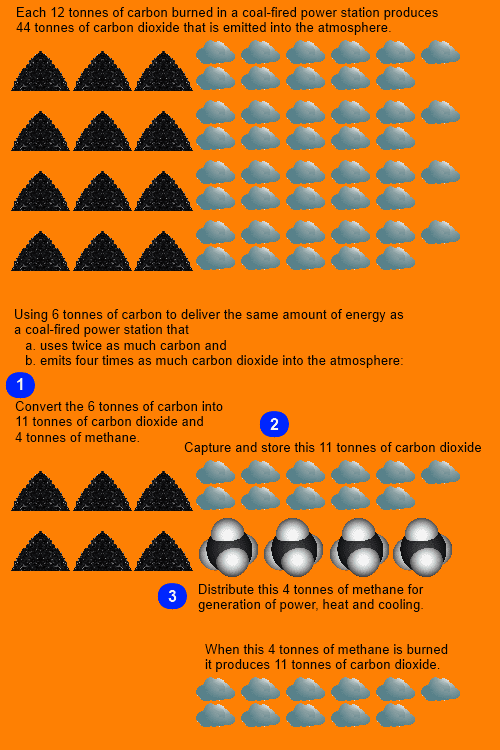
Science and technology show that we can halve the amount of coal needed to generate the energy we now use, cut CO2 emissions by 75 percent, and do this while delivering energy at a reduced cost:
Dakota Gas owns the Great Plains Synfuels Plant in Beulah, North Dakota that has operated since 1984.
It produces synthetic natural gas from brown coal.
Dakota Gas captures and sells CO2 produced at the plant.
CO2 from other power plants is very wet and diluted with nitrogen and oxygen and requires further processing, but Dakota Gas' process results in a CO2 stream that is very dry and 96 percent pure, so no additional processing is needed.

How to Halve Coal Demand and Cut Emissions by 75 per cent  
while Saving Money


Environmentalists oppose this technology. This group believes reliance on non-renewable energy resources must be ceased without delay. Note that this rejection of fossil fuels is quite separate from any risk of climate change that may or may not be caused by burning fossil fuels.

The fossil-fuel industry has an obvious lack of enthusiasm for this technology that gives us such a dramatic increase in energy efficiency. It results in demand for coal dropping by 50 per cent.

China on the other hand wishes to reduce its reliance on energy imports and to lower the cost of energy. It is increasingly building synthetic natural gas plants. Some examples (These links open web pages in new tabs):

  1. Synthetic gas from coal: Siemens to supply eight 500 MW coal gasifiers to China 
  2. India's coal-to-gas dream takes baby steps (Note:  "In comparison, China has some 50 coal gasification plants running and it is ploughing ahead with another 40.") 
  3. China Power Investment Corporation has awarded Haldor Topsøe the contract for a 2 billion Nm3 per year Coal to SNG plant in Xinjiang, China 
  4. GE Demonstrates Scale and Fuel Flexibility of Its Gasification Technology at Two Major Projects in China 
  5. Topsoe awarded the third coke oven gas to SNG plant in China   

For examples of savings in energy costs that result from using the technology described above, read more at A Tale of Two Shopping Centres.

Environmentalism has only a vague acquaintance with logic. This distinguishes it from science. For instance, it believes renewable energy technology is "necessary" even though it is clearly incapable of slowing growth in global demand for coal. Faced with this chronic failure, environmentalism still rejects out-of-hand available technology that halves the demand for coal. Logical thinking is not in evidence here. Environmentalism would prefer making no progress at all than get halfway to the "necessary" goal if this involves any use of despised fossil fuels.

Enter the climate change sceptics

Just as the environmentalists do not rely on climate science to justify their dislike of fossil fuels, the marketers of fossil fuels do not need climate science scepticism to justify their dislike of energy-efficiency technology that reduces the demand for fossil fuels.

However, it is logical to change a debate to a subject that cannot be quickly answered.

A debate in which the coal industry argues we should reject the available technology to reduce the cost of energy would be over very quickly.

The climate sceptics view of the world contains clear indications that it is an illogical invention of the fossil fuel industry. The clearly false assertions below serve only one purpose: To avoid engaging in the argument that we can create energy more cheaply with less fuel:
"The Kyoto Protocol, if implemented, reduces emissions by a mere five percent among industrialized nations only. But this would have a devastating effect on the economy of our nation."

"It is not possible to reduce carbon dioxide emissions, much less to stabilize or reduce atmospheric carbon dioxide concentrations, without severe restrictions on the use of coal, oil, and natural gas. This means a global regime of severe energy rationing, because it is not possible to replace these essential fuel sources with technology that is currently available and affordable."

"The use of coal and hydrocarbon fuel has another, more obvious effect: fueling the agriculture and industry that lifts billions of people from poverty and misery. Without abundant, economical sources of energy, millions of people would die and millions more would be reduced to dire poverty."

Has science become an alternative religion?


THE three wise monkeys of Australian climate science, professors Will Steffen, Matthew England and David Karoly, posted a self-justifying report on the Climate Commission website last week linking recent floods, heavy rain and low temperatures to global warming.
Historian Geoffrey Blainey, suggests science has become an "alternative religion". AFP

"The science behind southeast Australia's wet, cool summer" is their explanation for why the much-ridiculed predictions of endless drought by fellow climate activists, such as Climate Commissioner Tim Flannery, failed to materialise.

"The wetter conditions experienced in southeastern Australia in the last two years are consistent with scientists' knowledge and understanding of how the climate is changing in the long term," they write.

It's just the media that got it wrong.

"Most parts of Australia have experienced exceptionally heavy rains over the past two years, filling many dams around the country ... There has been much confusion in the media about what this means for climate change."

It's a pity these scientists weren't so proactive when the media was lapping up Flannery's Armageddon forecasts.

And no, contrary to Malcolm Turnbull's claims last week, Flannery wasn't "verballed".

It's a matter of public record that Flannery has warned of endless drought for years.

In 2007 he predicted, "rainfall across eastern Australia will reduce until a semi-permanent El Nino-like (drought) state is induced".

"Blind faith in alarmist predictions has serious consequences"
He urged desalination plants be built within 18 months.

He claimed, "even the rain that falls isn't actually going to fill our dams and our river systems".

He was wrong.

But through his best-selling book The Weather Makers, the Climate Commissioner influenced a lot of Australians.

Blind faith in alarmist predictions has serious consequences.

In last year's floods in Brisbane, for instance, we now know that engineers at the Wivenhoe dam chose to believe the doomsayers rather than the evidence of their own eyes and the actual weather forecast that told them the drought had broken and Dorothea Mackellar's "flooding rains" were back.

Conditioned to believe permanent drought was the new reality, the engineers hoarded water.

Instead of releasing it slowly and early, they waited until it was too late, and huge volumes of water escaping from the dam flooded Brisbane, engulfed 15,000 homes and businesses.

The hapless engineers, now facing criminal charges, are the scapegoats.

But the real culprits are opportunistic politicians and mad greenies, whose apocalyptic warnings supersede prudence and common sense.

With just four months left until the advent of the carbon tax, the alarmists have regrouped.

Without admitting any errors of the past, they blithely explain away the inconvenient truth of all that rain and ramp up Armageddon scenarios that justify the tax.

With the IPCC's Fifth Assessment Report due next year, the hyperbole meter is set to screech.

Historian Geoffrey Blainey, speaking last week, suggests science has become an "alternative religion".

Research into his new book, A Short History of Christianity, leads him to think our attitude towards science in an era of technological advances is akin to religious faith, with gods to worship, a vehemence of belief, good and evil, heretics and saints.

He says alternative religions have taken the place of Christianity, including communism, and nature worship.

The third alternative religion is "science, its cousin technology and its god, reason".

"Science has become incredibly powerful and influential, which is understandable.

So much of our increased standard of living in the last 150 years has come from science and technology and understandably science is worshipped by a large number of people."

MIT atmospheric physicist Professor Richard Lindzen also views climate alarmism as "quasi-religious".

Climate alarmists want science to act as the servant of politicians pushing for carbon control.

That is not the role of science.

Saturday, March 3, 2012

Warmer Climate Good For Singer

Debate Over Climate Science of Academic Interest Only -
Policy on Climate Change Resolved by Energy Technology


The debate that has raged for over a decade on climate science has turned out to be a fizzer.

The final answer to the question:
Do emissions from burning fossil fuels cause global warming?
turns out to be:
Apart from climate scientists publishing academic papers, no-one cares.
Where did we go wrong in elevating this unimportant question into a major political debate?
These two assumptions created the perception that climate science was important:
  1. That effects of climate change caused by human activity will be beneficial.
  2. That any efforts to limit climate change caused by human activity would have dire consequences.
We now know the second assumption was wrong. Academic climate scientists may continue to debate the first assumption for years to come, at their leisure.

Dr Fred Singer correctly describes policy formulation in circumstances where scientists disagree over important issues:
This is a problem that people will have to ask themselves. They'll have to say: What happens in the worst case?
The policy answer to this so-called "problem" is surprisingly simple:
  1. Energy generation with low emissions of carbon dioxide will NOT have a devastating effect on the economy and result in millions of people dying and millions more reduced to dire poverty. 
  2. Energy generation with low emissions of carbon dioxide will reduce the cost of energy, boost economic activity, create jobs growth and help to reduce poverty. This is THE RIGHT policy response. 


Interview, Dr. S. Fred Singer


If people can't rely on statements like "most scientists agree" and so forth, like that, with an issue of this complexity, how are they supposed to come to an opinion on it?

How should people come to some conclusion when scientists disagree? I think this is a problem that people will have to ask themselves. They'll have to say: What happens in the worst case? Supposing the scientists who say it will warm are correct, is that good or bad? And the answer is: If it warms, it will be good. So what is the concern, really? Even if the warming should take place, and the warming will be noticeable...if that should be the case, if it is measurable, that does not mean that it is economically damaging. In fact, the opposite is true.

But you might get, for instance, flooding in Bangladesh or in the [Maldive] Islands, or in southern United States. Those have to be scenarios. If you have a warming up,four or five degrees, those are possibilities, aren't they?

We have to ask, what is the impact of a warmer climate? It's not the warming itself that we should be concerned about. It is the impact. So we have to then ask: What is the impact on agriculture? The answer is: It's positive. It's good. What's the impact on forests of greater levels of CO2 and greater temperatures? It's good. What is the impact on water supplies? It's neutral. What is the impact on sea level? It will produce a reduction in sea-level rise. It will not raise sea levels. What is the impact on recreation? It's mixed. You get, on the one hand, perhaps less skiing; on the other hand, you get more sunshine and maybe better beach weather.

Let's face it. People like warmer climates. There's a good reason why much of the U.S. population is moving into the Sun Belt, and not just people who are retiring.


Moscow death toll soars as heat wave persists

"She could have been dead for two to three days, doctors suppose," said the psychologist, who had rushed back to Moscow from vacation in Croatia after she couldn't reach her mother by phone. "The windows in her apartment on the sixth floor were wide open and every piece of furniture in the apartment smelled of burning" from the thick white smoke hanging in the air outside.
...

Revich said the heat and smog were hardest on the elderly and those suffering from lung disorders. "Even after the heat is gone these people will be suffering from the consequences and we will see more and more deaths in the coming weeks," he said.


An Acceptable Solution for Fred Singer and his Antagonists 
(or, How we can have our cake and eat it too) 

If you want CHEAPER, RELIABLE energy the answer exists, and is repeatedly demonstrated on real projects:

Distributed energy generation produces energy at SUBSTANTIALLY lower costs than central power generation - either fossil-fueled or renewable.
BASIX Multi-Unit Residential Cogeneration Demonstration Project
Mirvac’s Cambridge Lane development is saving its occupants around $1,000 a month on power bills.
...cut its greenhouse emissions [at an annual rate of] 120 tonnes of CO2, equivalent to greenhouse emissions from around 35 cars.
Smart Energy Zones - Case Study: Glenfield, Australia
In most locations in Australia delivered grid power costs between 17 and 18 cents per kwh. ...It is projected that the GridX power system will cost less than 10 cents per kwh.
Immediate GHG reduction 33% - CO2 reduction per annum 250 tonnes.

If you want to reduce CO2 emissions:

Distributed energy generation cuts CO2 emissions at a LOWER COST than renewable energy.
Distributed Energy Delivers Big, Green Results in London
...distributed energy delivers greater carbon emissions cuts for every dollar spent than centralized renewable energy

Note that distributed energy generation can be fueled by fossil fuels, renewable fuels, or ANY COMBINATION of both.

Fred Singer and his supporters do not realise that cheap energy with low CO2 emissions is available -

Hot Topics, Cold Truth
The Kyoto Protocol, if implemented, reduces emissions by a mere five percent among industrialized nations only. But this would have a devastating effect on the economy of our nation. It’s part of the anti-technology, anti-energy, anti-growth philosophy of the extreme "greens."

Scientists Urge Rejection Of Kyoto Agreement
It is not possible to reduce carbon dioxide emissions, much less to stabilize or reduce atmospheric carbon dioxide concentrations, without severe restrictions on the use of coal, oil, and natural gas. This means a global regime of severe energy rationing, because it is not possible to replace these essential fuel sources with technology that is currently available and affordable.

The use of coal and hydrocarbon fuel has another, more obvious effect: fueling the agriculture and industry that lifts billions of people from poverty and misery. Without abundant, economical sources of energy, millions of people would die and millions more would be reduced to dire poverty.


Sunday, January 8, 2012

Agenda 21

A New Group of Extremists

Given the extracts of opponents to UN Agenda 21 below extreme conduct of carbon tax opponents is not  surprising.

The potential for violence from those who subscribe to such a conspiracy theory cannot be ruled out.

Your Town and Freedom Threatened

By Freedom Advocates
Tuesday, 04 August 2009

Right now, in your town and neighborhood, policies are being implemented that will ultimately eliminate your freedoms and destroy your way of life....
...
The false premise and outright lies of anthropogenic global warming to change our way of life, for the worse!
Local Governments for Sustainability promotes ... Local Agenda 21 and other United Nations programmes ...


Introduction to Sustainable Development

The new process is to by-pass elected officials and put  policy-making into the hands of selected individuals who agree with the objectives of Agenda 21...
...
The bedrock principle on which America is founded is the belief that government is empowered by the consent of those who are governed.
...
Public policies that are enacted by elected officials are, therefore, ultimately subject to the approval (or consent) of those who are governed.
...
Perhaps the greatest danger of sustainable development is the transformation of the process through which public policy is created.
...
It is difficult for Americans to comprehend a system of governance in which the government is omnipotent and ordinary citizens are subject to whatever whims may be imposed by whomever happens to be in power.  Nevertheless, sustainable development requires such a system of governance to manage the affairs of individual citizens to insure that social equity and environmental protection are integrated into all economic activity.
...
Social equity means that "...all citizens share equally in the benefits of natural resources."
America is said to be home for only five percent of the world's population which uses 20 percent of the earth's resources.  Therefore, America's consumption of natural resources must be reduced while providing access to the world's resources to the people in the rest of the world.  The Framework Convention on Climate Change, with its Kyoto Protocol, will force a 40% reduction in energy use in America and in 33 other developed countries.  The resulting increased cost of everything that uses energy will force a reduction of consumption in America.  But since no energy use restrictions are imposed on the remaining 137 developing nations, industry will move to China, Mexico, Brazil, and Asia to produce their goods for the people in developing nations.

The process will force the redistribution of wealth to achieve "social equity" in the name of protecting the environment.


Agenda for the 21st Century Invades Australia

By Diane Ross
Monday, 07 January 2008

Australian leaders enforce Agenda 21 Sustainable Development by restricting private property use...
...
Environmental groups sanction and aid Agenda 21 policies. They are funded by organizations such as the Rockefeller Foundation. Unsuspecting citizens are misled by buzz words such as:     
  • Sustainable Development
  • Smart Growth
  • Taking Care of the Planet
  • Climate Change
  • Global Warming
  • And other similar language
"Earth Dialogues" was held in Brisbane Australia in July 2006.  ...Children were encouraged to denounce national sovereignty and embrace a global government.

New Treaty In the Making

Covenant on Environment and Development

Few people in America have seen Agenda 21. Even fewer have read it.  ...This is the UN Treaty that will move the world into the clutches of global governance.
 ...
Part IV (Articles 16 through 22) says States "shall restrict human activities which modify, or are likely to modify..." ...global climate...
...
The "Precautionary Principle" ... of Agenda 21... is the idea that policy action should not wait on scientific justification if "government" decides that a "threat" to the environment exists.
...
Article 48 - State Liability
"Each State Party is liable for significant harm to the environment of other States or of areas beyond the limits of national jurisdiction, as well as for injury to persons resulting therefrom, caused by acts or omissions of its organs or by activities under its jurisdiction or control."
...
Article 54 - Sovereign Immunity
"Parties may not claim sovereign immunity in respect of proceedings instituted under this Covenant."

Carbon Tax

Making sense of the bizarre and dangerous

A tweet about a carbon tax elicited these responses:
  • "I'm Opposed to handing soverignty over to the Pope's United Nations..."
  • "How profitable does Carbon Tax need to be to justify treason thru loss of sovereignty?..."
  • "Its called treason/sedition, its in our law. Our soverign is the rightful heir of UK not the UN..."
  • "TREASON is rewarded with a noose from a tall tree. Careful , Australia is alot bigger than your Canberra herd..."
Curious about the introduction of the concepts "sovereignty", "Pope's United Nations", "treason" and "noose", some research identified a number of extremist websites promoting these within conspiracy theories. Read some extracts of these dangerous websites on Agenda 21.

The earliest discussion of these bizarre ideas is in a 1993 Los Angeles Times article on the beliefs of a group called The John Birch Society. It expressed fears including:
"Birchers preach that the United Nations wants socialism to rule the world and that global warming caused by pollution is a hoax foisted on gullible Americans to gain control over their land and businesses."

"Our feeling is that over a long period of time, they (communists) have taken control of the federal government of the United States," said Mark Walsh

Fred Koch founded the Koch Oil Corporation and was an early member of The John Birch Society's National Council, an advisory group to JBS founder Robert Welch.

Earlier this year The John Birch Society said it was pleased to announce that Nelson Bunker Hunt of Texas will again serve as a member of its National Council. Nelson Bunker Hunt is an American oil company executive.

This is the list of tweets exchanged:

9:40 PM - 7 Jan 12 via web

9:52 PM - 7 Jan 12 via web

9:54 PM - 7 Jan 12 via web

9:57 PM - 7 Jan 12 via web

10:03 PM - 7 Jan 12 via web

10:23 PM - 7 Jan 12 via web

10:34 PM - 7 Jan 12 via web