Latest Buzz...
                  

Translate

Showing posts with label Carbon Credits. Show all posts

Wednesday, December 8, 2021

Paying fossil fuel producers to store carbon dioxide

The Australian Government and fossil fuel industries have planned for over a decade to have taxpayers pay fossil fuel businesses to store carbon dioxide. 

Discussion on climate policy often raises the possibility of some carbon pricing mechanism. 

The preferred option of the Australian Government - to have taxpayers fund the storage of carbon dioxide - is ignored as though it is unthinkable.

Australia includes Carbon Capture and Storage in the Emissions Reduction Fund

The two different approaches can be easily understood in several other policy areas. 

As an example, consider the meat export industries in two countries - such as Australia and the U.S. 

Assume that beef producers in both countries need identical government-regulated export inspection services to assure the quality of the exports. 

Assume also that the cost of government-regulated export inspection services is identical in the two countries. 

The Australian Government, in line with policy of its economic advisors, considers that full cost recovery is the most rational method of funding the service it provides to beef producers. 

See for instance:

Australian Government Charging Framework

"The Australian Government Charging Framework (the Charging Framework) is a policy of the Australian Government. The Charging Framework covers activities where the government charges the non-government sector for a specific government activity such as, regulation, goods, services, or access to resources or infrastructure."

And the implications of implementing it:

Live exporters facing huge cost surges under Federal cost-recovery plan

The cost of an annual livestock export license in Australia will soar from $25,000 to over $100,000 under the latest round of cost recovery increases planned by the Federal Government.

As it does with other export sectors, the Federal Government aims to recover the full bureaucratic costs it incurs for certifying and regulating the livestock export industry, through a series of fees and charges imposed on livestock exporters.

Every five years or so the Federal Government reviews and updates the rates it charges with a view to ensuring full cost recovery from industry.

Suppose that the U.S. Government does not adhere to this economic philosophy, and provides its beef industry with the same services - at the same cost - but pays for the service from general revenue collected from taxpayers. 

In both countries, the same service is provided, but in the U.S. the cost is borne by taxpayers and so U.S. exporters - who do not bear the cost - do not need to recover the cost from the customers who import beef from the U.S. 

In Australia, the cost is borne by the beef industry. It needs to recover the cost by adding it to the price it charges its customers. 

The Australian beef producers are, as a result, at a commercial disadvantage to the competing beef exporters in the U.S. who are not charged for the service provided by the U.S.Government at no cost to them. 


Now, back to the public "blind spot" on alternatives to a carbon price...

While it may seem obvious to everyone that a carbon price is the way forward, it is only one of two ways to pay for reducing carbon dioxide emissions from fossil fuels. 

With a carbon price, businesses that emit carbon dioxide bear the cost - through that carbon price - for emitting the carbon dioxide, and need to add that price on to the products they sell. 

This puts them at a commercial disadvantage to other businesses that provide alternate products that do not incur that cost. 

This is similar to the example of beef exporters, where one group bear the cost of a service, who are in competition with exporters in another country who are selling a competing product but without bearing any cost for the same service. 

The Australian Government has long planned to allow fossil fuel exporters to avoid the cost of carbon dioxide emissions. 

The most recent and clearest example is the measure announced in October 2021 to give Australian Carbon Credit Units (ACCUs) for carbon capture and storage. 

This measure is only the latest step in a sequence of measures put in place over several decades. Earlier steps were in preparation for regulating and licencing underground storage sites for carbon dioxide. 

Greenhouse Gas titles in Commonwealth waters in Australia

The most recent step is the concluding step to address commercial viability of carbon capture and storage. It prevents carbon capture and storage being a cost to fossil fuel producers that they will only choose if a carbon price makes it cheaper to store carbon dioxide to avoid paying the carbon price.

Allocating Carbon Credits for storing carbon dioxide results in taxpayers paying for pumping carbon dioxide into the underground storage sites that are being licensed. 

This is like the hypothetical example of beef exporters where cost of the service is the same - in this case, storage instead of emitting carbon dioxide - but the cost is borne by taxpayers and not by the businesses that use the service.

Friday, April 26, 2013

NSW Government lies to electricity consumers

Extract from Media Release by The Hon Chris Hartcher, New South Wales Minister for Resources and Energy, Special Minister of State and Minister for the Central Coast

23 April 2013
"NSW electricity bills will continue to show the cost of Labor’s carbon tax following the release of the Independent Pricing and Regulatory Tribunal’s (IPART) draft pricing determination that estimates the carbon tax and green schemes component will increase to $330 for the typical household bill.
...
Energy Minister Chris Hartcher said that with the Government capping network price rises at CPI or below, the carbon tax and green schemes continue to drive up the price of electricity for NSW households.

“IPART estimates that NSW electricity bills would be $171 cheaper from 1 July if Labor scrapped its disastrous carbon tax,” Mr Hartcher said. "
What Mr Hartcher conceals is that personal income tax cuts averaging $520 per year were made to cover the cost of the carbon price. The Federal Coalition has promised to remove these income tax cuts.

Extract from Draft Report - Review of regulated retail prices for electricity 2013 to 2016

23 April 2013
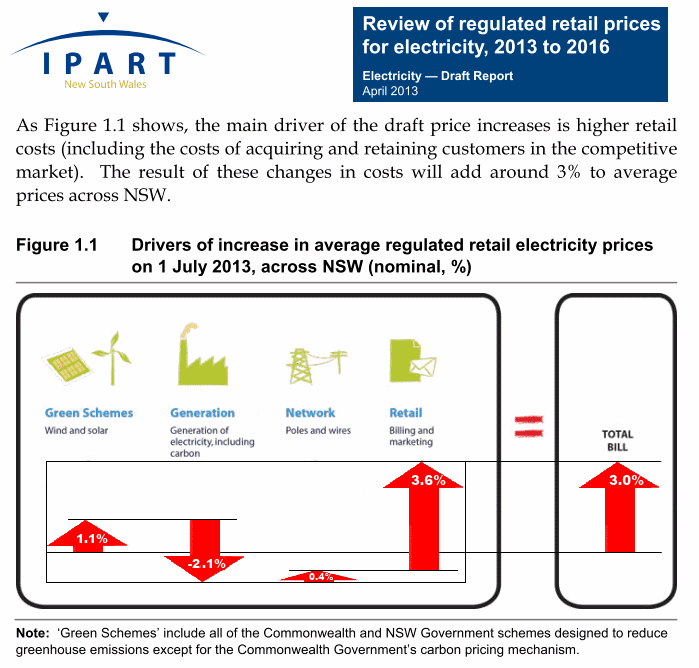
Regulated electricity prices NSW, July 2013

The IPART review of electricity prices shows the carbon price and renewable energy generation has forced down the cost of electricity generation by 2.1 percent. The result is a REDUCTION of 1 percent in NSW electricity bills.

Unfortunately, there are increases of 0.4 percent for Network charges and 3.6 percent for Billling and Marketing charges by NSW electricity retailers.

These are responsible for the increase in NSW power bills of 3 percent on 1 July 2013.

Further deception by the NSW Government


The NSW Government has announced it will place a statement in red on all NSW electricity bills, falsely claiming that  "NSW Govt estimates that the Federal carbon tax and green energy schemes add about $330 a year to a typical 6.5MWh household bill – www.ipart.nsw.gov.au"

Struggling NSW families are missing out on $40 million in electricity rebates. Tony Abbott, the NSW Government and the media spray the public with carbon tax nonsense. The NSW Government is less interested in letting 540,000 families know they are eligible for rebates.

Fewer than a couple of thousand have applied for this money to help with rising power bills.

Find out about the secretive NSW electricity assistance package in the related post -

News blackout on carbon tax relief

Friday, April 12, 2013

Woodside LNG Project hits energy innovation wall

Mixed reaction as Woodside shelves Kimberley gas hub
ABC Rural, Friday April 12, 2013

RIL selects Phillips 66's E-Gas Technology


The Hindu Business Line | May 22, 2012

Reliance Industries Ltd (RIL) on Tuesday announced it has selected Phillips 66’s E-Gas technology for its planned gasification plants at Jamnagar in Gujarat.
...
The largest gasification project in the world...

The planned gasification plants at Jamnagar will process petroleum coke and coal into synthesis gas utilizing the new technology. The synthesis gas will be used as feedstock for a new chemical complex and will fuel the refinery's existing gas turbine power generation units... (Read more...)

... The E-Gas technology has been utilized in commercial applications since 1987. It incorporates a gasification system design that can be applied with gas and steam turbine combined-cycle power generation to produce electric power, as well as synthesis gas applications for the production of hydrogen, chemicals or substitute natural gas in highly flexible combinations.

It is among the cleanest and most efficient commercial technologies for coal or petroleum coke-based electric power generation and syngas production. It offers high system efficiencies, minimized water consumption and very low emissions...


Using the technology China, India, Pakistan and other countries have acquired, Australia's energy needs can be met with no coal seam gas and half of its existing coal mine output.
  • The cost-savings for Australian industry are substantial. 
  • Australian industry would benefit from increased international competitiveness.


Related articles


Friday, April 5, 2013

Earning income from a carbon price - extra information

IN SALAH

Industrial-scale carbon capture and storage (CCS) in action

In Salah, an industrial-scale CCS project in Algeria has been in operation since 2004. More than three million tonnes of CO₂, separated during gas production, have been securely stored in a deep saline formation. BP, Sonatrach and Statoil, the project operators, aim to store a total of 17 million tonnes over the next 20 years. (Read more...)


Coal industry delaying CO2 cuts for another 15 years

Why is Australia to spend over $1 billion on CarbonNet and take 15 years developing new Carbon Capture technology ----
 ---- when proven technology has existed for decades in the USA?


Santos Booklet "Moomba Carbon Storage project"


Science behind carbon storage validated


Monday, April 1, 2013

Australian media bias on carbon tax

Tony Abbott confronting a journalist asking tough questions

What the Australian Media DID Report


US inaction on carbon tax shows Australia isolated: Tony Abbott 

The Australian From: AAP January 22, 2013 
FEDERAL Opposition Leader Tony Abbott has pointed to the Obama administration's inaction on carbon pricing after the US president said more must be done to address climate change.
...
Asked if the president's speech meant Australia should do more to tackle climate change, Mr Abbott said the US Democratic administration had backed away from an emissions trading scheme.

"The interesting thing is that President Obama's administration has three times, in the last few months, explicitly ruled out a carbon tax or an emissions trading scheme," he said.

"Now, all of us are concerned about climate change. All of us want to do the right thing by our planet. We all want to give the planet the benefit of the doubt.

"But we've got to have smart policies, not dumb policies, to do that."
(Read more ...)


Doorstop Interview, Forestville 

Tony Abbott Latest News Sunday, April 7, 2013 
...
QUESTION:

The Prime Minister has recently been praising other countries in Asia with regards to climate change. Do you think that you should leave the carbon tax alone?

TONY ABBOTT:

The carbon tax is damaging our economy. It is not doing any good for the environment.
No other country is imposing a carbon tax on its economy at that scale.
So one of the best things I can do for the families of Australia, one of the best things I can do for the job security of workers, one of the best things I can do to boost our economy and make things like the NDIS more affordable is scrap the carbon tax.

QUESTION:

When is the Coalition going to release its broadband policy?

...
(Read more ...)

This nation's a bit player in game theory of climate change policy 

The Australian Noel Pearson, The Australian, April 20, 2013 
...
Having committed Australian industry to a tax of $23 a tonne, rising to $24.15 on July 1, our country will pay while the rest of the world will not, and there is still no sign other countries will join us.
(Read more ...)

What the Australian Media DIDN'T Report


UK Government action on carbon tax shows Australia is not isolated 

HM Government
March 20, 2013 
The UK Government is acting to give private investors the confidence to invest in the UK’s energy sector.

From April 2013 the carbon price floor announced at Budget 2011 will come into effect, providing a clear and credible long-term signal to support investment in low carbon electricity generation.

[The carbon price floor starts at £16 ($AUD26.79) per tonne in April 2013 and has a target price for carbon of £30 ($AUD50.24) per tonne of carbon dioxide in 2020.]
(Read more ...)

University of Western Australia - Coalition's Direct Action plan may be impractical

HM Government
January 23, 2013 
NEW UWA research looking at the economic impacts of implementing soil organic carbon (SOC) sequestration methods into farming practices, is showing that these impacts may prove impractical for farmers.
...
The authors found that while altering certain practices can be used to increase carbon sequestration it is costly and farmers would require high levels of compensation to make it a viable option.

By modeling the cost of these practices researchers estimate the profit lost for each additional tonne of CO2 stored on the model farm was $80.00 which is far more than the initial buying price of $23.00 per tonne under carbon tax legislation.

[It is 10 times more than the $8.00 per tonne estimate relied upon by Tony Abbott for costing the Coalition's Direct Action plan.]
(Read more ...)

Earning income from a carbon price

The notion that carbon dioxide-emitting industries and power stations MUST stop emitting carbon dioxide, regardless of the expense, and pass this increased expense onto customers is a widely held but WRONG belief.

It's easy to find criticisms of a carbon price and emission trading schemes. Reading these criticisms you could easily come to the conclusion that money ends up flying off to governments or foreign countries.

Information on how to earn an income from a carbon price is pretty scarce.

Every cloud has a silver lining and carbon pricing schemes are no different.

Suppose an industry can cheaply collect carbon dioxide from the atmosphere and store it.
  • It makes a lot of sense to pay this industry to collect as much carbon dioxide as possible. 
  • If it can collect carbon dioxide for, say, half of the cost that would be incurred by a power station to prevent the carbon dioxide being emitted in the first place, then it is obviously cheaper, and more profitable, to collect it later and DON'T BOTHER preventing the carbon dioxide being emitted by the power station.

Collecting carbon dioxide for extra income

A couple of ideas on earning income by collecting carbon dioxide from the atmosphere as a byproduct from existing industries are described in the article Negative CO² emissions - Climate protection opens new business areas.

The Rumpke Sanitary Landfill near Cincinnati, Ohio collects landfill gas and upgrades it to pipeline-quality natural gas by separating carbon dioxide. No extra cost is involved. The process uses an XEBEC gas purification system. There is no new technology to be developed and commercialised.
XEBEC’s systems are being used worldwide to effectively remove carbon dioxide (CO2) from landfill, digester or well gas streams
XEBEC’s systems are being used worldwide
to effectively remove carbon dioxide (CO2)
from landfill, digester or well gas streams

Storing carbon dioxide for extra income

Want a new industry that generates $10 billion revenue?
Store one billion tonnes of carbon dioxide at a price of $10 per tonne.
Santos has designed one -


More information -

Earning income from a carbon price - extra information

Old plays won't save coal but a carbon tax could

Attempts to access this story had been unsuccessful throughout April. 
(Error message: Oops! Google Chrome could not find www.kentucky.com)
The original can be accessed (on May 3, 2013): Old plays won't save coal but a carbon tax could

The cached copy is reproduced below -

Published: March 31, 2013 Updated 6 hours ago


Bob Inglis, who directs the Energy and Enterprise Initiative, is a former Republican member of Congress from South Carolina.
Bob Inglis, who directs the Energy and Enterprise Initiative,
is a former Republican member of Congress
from South Carolina.


Coal built our economy but its future is grim — unless we find an alternative to EPA regulation of heat-trapping gases like CO². If we can clean it up, coal can be a useful resource for years to come. If we can't, it will ultimately become much less valuable.

Strange as it may sound, that's why the CEO of one of the world's largest coal companies is in favor of a carbon tax. Marius Kloppers figures that BHP Billiton has hundreds of years of coal in the ground in Australia. The problem is that his biggest customer, China, may tire of breathing dirty air. If they do and if the Chinese innovate around coal, BHP's inventory could be reduced to a 20- or 30-year salable commodity. So BHP wants to push coal up the technology curve.

Some U.S. coal companies are also investing in the long-term viability of America's most abundant energy resource. They're rightly asking for and are conducting research on carbon capture and sequestration (CCS). If CCS could be combined with coal gasification technologies, it's possible that water vapor would be the only emission from coal-fired plants. That's a bold future — the kind of future that CEOs like Kloppers want to bring about.

The standard play is to try to slow the inevitable. And nowhere is it more standard than in Washington, D.C. The Environmental Protection Agency is under orders from the Supreme Court to regulate CO² as a pollutant under the Clean Air Act. The EPA has drafted CO² regulations for new coal plants. Soon, EPA plans to regulate CO² from existing coal plants. When it does, coal will lose, quickly, to competitors like natural gas. This regulatory scenario gives coal no time to innovate.

The standard line from coal state representatives is, "Let's get together and try to stop those regulations." It's the same play textile states attempted when the rest of the country decided it liked cheaper, imported clothes. It's the same play tobacco states tried when the rest of the county decided to quit subsidizing smoking.
When something becomes inevitable — like the pricing of carbon — there's little to be gained from simply slowing government regulation. Endless litigation and aggressive congressional oversight may delay the onset of regulations but, like textiles and tobacco, the writing's on the wall.

Bluster may provide some cover to elected officials representing coal-dependent constituents, but it won't secure their constituents' future. Coal needs a different series of plays.

For coal, the right kind of CO² tax would be far better than pending CO² regulation. A well-planned and fair carbon tax would give coal time — time to try CCS, time for domestic users of coal-fired power to continue manufacturing here rather than moving production to non-CO² regulated countries, and time to continue exporting coal, tax-free.

The very different play for coal might look like this: Tax carbon upstream at the mine and at the pipeline. Pair that new carbon tax with a dollar-for-dollar reduction in other taxes so we don't grow the government and families have more money to cope with higher energy prices. Repeal Clean Air Act regulations that would be made redundant by the price on carbon. Make the new carbon tax border-adjustable so that it's removed on exports and imposed on imports.

The border-adjustable feature is critical in two ways. First, coal from the U.S. wouldn't be priced out of foreign markets because the U.S. carbon tax would be removed on export. Second, manufacturers who use coal-fired power in the U.S. would have level CO² costs with their foreign competitors. CO² pricing here wouldn't cause them to move their factories to a non-CO²-priced countries because imports would be taxed equally on CO² content.

Sometimes we find that something we've been doing for years has consequences we never envisioned. Years ago, who knew smoking caused cancer? Tobacco companies fought the inevitable conclusion of the research, but they ultimately lost. Now, some of the same people — literally some of the same people — are fighting the inevitable conclusion of chemistry and physics and the effects of greenhouse gasses. They will lose. Coal could lose with them.

Coal states have the opportunity to call the next series of plays. There's something better than "Up the middle, up the middle, up the middle, punt."

Related links:


Ex-GOP rep talks climate change solutions

Bob Inglis’ plan proposes market-based climate change solutions, like fuel taxes and subsidy cuts

Friday, March 22, 2013

UK Carbon Price Floor - Budget 2013

Extracts from UK "Budget 2013 documents",
20 March 2013


Chapter 1 - Budget Report

- at https://www.gov.uk/government/uploads/system/uploads/attachment_data/file/188360/budget2013_chapter1.pdf.pdf

Support for private investment in infrastructure

(Chapter 1, page 35-36)

1.90 The Government is acting to give private investors the confidence to invest in the UK’s energy sector. From April 2013 the carbon price floor announced at Budget 2011 will come into effect, providing a clear and credible long-term signal to support investment in low carbon electricity generation.

1.91 The Energy Bill, currently making its passage through Parliament, will introduce Electricity Market Reform. By providing stable revenues for investors at a fixed level known as a strike price, Contracts for Difference, as set out in the Bill, will provide long-term certainty for investors in low carbon generation. This will lower the cost of capital and help developers secure the large upfront amounts of capital investment required. Support available for low carbon electricity investment through the Levy Control Framework up to 2020 will rise to £7.6 billion a year (in 2012 prices), more than triple the £2.35 billion available in 2012-13. Together with the Government’s Energy Bill and Gas Generation Strategy, published in 2012, this will provide the framework needed for new energy investment.

1.92 The Government intends to take forward two Carbon Capture and Storage projects to the detailed planning and design stage of the competition. This represents the next step in the £1 billion Carbon Capture and Storage commercialisation programme and follows a period of intensive commercial negotiations with a number of bidders. The Department for Energy and Climate Change will set out the details of the preferred bidders, next steps on these front end engineering and design studies, and the process to final investment decision.

Chapter 2 - Budget policy decisions

- at https://www.gov.uk/government/uploads/system/uploads/attachment_data/file/188361/budget2013_chapter2.pdf.pdf

Carbon Taxes

(Chapter 2, page 85)

2.159 Climate change levy (CCL) rates – CCL rates will increase in line with RPI from 1 April 2014. (Finance Bill 2013)

2.160 Carbon price floor (CPF) rates – The Government will set 2015-16 carbon price support rates equivalent to £18.08 ($AUD33.83) per tonne of carbon dioxide in line with the carbon price floor set out at Budget 2011. The Government will continue to provide support to energy-intensive industries to compensate for the indirect cost of the CPF in 2015-16. Further details will be announced at the next spending round. (Finance Bill 2013)

Carbon Price Floor - Briefing Paper

- at www.parliament.uk/briefing-papers/sn05927.pdf

Fluctuations in the price of carbon in the form of EU ETS allowances have resulted in uncertainty for investors in low carbon technologies. This has contributed to a lower level of investment in these technologies, below what is required to meet UK carbon reduction and renewable targets.

To address this, the Coalition Government committed to introduce a floor price carbon and published a consultation on carbon price support in December 2010. Following this it announced in the March 2011 Budget that it would be introducing price support via the Climate Change Levy and fuel duty with a target price of £30 per tonne of carbon dioxide in 2020. The floor price will start at about £16 per tonne. At the time of the announcement the trading price was around £15 per tonne, but by January 2013 it had fallen to under £4.

Detailed proposals for the carbon price floor were published by HMRC in December 2012 as part of the draft Finance Bill 2013.

1 Background

1.1 The EU ETS

The EU Emissions Trading Scheme (EU ETS) is a mandatory cap-and-trade scheme for carbon dioxide, which is central to the EU’s climate change target of reducing emissions by 20% by 2020. It sets a decreasing cap for emissions from energy intensive sectors, and allocates or auctions emissions allowances (EUAs) which can be traded on the open market. It is currently in Phase II, which imposes reductions of 6.8% compared to 2005 emissions.
...

1.2 Is the price of carbon too low?

Over allocation of permits in Phase I led to the price falling to only a few cents. The consensus is that an allowance price of at least €30 a tonne is needed to drive investment. For Phase II the price reached €29 in 2008. However prices have fallen significantly since and at the end of January 2013 were hovering around €4.

The response from the Commission has been to consider raising the emissions reduction target for 2020 from 20% to 30%. This has full support from the UK Government and most Member States, although it has so far been strongly resisted by Poland. The EU Commission has also proposed holding back future credits due for auction – or backloading – but there is opposition to this from the EU Parliament.
...

3 Coalition Position

The Coalition Agreement made the following commitments with regard to the EU ETS:
  • We will push for the EU to demonstrate leadership in tackling international climate change, including by supporting an increase in the EU emission reduction target to 30% by 2020.
  • We will introduce a floor price for carbon, and make efforts to persuade the EU to move towards full auctioning of ETS permits.
Further details on a floor price were provided in July 2010 in response to a written parliamentary question:
The creation of a floor for the carbon price is an important commitment in the Programme of Government. As announced in the Budget, the Government will publish proposals in the autumn to reform the climate change levy in order to provide more certainty and support to the carbon price. Further detail will be published as part of the consultation process.
...

4 Government Budget Announcement

The Government announced its decision in the March 2011 Budget:
Carbon price floor – The Government announces a floor price for carbon in the power sector from 1 April 2013 to target a price for carbon of £30 ($AUD56.13) per tonne of carbon dioxide in 2020. The floor will start at around £16 ($AUD29.94) per tonne of carbon dioxide and the carbon price support rates for 2013-14 will be equivalent to £4.94 per tonne. The Government intends to introduce relief for carbon capture and storage and combined heat and power (CHP), and remove an existing exemption in the climate change levy for electricity CHP plants supply indirectly to an energy consumer. Anti-avoidance provisions will be introduced to prevent forestalling with effect from 23 March 2011. (Finance Bill 2011)
The then Energy and Climate Change Secretary, Chris Huhne, welcomed the decision, together with the commitment in the Budget to a Green Investment Bank:
“There’s a clear, long term signal to energy investors in today’s Budget. A Green Investment Bank with substantially more capital and borrowing capacity and a stronger, more stable carbon price put investment in green energy technologies at the heart of the coalition’s strategy for sustainable, balanced economic growth.”

4.1 Costs and Benefits

The costs and benefits for a target price of £30 for 2020 were set out in the regulatory impact assessment. This concluded that the resource cost – investment in new technology – would be around £6.1bn for 2013-2030. Over the same period there would be a carbon saving of £7.2bn and savings due to improvement in air quality of £0.9bn. This results in a total benefit in net present value of £1.9bn.

Monday, January 2, 2012

Negative CO2 emissions - Climate protection opens new business areas


Farmers to the Rescue - 

One solution to concerns over carbon dioxide levels in the atmosphere

OR

Who needs Coal Seam Gas anyway?

Pine plantations and other crops can collect solar energy. They can also store solar energy and remove carbon dioxide from the atmosphere.
In contrast, solar panels and wind turbines cannot store solar energy and cannot remove carbon dioxide from the atmosphere.

Unlike solar panels and wind turbines, pine trees and other crops grow themselves - they are "self-manufacturing". There is no need for factories with high energy demands to manufacture trees and other crops.

Unlike coal seam gas - once its been used, its gone - agriculture can provide a continuous source of energy.

Biomass combined with carbon dioxide capture and storage to remove CO2 from the atmosphere
Biomass combined with carbon dioxide capture and storage to remove CO2 from the atmosphere.
Sawmill waste, other agricultural and municipal waste and coal may be combined and converted into synthesis gas or methane and carbon dioxide.
Ze-gen Gasification Unit

From "BTOLA: Growing Tomorrows Energy Today" -
BTOLA has completed the selection of a Biomass energy crop highly suited to Australian / Queensland conditions: a high yielding cane type perennial grass: Pennisetum Purpureum often called Elephant Grass has been introduced and is widely distributed throughout Queensland. It is usually grown to create windbreaks for conventional crops.  At present it is not considered in itself as a commercial crop.  The crop has the following advantages: 
  • Highly drought tolerant due to a deep tap root.
  • Is extremely high yielding with yields of 75 tonnes/hectare substantiated in initial trials.
    (Energy use of an average Australian home is the equivalent of about 2.5 tonnes of biomass per year. Here is one way to represent obtaining this energy on a sustainable basis:
    Combine 1.5 tonnes of water, 4 tonnes of carbon dioxide and sunlight
    to create 2.5 tonnes of biomass and 3 tonnes of oxygen.)
  • Is a perennial and does not need replanting after harvest.
  • Palatable to livestock (can be cut and baled for forage food).
  • Is not invasive and only propagated by cane planting (as with sugar cane).
  • Planted using conventional sugar cane planting equipment.
  • Harvested using conventional cutting, conditioning and baling equipment.
From "BTOLA Indirectly fired gas turbine technology" -
BTOLA converts existing proven gas turbines to indirectly fired gas turbine engines allowing them to run on Biomass, waste products and other fuels lowering fuel costs and greenhouse gas emissions.


BTOLA Rolls Royce 250 C18 on test Bed


From "Carbon Farmers of Australia" - 
1. The Carbon Farming Initiative: new opportunities for additional farm-based revenue.
2. Australian pork producers have been cleared to start earning Carbon Credits under the Carbon Farming Initiative by cutting emissions from manure. They can also slash their power costs by turning the emissions into fuel.

Read more at "Get Carbon Technology Right".

Methane is the major component of natural gas and coal seam gas.
  1. It can be distributed through existing natural gas distribution pipelines.
  2. It can be used to fuel large gas power stations, domestic and commercial distributed power stations, or any other natural gas appliance.
Carbon dioxide separated from the methane can be stored permanently or sold for a number of applications. For example, algae farming requires reliable supplies of carbon dioxide. Algae can be dried to use as stock-feed, and are very productive; able to produce over 100 tonnes per hectare a year.

More on Science Daily report to remove CO2 from the atmosphere

Carbon storage safe, reliable: scientists

13 December 2011

Carbon dioxide can be safely and reliably stored underground, an Australian-led team of researchers has concluded.

The team found that depleted gas fields would be able to store globally significant amounts of CO2 - a key strategy in tackling climate change.

The scientists are based at the Cooperative Research Centre for Greenhouse Gas Technologies (CO2CRC) Otway Project at Nirranda South in south-western Victoria.

Another response to concerns over atmospheric carbon dioxide levels

Beyond Zero Emissions has produced a plan that calls for the replacement of all Australia's fossil-fuel power generation infrastructure with solar and wind turbine technology. Features of this plan are summarised below.

Considerable infrastructure is to be written-off, including -
  1. All existing coal mines, road and rail transport of coal, and coal-fired power stations.
  2. All natural gas power stations including gas peaking plants.
  3. All of the natural gas distribution pipelines.
Considerable infrastructure is required, including -
  1. Solar thermal power stations.
  2. Solar thermal storage.
  3. Wind turbines.
  4. Electricity grid connections from multiple wind farms, where any or all of those wind-farms may be idle for extended times.
This massive and expensive infrastructure replacement planned by Beyond Zero Emissions will only reduce emissions of carbon dioxide into the atmosphere. It will do nothing to remove carbon dioxide already in the atmosphere.