Extract of - The Global Warming Policy Foundation
2011 Annual GWPF Lecture
Westminster Cathedral Hall | 26 October 2011
One Christian Perspective on Climate Change
Cardinal George Pell
Archbishop of Sydney
Let me begin by thanking the Global Warming Policy Foundation for the invitation to deliver this lecture.
Why might a Catholic bishop comment?
We might ask whether my scepticism is yet another example
of religious ignorance and intransigence opposing the forward
progress of science as is alleged in the confrontations between
Galileo and the Papacy in the early seventeenth century,
when the Church party on the evidence of scripture insisted
that the sun moved around the earth.
It is not generally realized that in 2001 at least, one of the IPCC
Third Assessment Report’s Working Groups agreed: “In climate
research and modelling, we are dealing with a coupled,
non-linear, chaotic system, and therefore that the long-term
prediction of future climate states is not possible”.
Arnold helped to explain why the systems around us work, how
fluids flow. Like Lorenz, he found that small changes had an
immense impact on outcomes. For him long-range weather
forecasting was effectively impossible, because small events
could have dramatic, unforeseen consequences.
A small event - dramatic, unforeseeable consequences
Changes in Carbon Dioxide and Temperature
Fluctuations in temperature (red line) and in the atmospheric concentration of carbon dioxide (yellow) over the past 649,000 years. "SMALL" Change: The vertical red bar at the end is the increase in atmospheric carbon dioxide levels over the past two centuries and before 2007.
Human beings first arrived in Europe about 35,000 years ago.
The first cities were only built 8,800 years ago.
An observation on Cardinal Pell's Lecture
Cardinal Pell highlights key attributes of climate science that give little reason for comfort:
"In climate research and modelling, we are dealing with a coupled, non-linear, chaotic system, and therefore that the long-term prediction of future climate states is not possible" and
"small events could have dramatic, unforeseen consequences."
The implications of this description are perhaps a little obscure.
An example of a non-linear system is a house-of-cards. It is susceptible to sudden collapse when a single card is moved even though it is seemingly stable when other small changes are made. That is, small events can have dramatic, unforeseen consequences.
There are three unfortunate characteristics of such systems -
Very small changes can create completely unexpected and seemingly disproportionate changes with little warning.
Predicting behaviour of the system will be very difficult.
Removing a "trigger" that seemingly precipitated a disproportionate change will most likely fail to restore the system to its previous state.
TONY JONES, JOURNALIST (ABC TV, Lateline, 2004): Have you met Archbishop Pell during the election campaign?
TONY ABBOTT: Not that I can recall.
TONY JONES: Not that you can recall, because we believe that you've had at least one meeting with him quite recently.
TONY ABBOTT: Well, when? Where?
TONY JONES: You don't recall that? At the Presbytery in Sydney.
TONY ABBOTT: Actually, now that you mention it, I did meet with Cardinal Pell. So what?
Tony Abbott talks about Coalition Climate Change Policy, July 2009
Source: David Speers Sky News Interview with Tony Abbott, July 2009
TONY ABBOTT: If you want to put a price on carbon why not just do it with a simple tax. Why not ask motorists to pay more?
Why not ask electricity consumers to pay more?
And then at the end of the year, you can take your invoices to the tax office and get a rebate on the carbon tax you paid.
It would be burdensome, all taxes are burdensome, but it would certainly change the price on carbon, raise the price of carbon without increasing in any way the overall tax burden.
Tony Abbott talks about Coalition Climate Change Policy after Labor adopts his proposal, March 2011
Source: Sydney Morning Herald, February 24, 2011 "Carbon price to start July 2012"
JULIA GILLARD: This is an essential economic reform, and it is the right thing to do. Carbon pollution is a threat to our country, and a threat to our future prosperity.
I do not believe that Australia needs to lead the world on climate change, but I also don't believe that we can afford to be left behind. That is why the time is right and the time is now.
Every cent raised from pricing carbon will go to assisting households, helping businesses manage the transition and funding climate change programs.
Source: Courier Mail, March 1, 2011 "Abbott will scrap carbon tax if PM"
TONY ABBOTT: We will oppose this in opposition. We will rescind it in government.
Extract of - The Global Warming Policy Foundation 2011 Annual GWPF Lecture Westminster Cathedral Hall | 26 October 2011 One Christian Perspective on Climate Change Cardinal George Pell Archbishop of Sydney
Let me begin by thanking the Global Warming Policy Foundation for the invitation to deliver this lecture.
Why might a Catholic bishop comment?
We might ask whether my scepticism is yet another example
of religious ignorance and intransigence opposing the forward
progress of science as is alleged in the confrontations between
Galileo and the Papacy in the early seventeenth century,
when the Church party on the evidence of scripture insisted
that the sun moved around the earth.
I first became interested in the question in the 1990s when
studying the anti-human claims of the “deep Greens”, so I
had long suspected that those predicting dangerous and
increasing anthropogenic global warming were overstating
their case. During the years 2008-09 it was dangerous for an
Australian politician to voice dissent unless he was from a
country electorate. Opponents were silenced.
As I was not
up for re-election and I suspected the Emperor had few if any
clothes, I made a few more small public statements.
In my view the evidence is
insufficient to achieve practical certainty on many of these
scientific issues.
The cost of attempts to make global warming go away will be very heavy.
They may be levied initially on “the big polluters” but they will
eventually trickle down to the end-users. Efforts to offset the
effects on the vulnerable are well intentioned but history tells us
they can only ever be partially successful.
Will the costs and the disruption be justified by the benefits?
We must be sure
the solutions being proposed are valid, the benefits are real
and the end result justifies the impositions on the community,
particularly the most vulnerable. You will gather that I have
concerns on all three fronts.
Are there any long term benefits from the schemes
to combat global warming, apart from extra tax revenues for
governments and income for those devising and implementing
the schemes? Will the burdens be shared generally, or fall
mainly on the shoulders of the battlers, the poor? Another
useful Latin maxim is “in dubio non agitur”: don’t act when in
doubt. There is no precautionary principle, only the criteria for
assessing what actions are prudent.
Extract of - The Global Warming Policy Foundation 2011 Annual GWPF Lecture Westminster Cathedral Hall | 26 October 2011
One Christian Perspective on Climate Change Cardinal George Pell Archbishop of Sydney
Let me begin by thanking the Global Warming Policy Foundation for the invitation to deliver this lecture.
Why might a Catholic bishop comment?
We might ask whether my scepticism is yet another example
of religious ignorance and intransigence opposing the forward
progress of science as is alleged in the confrontations between
Galileo and the Papacy in the early seventeenth century,
when the Church party on the evidence of scripture insisted
that the sun moved around the earth.
I first became interested in the question in the 1990s when
studying the anti-human claims of the “deep Greens”, so I
had long suspected that those predicting dangerous and
increasing anthropogenic global warming were overstating
their case.
In my view the evidence is
insufficient to achieve practical certainty on many of these
scientific issues. Much less is there validation to justify huge
public expenditure on these phantoms.
It is not generally realized that in 2001 at least, one of the IPCC
Third Assessment Report’s Working Groups agreed: “In climate
research and modelling, we are dealing with a coupled,
non-linear, chaotic system, and therefore that the long-term
prediction of future climate states is not possible”.
Arnold helped to explain why the systems around us work, how
fluids flow. Like Lorenz, he found that small changes had an
immense impact on outcomes. For him long-range weather
forecasting was effectively impossible, because small events
could have dramatic, unforeseen consequences.
The immense
financial costs true-believers would impose on economies can
be compared with the sacrifices offered traditionally in religion,
and the sale of carbon credits with the pre-Reformation
practice of selling indulgences.
The cost of attempts to make global warming go away will be very heavy.
They may be levied initially on “the big polluters” but they will
eventually trickle down to the end-users. Efforts to offset the
effects on the vulnerable are well intentioned but history tells us
they can only ever be partially successful.
Will the costs and the disruption be justified by the benefits?
We must be sure
the solutions being proposed are valid, the benefits are real
and the end result justifies the impositions on the community,
particularly the most vulnerable. You will gather that I have
concerns on all three fronts.
Are there any long term benefits from the schemes
to combat global warming, apart from extra tax revenues for
governments and income for those devising and implementing
the schemes? Will the burdens be shared generally, or fall
mainly on the shoulders of the battlers, the poor? Another
useful Latin maxim is “in dubio non agitur”: don’t act when in
doubt. There is no precautionary principle, only the criteria for
assessing what actions are prudent.
Some observations on Cardinal Pell's Presentation
The assumption "the cost of attempts to make global warming go away will be very heavy" may not be the most helpful of views:
Some measures to reduce carbon dioxide emissions may be relatively inexpensive. It seems prudent to adopt them.
Innovations in energy production and the way energy is used that increase efficiency may save money and happen coincidentally to reduce carbon dioxide emissions. Implementing such innovations as rapidly as possible will make the cost savings available sooner. They will help to reduce carbon dioxide emissions too, even though this may be an unintended, serendipitous benefit.
The cost of energy is increasing rapidly for reasons that have nothing to do with attempts to "make global warming go away". The social harm of increasing energy costs is exactly the same no matter what the reason. Effort to minimise this harm is equally important. The intensity of the global warming debate has tended to leave these other sources of harm by the way-side. A number however are inflicting significantly greater financial hardship and there is the potential to find better and less harmful approaches.
See "Discussion of Electricity Prices" on a number of other factors creating rapid energy price increases, and avenues to overcome them.
Cardinal Pell also highlights some key attributes of climate science that give little reason for comfort: “In climate research and modelling, we are dealing with a coupled, non-linear, chaotic system, and therefore that the long-term prediction of future climate states is not possible”.
The implications of this description are perhaps a little obscure. An example of a non-linear system is a house-of-cards. It is susceptible to sudden collapse when a single card is moved even though it is seemingly stable when other small changes are made. There are three unfortunate characteristics of such systems -
Very small changes can create completely unexpected and seemingly disproportionate changes with little warning.
Predicting behaviour of the system will be very difficult.
Removing a "trigger" that seemingly precipitated a disproportionate change will most likely fail to restore the system to its previous state.
Report and comment by Ellen Teague on Australian Cardinal George Pell’s
26 October London talk -
‘One Christian Perspective on Climate Change’.
Catholic Archbishop of Sydney Cardinal George Pell was challenged by
Columbans after he gave he talk in London questioning the cost benefits
of financing action to curb climate change, such as funding clean,
renewable energy. “The cost of attempts to make global warming go away
will be very heavy” he said on 26 October; “they may be levied initially
on ‘the big polluters’ but they will eventually trickle down to the
end-users”.
...
It was only under questioning from the audience in a two-thirds full Westminster Cathedral Hall that Cardinal Pell made clear that he was speaking as an individual and not presenting an official Catholic stance. Ellen pointed out that a joint communiqué issued by the Holy See and the British Government last September, during the papal visit, clearly indicates the Vatican’s position. The second paragraph stated that, ‘The British Government and the Holy See share a conviction of the urgent need for action to address the challenge of climate change’ and that ‘action is needed at every level from the governmental to the individual if we are to rapidly reduce greenhouse gas emissions, to set in motion the transition to a global low-carbon economy, and to assist poor and vulnerable countries to adapt to the impacts of climate change that are already inevitable’.
(Read more...)
Marc Morano's objections to scientific evidence of anthropogenic global warming and the risks it creates are underpinned by an ideology that is crucial to those who subscribe to it.
In speaking with Anna Rose, Marc Morano said:
"You are the face of one of the greatest threats of our liberty, and that is intellectual, international bean-counters trying to control average people's lives because they think they know better how people should live, because people left to their own devices will somehow destroy the planet."
Compare this statement with Adam Smith's "invisible hand" - that rational self-interest in a free-market economy leads to economic well-being, and is THE central justification for the laissez-faire economic ideology.
Adam Smith never contemplated an "invisible hand" to mean scientific knowledge was to be dismissed when it suggested rational self-interest was best served by a change in economic behaviour. Innovation and economic growth is driven by scientific knowledge.
Marc Morano's diatribe in which he asserts Anna Rose is the face of a threat to "liberty" has confused irrational and uninformed action with the rational self-interest of the "invisible hand" of which Adam Smith wrote.
Misguided Climate Sceptics
Climate sceptic Dr Fred Singer said "The Kyoto Protocol [is]
part of the anti-technology, anti-energy, anti-growth philosophy of the
extreme 'greens.'"
And also "When you have a particular point of view ...you become selective in the way you present your observations."
What are the Q&A panelists
thoughts on Dr Singer's mistaken observation: "We're being asked to
reduce energy use[sic], not just by a few percent but, according to the Kyoto
Protocol, by about 35 percent within ten years."?
Note: The Kyoto Protocol describes reductions in EMISSIONS. It says nothing about reducing ENERGY USE as Dr Fred Singer mistakenly observed. "The Kyoto Protocol aims to reduce the collective greenhouse gas emissions..."
Coal industry delaying CO2 cuts for another 15 years
Why is Australia to spend over $1 billion on CarbonNet and take 15 years developing new Carbon Capture technology ----
---- when proven technology has existed for decades in the USA?
A Possible Reason for the Coal Industry to Delay Pre-Combustion Carbon Capture
Post-combustion Carbon Capture and Storage (CCS) provides a justification to continue
construction of coal-fired power stations. It holds out a promise of one
day being able to reduce emissions of such power plants.
Once a coal-fired power plant is constructed, the coal industry is guaranteed a customer for at least 40 years.
Gasification of coal with pre-combustion Carbon Capture eliminates the reason for constructing any new coal-fired power stations. Once converted to gas, the fuel can be used in high-efficiency combined-cycle gas turbine (CCGT) power stations. In addition a number of toxic components of coal such as mercury can be economically removed when the coal has been converted to gas.
The demand for coal would go down when natural gas prices fall. There would be no guaranteed demand to provide fuel for new coal-fired power stations.
A gas-fired power station achieves 60 percent thermal efficiency,
much higher than the 40 percent for advanced coal-fired power stations.
This difference also results in lower demand for coal.
China Adopting More Efficient (and Cleaner) Coal Technology
From coal to clean energy - Topsoe
China has built 50 coal gasification plants in the last 10 years and has another 40 in planning or under construction. On 21 May 2012 the article "China to Invest in Coal Gasification - with GEs help" by John Daly reported:
With more than 50 licensed facilities in China, GE’s gasification technology is one of the most widely deployed in the industry, while Shenhua is one of the world’s largest coal and energy companies, with integrated coal production, power generation, railway, port and shipping infrastructure. ... Putting the final seal of approval on the project GE Energy Thermal Products president and CEO Paul Browning concluded, “Coal plays an important role in the economies of both the U.S. and China, and gasification technology allows us to use this abundant and low-cost resource in a much cleaner way. ... The emphasis shift in coal power generation from thermal plants to utilizing IGCC technology is a key element in the Chinese leadership’s efforts to maintain its economic momentum by providing its vast industrial base uninterrupted power supplies.
New technology is increasing efficiency of converting coal to gas. China is building
commercial-scale plants as new technology becomes available. For example:
India needs to master the coal-gasification technology so as to boost both energy efficiency and attendant security. ... ...Integrated coal-gasification combined-cycle (IGCC) power plants, which incorporate both gas and steam turbines, vastly improve the conversion of coal energy into usable electricity. ... Note that while the efficiency rate is just about 30% in standard coal-fired stations and 40-odd per cent using super-critical technology, the mavens hold that, in future gasification plants, the ratio could touch 70-80%. We clearly need to adopt IGCC in a big way.
The likely impact on Australia's coal export industry can be seen from an earlier article on 12 March 2012. Reuters reported in its article "India's coal-to-gas dream takes baby steps":
NEW DELHI, March 12(Reuters) - India is at least a decade behind China in embracing technology that could convert its coal reserves into enough gas and oil to surmount chronic power shortages and halve its energy import bill of $110 billion a year.
Tony Abbott Warns Minerals Council of Impact of above Changes
In an Address to the Minerals Council of Australia at Canberra on 30 May 2012, coincidentally just one day after the above article on India's need to follow the example set by China to embrace more efficient energy-from-coal technology, Tony Abbott said:
...We all know what the carbon tax is designed to do: it is designed to reduce our use of coal and our use of gas [sic]. In other words, it is designed to limit the production, ultimately, of the minerals upon which our country so critically depends [sic]...The government’s own documents say that Australia’s energy production from coal, absent carbon capture and storage, will fall from over 70 percent right now to 10 percent by 2050.
So, the carbon tax is designed to damage the very things on which our country's wealth depends [sic]. The only way our country's wealth can survive the carbon tax is if other countries don't do what we're doing. If China and India took the same attitude to coal and gas that we are taking, our export industries would be in diabolical trouble...
Cheap Natural Gas in the U.S. replacing Coal-Fired Power Generation
In the U.S. plans for the construction of a number of coal gasification plants have recently been put on hold. The reason: a massive over-supply of natural gas in the U.S. has dramatically lowered the price and the continued use of coal is for the time-being at least, not competitive.
The share of U.S. power generation that comes from coal has fallen to near a 35-year low, as electric power plants shift to cheaper natural gas.
Although coal is still the main fuel for electricity generation, its share of monthly power generation in the U.S. dropped below 40 percent in the last two months in 2011, according to the Energy Department. The last time coal's share of total generation was below 40 percent for a monthly total was March 1978. ... "Natural gas combined-cycle units operate at higher efficiency than do older, coal-fired units, which increases the competitiveness of natural gas relative to coal," the Energy Department said in a statement.
Natural gas prices have continued their downward trend this winter as a result of warmer-than-normal temperatures, ample natural gas in storage and growing natural gas production, which has been boosted by companies tapping so-called shale reservoirs using a technique called hydraulic fracturing, also known as "fracking."
The Audi e-gas project demonstrates how large amounts of green electricity can be stored efficiently and independently of location by transforming it into methane gas and storing it in the natural gas network, the largest public energy storage system in Germany.
The e-gas plant utilizes a two-step process: electrolysis and methanation. First, the plant uses surplus green electricity to break water down into oxygen and hydrogen in three electrolyzers. While the hydrogen could one day power fuel-cell vehicles, in the absence of an area-wide infrastructure, a second process step is carried out directly: methanation. The hydrogen is combined with carbon dioxide (CO2) to produce synthetic methane, or Audi e-gas.
Audi said the efficient use of energy flows was the top priority in the plant’s production sequence: The waste heat given off during methanation is used as process energy in the adjacent biogas plant, significantly increasing overall efficiency. In return, the biogas plant supplies the highly concentrated CO2 required as a basic building block for e-gas. This CO2 thus serves as a raw material and is not emitted to the atmosphere.
The US National Renewable Energy Laboratory (NREL) in partnership with Xcel Energy launched a wind-to-hydrogen (Wind2H2) demonstration project at the National Wind Technology Center in Boulder, Colorado.
The Wind2H2 project links wind turbines to electrolyzers, which pass the wind-generated electricity through water to split it into hydrogen and oxygen. The hydrogen can then be stored and used later to generate electricity from an internal combustion engine or a fuel cell.
Extract of Figure 1-1 Overall Wind2H2 system design
Storing Energy in Hydrogen. “The larger the share of electricity production accounted for by
renewable sources such as the wind and sun, the greater will be the
fluctuations in the amount of energy available,” says Dr. Manfred Waidhas from the new Hydrogen Electrolyzer Division at Siemens’ Industry Sector.
Waidhas believes hydrogen offers the best energy storage solution. “You could set up an electrolyzer at a location where electricity from an offshore wind park reaches land, for example,” he says. “If the wind park were to produce too much electricity, you could use it to produce hydrogen, which could then be stored in a cavern.”
If demand for power rises, the energy-rich gas could then drive a turbine to supply CO2-neutral electricity to the grid.
If you combine the efficiency of the electrolysis (approx. 75 percent) with that of a gas turbine (around 60 percent in combined cycle operation with a steam turbine), the resulting “energy-recirculation” process would still exploit up to 45 percent of the original energy. “That’s not as good as a pumped-storage plant, but it’s better than shutting down windmills when demand isn't there,” says Waidhas.
E.ON is developing a pilot plant in Falkenhagen in the north east of Germany to convert power from wind energy into hydrogen which can then be stored in the country’s gas grid. The company is investing over EUR5 million on the pilot plant and further research into this innovative technology.
Using power from renewable energy sources, the plant will produce about 360 m³ of hydrogen per hour from 2013 onwards through electrolysis. The hydrogen will be fed into the Ontras gas pipeline system and be used like normal natural gas. This makes the gas grid a storage system for power from weather-dependent renewables.
And now, for something completely different -
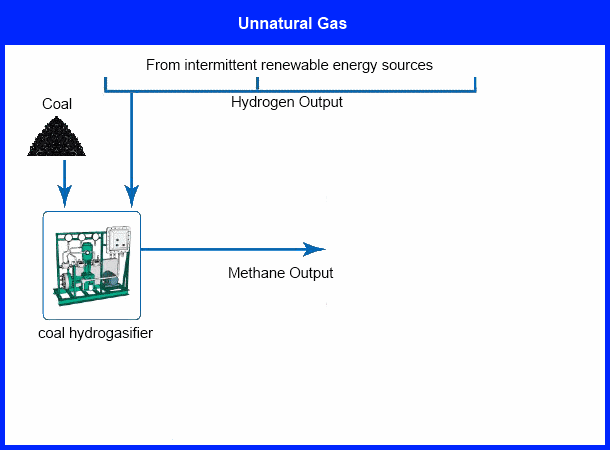
"Unnatural Gas"Methane that contains 50 percent fossil fuel energy (from coal) and 50 percent renewable energy (from wind and/or solar).
Methane from Coal and Hydrogen
Add 2 molecules of hydrogen to an atom of carbon and you have a new fuel (methane) that:
possesses TWICE the energy content of the hydrogen molecules,
can be transmitted through natural gas pipelines,
can be used in any appliance that runs on natural gas, and
can be used as fuel in any engine, fuel cell, trigeneration power system or power station that runs on natural gas to generate electricity.
In comparison, coal is far more limited. For example, natural-gas fueled power stations can achieve 60 percent efficiency. Coal-fired power stations can achieve little over 35-40 percent efficiency. Coal cannot be transmitted through natural gas pipelines so it cannot be easily distributed for fuel in trigeneration power systems.
Coal gasification technology can convert coal to methane and carbon dioxide. With carbon capture and storage, this carbon dioxide could be stored. The methane that is produced possesses about the SAME amount of energy that the coal contained before
being gasified.
However, if coal is converted into methane by combining it with hydrogen, no carbon dioxide is produced during conversion. There is no need for carbon capture and storage technology. The methane that is produced possesses about TWICE the energy that the coal contained before being gasified.
Dr
Waidhas of Siemens' Industry Division notes about hydrogen from renewables: "If you combine the efficiency of the electrolysis (approx. 75 percent) with that of a gas turbine (around 60 percent in combined cycle operation with a steam turbine), the resulting “energy-recirculation” process would still exploit up to 45 percent of the original energy."
By combining that hydrogen with coal to form methane then using this methane in a trigeneration power system, the result is a little different -
Combining the efficiency of the electrolysis (approx. 75 percent) with that of a
trigeneration power system (around 80 percent), the resulting “energy-recirculation” process would exploit up to 60 percent of the original energy.
Converting the coal to methane and using it in a trigeneration power system (approx. 80 percent efficient) instead of a coal-fired power station (about 40 percent) would exploit 200 percent of the original output energy.
The overall effect is that total energy delivered is equal to the output of the coal from a coal-fired power station plus 90 percent of the original renewable energy.
An example illustrates these results: 10 KWh original renewable energy will directly contribute about 6 KWh after the electrolysis, hydrogasifier and trigeneration cycle. The coal added in the
hydrogasifier will deliver about the same amount of energy - another 6 KWh. Had this coal been used as fuel in a coal-fired power station, it would have delivered only 3 KWh.
Thus, the total output of 12 KWh is equivalent to the original 3 KWh from the coal plus 9 KWh of the original 10 KWh from the renewable energy source.
Overhauling Australia's Electricity Sector as Prices Soar
Updated: Saturday, June 16, 2012
This is not a discussion about the carbon tax. It is also not a discussion about renewable and non-renewable energy sources.
This discussion is on another cause of soaring electricity prices in Australia and for now is a brief summary of a number of ideas that different organisations and people have raised.
When the noise over the carbon tax dies down and attention moves to renewable energy versus non-renewable energy, the issue of cost-effective grid capacity for extreme peaks in demand will still need to be addressed. There is and has been very little public debate on this costly issue.
The Productivity Commission reports (Overview: Electricity, Gas and Water) that a cause of rising electricity prices is rapidly growing peak demand and the investments being made to supply energy to satisfy peak demand:
"...an increase in the ratio of peak to average electricity demand lowered average rates of capacity utilisation. This was largely attributable to rapid growth in household use of air conditioners."
The view by the Productivity Commission is reflected in various places.
AGL: $1.5 billion power plant "switched off for months on end"
"AGL project manager Neil Cooke said the planned $1.5 billion gas turbine power station would only operate between 200 and 400 hours a year during periods of
peak demand and could be switched off for months on end." (Article in Canberra Times, May 7, 2011 - page 15)
Financial offer for electricity price rise
"Clean Energy Council chief executive Matthew Warren said electricity prices were likely to go up by 100 per cent between 2008 and 2015 due to network costs that came from increased peak demand." (Article in Canberra Times, May 26, 2011 - page 3)
Batteries to store energy in off-peak periods and discharge energy in peak periods. (Example: Charge of the battery brigade)
Reduce electricity consumption.
RMIT Adjunct Professor Alan Pears says Australia has to reduce electricity demand at all times of the year: "The rules of the energy market need to change in a pretty serious way so that energy networks have a financial incentive to help people to save energy rather than to get them to use more." (Example: Rising power prices prompt calls for overhaul)
In the US, where energy saving has been big for decades, you can read your usage in real time, online. In 2008 15.2 trillion kWh were saved. (Example: It's time to switch on to the great switch off)
Innovate - "An air-conditioning system that can reduce energy consumption and greenhouse gas emissions in commercial and industrial buildings by up to 85 per cent has won the 2011 Australian Clean Technologies Ideas Competition. SMAC Technologies was announced as the competition winner at an awards gala dinner in Sydney..." Read more...
The third option can have the opposite effect if the savings are made without slowing the growth in maximum peak demand. During the recent drought in Sydney when calls to cut water consumption were heeded, the price per kilolitre of water was raised to maintain revenue.
Follow the conversation on Twitter
@Askgerbil More a case of symptom rather than cause. Peak demand price is so high makes these generators worth it. #auspol
— GoneHomer (@GoneHomeR) April 14, 2012
@GoneHomeR when the demand spikes and also provide system reliability when wind stops blowing and turbines shutdown @Askgerbil
— Robbie Singh (@RobbieSingh2) April 14, 2012
@Askgerbil @GoneHomeR distribution costs are a big element. Yes. They will actually worsen even more with wind turbines/solar PV
— Robbie Singh (@RobbieSingh2) April 14, 2012
@Askgerbil @GoneHomeR 100% renewables will not work with current grid topology - it will have to change from hub-spoke to distributed grid
— Robbie Singh (@RobbieSingh2) April 14, 2012
"In addition to increased household consumption, it is peak demand that is really growing at an extraordinary rate and putting pressure on our electricity grid and prices.
Over the period 1998 to 2010 Brisbane saw a 35% increase in the number of households.
At the same time peak electricity demand increased by 104%, and the number of households with an air conditioner installed increased from 23% to 72%, with 34% of homes running two or more air conditioners.
Reducing or moderating the increase in peak demand is an important objective.
One measure to achieve this – and Victoria is leading the nation in this respect – is the deployment of smart-meters.
If the functionality is enabled smart-meters can allow time of use pricing so that consumers see higher costs at times of higher demand."
The Hon Martin Ferguson AM MP
Minister for Resources and Energy, Minister for Tourism
Australia's Energy Future
04 May 2011
Committee for the Economic Development of Australia
Sydney
"For many South Australians first quarter electricity bills will reach new heights driven up by record levels of electricity consumption during the recent heatwave.
Some households however, will have lower bills than expected, not because they are being more energy efficient, but rather because they lost power for long periods of time during the blackouts. The blackouts forced thousands of households and businesses to go without power for hours in the middle of sweltering heat.
A preliminary report on the blackouts by the Essential Services Commission of SA (ESCOSA) shows that the number of customers affected far exceeded the initial estimate of 50,000. In fact around 63,000 customers representing nearly 10 percent of the SA customer base were affected.
Around 1000 customers were without power for over 12 hours."
Power Struggles - apologies are not good enough
Monday, 13 February 2006
Author: Associate Professor John Spoehr (Australian Institute for Social Research)
The Adelaide Review
February 2006
"Following a 2003 heatwave in Europe that caused 80,000 deaths, the World Health Organisation recommended that heat health action plans be established."Draft Heatwave Plan released for public exhibition
20/12/2011
"Heatwaves are increasing in frequency, intensity and duration, and are associated with an increase in mortality" Heatwaves and the elderly
from Australian Family Physician Vol. 40, No. 8, July 2011
An Affordable Solution?
Instead of attempting to discourage use of energy in extreme peak periods with very high electricity prices, and instead of investing in energy generation and distribution capital that is only needed for very small periods each year, a less-expensive approach is to make additional use of existing equipment on those few occasions when extra energy is needed.
Hybrid electric vehicles such as the Toyota Prius have onboard engines/generators able to produce 50 kilowatts of electrical energy or more.
Connecting hybrid electric vehicles to natural gas fuel lines in their owners' garages and dynamically scheduling them to generate power or shutdown in response to demand by a Smart Grid supply management system provides a possible low-cost solution.
Petrol in the vehicles' fuel tanks would be used when the vehicles were being driven, and not when garaged and generating electricity.
A federal coalition government could encourage big business to "bid" to use less energy on peak-demand days as a way of reducing future electricity price rises for households.
Climate action spokesman Greg Hunt says a coalition government would limit power bill rises by ... looking at incentives for so-called demand reduction.
Network costs are to blame for the significant increases in power bills over recent years.
...
"Demand reduction bidding is an incredibly effective means of reducing the pressure on capital expenditure."
Mr Hunt said such bidding would require a change to the current regulatory regime. But he met with a major energy company last week to discuss such a mechanism.
This includes a discussion of U.S. measures implementing "demand reduction" along the lines coalition Climate action spokesman Greg Hunt first raised publicly on June 14, 2012.
The Australian
Government carbon tax starts in July 2012 and some of the big
polluters do not have any viable alternative but to pay. In
particular power companies are stuck with coal.
A great many
businesses seem unaware that they do have a viable alternative to
paying any carbon tax that big polluters may want to pass on to them:
Big power companies might well be stuck with coal, but Australian
businesses are not stuck with these big power companies.
City
of Sydney
Decentralised
Energy
Making it happen - clean, green energy
The City has an ambitious plan to reduce greenhouse gas emissions by 70 per cent by 2030 which can also cut electricity bills for NSW consumers.
To help achieve this target the City has appointed UK energy expert Allan Jones. His previous work reduced greenhouse gas emissions at the city of Woking by 80 per cent and produced similar results for the city of London
At the moment, 80 per cent of the City of Sydney’s emissions come from the production of electricity by coal-fired power stations in the Hunter Valley. Two thirds of the energy being used by these stations is wasted as heat from the cooling towers and on long-distance transmission over power lines to Sydney.
The City’s goal is to produce 70 per cent of its energy needs locally from trigeneration plants. These local generators are nearly three times more energy efficient than coal-fired power plants because they use the waste heat from electricity production to both heat and cool buildings.
Shopping centre
management and shop-owners at the “Thick Shopping Centre” and
“Not-So-Thick Shopping Centre” in nearby suburbs of any
Australian city make different choices about the carbon tax that
starts in July 2012.
At the Thick Shopping
Centre, the shopping centre management pays for electricity from
its existing supplier and passes on the cost of the carbon tax to the
shop-owners who operate in the shopping centre. The shop-owners
continue to buy electricity from their existing suppliers too, pay extra because of the carbon tax, and pass both this cost and the extra costs of
the Thick Shopping Centre management on to their customers.
At the Not-So-Thick
Shopping Centre, the shopping centre management installs a
trigeneration system that generates power, heat and cooling for the
whole shopping centre. It saves money on its power bills, and passes
these savings on to the shop-owners who operate in the shopping
centre. The Not-So-Thick Shopping Centre Management trigeneration system also generates
enough power to supply the shop-owners who
operate in the shopping centre.
The shop-owners at the
Not-So-Thick Shopping Centre decide to buy their power at the reduced price offered by the shopping centre management, and pass both this saving
and the extra savings of the Not-So-Thick Shopping Centre management
on to their customers.
Customers of the Thick
Shopping Centre quickly learn that they can enjoy great savings by
doing all their shopping at the Not-So-Thick Shopping Centre.
Carbon tax: a lot of fuss about nothing.
Nothing is the amount of carbon tax shoppers pay at the Not-So-Thick Shopping Centre.