Latest Buzz...
                  

Translate

Monday, April 23, 2012

QandA Climate Debate Special

Updated June 7, 2012

Q&A Climate Debate

Take Part in the Q&A Climate Debate on ABC TV    On Thursday 26 April -  a special Q&A climate debate followed the screening of the documentary I Can Change Your Mind About Climate on ABC TV. 

Tony Jones was joined by Anna Rose, Nick Minchin, Clive Palmer and Rebecca Huntley to answer your questions.
Update: Saturday 28 April 2012

THE CLASH OF IDEOLOGIES on Q&A

Marc Morano's objections to scientific evidence of anthropogenic global warming and the risks it creates are underpinned by an ideology that is crucial to those who subscribe to it.

In speaking with Anna Rose, Marc Morano said:
"You are the face of one of the greatest threats of our liberty, and that is intellectual, international bean-counters trying to control average people's lives because they think they know better how people should live, because people left to their own devices will somehow destroy the planet."
Compare this statement with Adam Smith's  "invisible hand" - that rational self-interest in a free-market economy leads to economic well-being, and is THE central justification for the laissez-faire economic ideology.

Adam Smith never contemplated an "invisible hand" to mean scientific knowledge was to be dismissed when it suggested rational self-interest was best served by a change in economic behaviour. Innovation and economic growth is driven by scientific knowledge.

Marc Morano's diatribe in which he asserts Anna Rose is the face of a threat to "liberty" has confused irrational and uninformed action with the rational self-interest of the "invisible hand" of which Adam Smith wrote.

Misguided Climate Sceptics
Climate sceptic Dr Fred Singer said "The Kyoto Protocol [is] part of the anti-technology, anti-energy, anti-growth philosophy of the extreme 'greens.'"
And also "When you have a particular point of view ...you become selective in the way you present your observations."

What are the Q&A panelists thoughts on Dr Singer's mistaken observation: "We're being asked to reduce energy use [sic], not just by a few percent but, according to the Kyoto Protocol, by about 35 percent within ten years."?

Note: The Kyoto Protocol describes reductions in EMISSIONS. It says nothing about reducing ENERGY USE as Dr Fred Singer mistakenly observed. "The Kyoto Protocol aims to reduce the collective greenhouse gas emissions..."


Coal industry delaying CO2 cuts for another 15 years

Why is Australia to spend over $1 billion on CarbonNet and take 15 years developing new Carbon Capture technology ----
 ---- when proven technology has existed for decades in the USA?


A Possible Reason for the Coal Industry to Delay Pre-Combustion Carbon Capture

Post-combustion Carbon Capture and Storage (CCS)  provides a justification to continue construction of coal-fired power stations. It holds out a promise of one day being able to reduce emissions of such power plants.

Once a coal-fired power plant is constructed, the coal industry is guaranteed a customer for at least 40 years.

Gasification of coal with pre-combustion Carbon Capture eliminates the reason for constructing any new coal-fired power stations. Once converted to gas, the fuel can be used in high-efficiency combined-cycle gas turbine (CCGT) power stations. In addition a number of toxic components of coal such as mercury can be economically removed when the coal has been converted to gas.

The demand for coal would go down when natural gas prices fall. There would be no guaranteed demand to provide fuel for new coal-fired power stations.

A gas-fired power station achieves 60 percent thermal efficiency, much higher than the 40 percent for advanced coal-fired power stations. This difference also results in lower demand for coal.

China Adopting More Efficient (and Cleaner) Coal Technology

Block diagram with major units of the SNG plant
From coal to clean energy - Topsoe

China has built 50 coal gasification plants in the last 10 years and has another 40 in planning or under construction. On 21 May 2012 the article "China to Invest in Coal Gasification - with GEs help" by John Daly reported:

With more than 50 licensed facilities in China, GE’s gasification technology is one of the most widely deployed in the industry, while Shenhua is one of the world’s largest coal and energy companies, with integrated coal production, power generation, railway, port and shipping infrastructure.
...
Putting the final seal of approval on the project GE Energy Thermal Products president and CEO Paul Browning concluded, “Coal plays an important role in the economies of both the U.S. and China, and gasification technology allows us to use this abundant and low-cost resource in a much cleaner way.
...
The emphasis shift in coal power generation from thermal plants to utilizing IGCC technology is a key element in the Chinese leadership’s efforts to maintain its economic momentum by providing its vast industrial base uninterrupted power supplies.


New technology is increasing efficiency of converting coal to gas. China is building commercial-scale plants as new technology becomes available. For example:

India to Follow China's Lead with More Efficient (and Cleaner) Coal Technology


On 29 May 2012 the Economic Times reported in the article "India needs to master the coal-gasification technology":

India needs to master the coal-gasification technology so as to boost both energy efficiency and attendant security.
...
...Integrated coal-gasification combined-cycle (IGCC) power plants, which incorporate both gas and steam turbines, vastly improve the conversion of coal energy into usable electricity.
...
Note that while the efficiency rate is just about 30% in standard coal-fired stations and 40-odd per cent using super-critical technology, the mavens hold that, in future gasification plants, the ratio could touch 70-80%. We clearly need to adopt IGCC in a big way. 
The likely impact on Australia's coal export industry can be seen from an earlier article on 12 March 2012. Reuters reported in its article "India's coal-to-gas dream takes baby steps":
NEW DELHI, March 12(Reuters) - India is at least a decade behind China in embracing technology that could convert its coal reserves into enough gas and oil to surmount chronic power shortages and halve its energy import bill of $110 billion a year. 

Tony Abbott Warns Minerals Council of Impact of above Changes


In an Address to the Minerals Council of Australia at Canberra on 30 May 2012, coincidentally just one day after the above article on India's need to follow the example set by China to embrace more efficient energy-from-coal technology, Tony Abbott said:
...We all know what the carbon tax is designed to do: it is designed to reduce our use of coal and our use of gas [sic]. In other words, it is designed to limit the production, ultimately, of the minerals upon which our country so critically depends [sic]...The government’s own documents say that Australia’s energy production from coal, absent carbon capture and storage, will fall from over 70 percent right now to 10 percent by 2050.

So, the carbon tax is designed to damage the very things on which our country's wealth depends 
[sic]. The only way our country's wealth can survive the carbon tax is if other countries don't do what we're doing. If China and India took the same attitude to coal and gas that we are taking, our export industries would be in diabolical trouble...

Cheap Natural Gas in the U.S. replacing Coal-Fired Power Generation


In the U.S. plans for the construction of a number of coal gasification plants have recently been put on hold. The reason: a massive over-supply of natural gas in the U.S. has dramatically lowered the price and the continued use of coal is for the time-being at least, not competitive.

On 13 March 2012 the article "Coal’s Share of U.S. Electricity Generation Falls to 35-Year Low" by Moran Zhang reported:

The share of U.S. power generation that comes from coal has fallen to near a 35-year low, as electric power plants shift to cheaper natural gas.

Although coal is still the main fuel for electricity generation, its share of monthly power generation in the U.S. dropped below 40 percent in the last two months in 2011, according to the Energy Department. The last time coal's share of total generation was below 40 percent for a monthly total was March 1978.
...
"Natural gas combined-cycle units operate at higher efficiency than do older, coal-fired units, which increases the competitiveness of natural gas relative to coal," the Energy Department said in a statement.

Natural gas prices have continued their downward trend this winter as a result of warmer-than-normal temperatures, ample natural gas in storage and growing natural gas production, which has been boosted by companies tapping so-called shale reservoirs using a technique called hydraulic fracturing, also known as "fracking."


Friday, April 20, 2012

Unconventional Ideas on Energy

Thinking Outside the Box

Audi opens 6 MW power-to-gas facility
The Audi e-gas project demonstrates how large amounts of green electricity can be stored efficiently and independently of location by transforming it into methane gas and storing it in the natural gas network, the largest public energy storage system in Germany.

The e-gas plant utilizes a two-step process: electrolysis and methanation. First, the plant uses surplus green electricity to break water down into oxygen and hydrogen in three electrolyzers. While the hydrogen could one day power fuel-cell vehicles, in the absence of an area-wide infrastructure, a second process step is carried out directly: methanation. The hydrogen is combined with carbon dioxide (CO2) to produce synthetic methane, or Audi e-gas.

Audi said the efficient use of energy flows was the top priority in the plant’s production sequence: The waste heat given off during methanation is used as process energy in the adjacent biogas plant, significantly increasing overall efficiency. In return, the biogas plant supplies the highly concentrated CO2 required as a basic building block for e-gas. This CO2 thus serves as a raw material and is not emitted to the atmosphere.

Wind-to-Hydrogen Project
The US National Renewable Energy Laboratory (NREL) in partnership with Xcel Energy launched a wind-to-hydrogen (Wind2H2) demonstration project at the National Wind Technology Center in Boulder, Colorado.

The Wind2H2 project links wind turbines to electrolyzers, which pass the wind-generated electricity through water to split it into hydrogen and oxygen. The hydrogen can then be stored and used later to generate electricity from an internal combustion engine or a fuel cell.
The Wind2H2 project links wind turbines to electrolyzers, which pass the wind-generated electricity through water to split it into hydrogen and oxygen.
Extract of Figure 1-1 Overall Wind2H2 system design

Siemens: The New Age of Electricity | Electrolysis
Storing Energy in Hydrogen. “The larger the share of electricity production accounted for by renewable sources such as the wind and sun, the greater will be the fluctuations in the amount of energy available,” says Dr. Manfred Waidhas from the new Hydrogen Electrolyzer Division at Siemens’ Industry Sector.

Waidhas believes hydrogen offers the best energy storage solution. “You could set up an electrolyzer at a location where electricity from an offshore wind park reaches land, for example,” he says. “If the wind park were to produce too much electricity, you could use it to produce hydrogen, which could then be stored in a cavern.”

If demand for power rises, the energy-rich gas could then drive a turbine to supply CO2-neutral electricity to the grid.

If you combine the efficiency of the electrolysis (approx. 75 percent) with that of a gas turbine (around 60 percent in combined cycle operation with a steam turbine), the resulting “energy-recirculation” process would still exploit up to 45 percent of the original energy. “That’s not as good as a pumped-storage plant, but it’s better than shutting down windmills when demand isn't there,” says Waidhas.

Power to Gas: innovative contribution to energy turnaround
E.ON is developing a pilot plant in Falkenhagen in the north east of Germany to convert power from wind energy into hydrogen which can then be stored in the country’s gas grid. The company is investing over EUR5 million on the pilot plant and further research into this innovative technology.

Using power from renewable energy sources, the plant will produce about 360 m³ of hydrogen per hour from 2013 onwards through electrolysis. The hydrogen will be fed into the Ontras gas pipeline system and be used like normal natural gas. This makes the gas grid a storage system for power from weather-dependent renewables.

And now, for something completely different -

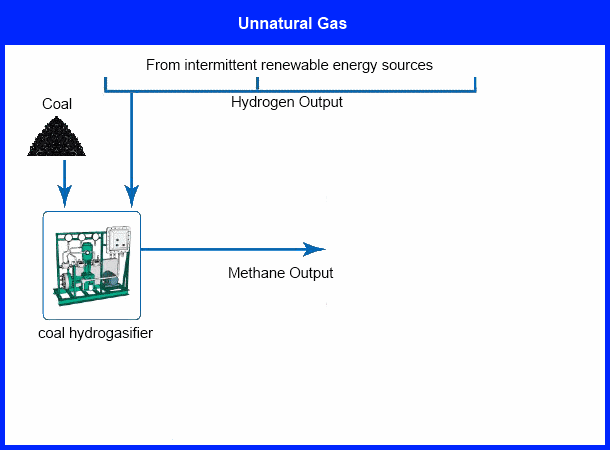
"Unnatural Gas" Methane that contains 50 percent fossil fuel energy (from coal) and 50 percent renewable energy (from wind and/or solar). 
Methane from coal and hydrogen
Methane from Coal and Hydrogen

Add 2 molecules of hydrogen to an atom of carbon and you have a new fuel (methane) that:
  • possesses TWICE the energy content of the hydrogen molecules, 
  • can be transmitted through natural gas pipelines, 
  • can be used in any appliance that runs on natural gas, and 
  • can be used as fuel in any engine, fuel cell, trigeneration power system or power station that runs on natural gas to generate electricity. 
In comparison, coal is far more limited. For example, natural-gas fueled power stations can achieve 60 percent efficiency. Coal-fired power stations can achieve little over 35-40 percent efficiency. Coal cannot be transmitted through natural gas pipelines so it cannot be easily distributed for fuel in trigeneration power systems.

Coal gasification technology can convert coal to methane and carbon dioxide. With carbon capture and storage, this carbon dioxide could be stored. The methane that is produced possesses about the SAME amount of energy that the coal contained before  being gasified.

However, if coal is converted into methane by combining it with hydrogen, no carbon dioxide is produced during conversion. There is no need for carbon capture and storage technology. The methane that is produced possesses about TWICE the energy that the coal contained before being gasified.

Dr  Waidhas  of Siemens' Industry Division notes about hydrogen from renewables: "If you combine the efficiency of the electrolysis (approx. 75 percent) with that of a gas turbine (around 60 percent in combined cycle operation with a steam turbine), the resulting “energy-recirculation” process would still exploit up to 45 percent of the original energy."

By combining that hydrogen with coal to form methane then using this methane in a trigeneration power system, the result is a little different -

  • Combining the efficiency of the electrolysis (approx. 75 percent) with that of a trigeneration power system  (around 80 percent), the resulting “energy-recirculation” process would exploit up to 60 percent of the original energy. 
  • Converting the coal to methane and using it in a trigeneration power system (approx. 80 percent efficient) instead of a coal-fired power station (about 40 percent) would exploit 200 percent of the original output energy. 

The overall effect is that total energy delivered is equal to the output of the coal from a coal-fired power station plus 90 percent of the original renewable energy.

An example illustrates these results: 10 KWh original renewable energy will directly contribute about 6 KWh after the electrolysis, hydrogasifier and trigeneration cycle. The coal added in the  hydrogasifier will deliver about the same amount of energy - another 6 KWh. Had this coal been used as fuel in a coal-fired power station, it would have delivered only 3 KWh.

Thus, the total output of 12 KWh is equivalent to the original 3 KWh from the coal plus 9 KWh of the original 10 KWh from the renewable energy source.

Saturday, April 14, 2012

Discussion of Electricity Prices

Overhauling Australia's Electricity Sector as Prices Soar

Updated: Saturday, June 16, 2012

This is not a discussion about the carbon tax. It is also not a discussion about renewable and non-renewable energy sources.

This discussion is on another cause of soaring electricity prices in Australia and for now is a brief summary of a number of ideas that different organisations and people have raised.

When the noise over the carbon tax dies down and attention moves to renewable energy versus non-renewable energy, the issue of cost-effective grid capacity for extreme peaks in demand will still need to be addressed. There is and has been very little public debate on this costly issue.

The Productivity Commission reports (Overview: Electricity, Gas and Water) that a cause of rising electricity prices is rapidly growing peak demand and the investments being made to supply energy to satisfy peak demand:
"...an increase in the ratio of peak to average electricity demand lowered average rates of capacity utilisation.
This was largely attributable to rapid growth in household use of air conditioners."
The view by the Productivity Commission is reflected in various places.

AGL: $1.5 billion power plant "switched off for months on end"

"AGL project manager Neil Cooke said the planned $1.5 billion gas turbine power station would only operate between 200 and 400 hours a year during periods of peak demand and could be switched off for months on end."
(Article in Canberra Times, May 7, 2011 - page 15)

Financial offer for electricity price rise

"Clean Energy Council chief executive Matthew Warren said electricity prices were likely to go up by 100 per cent between 2008 and 2015 due to network costs that came from increased peak demand."
(Article in Canberra Times, May 26, 2011 - page 3)

Responses

  1. Encourage customers to cut peak electricity use. 
  2. Increase electricity supply in peak periods. 
  3. Reduce electricity consumption. 
    • RMIT Adjunct Professor Alan Pears says Australia has to reduce electricity demand at all times of the year: "The rules of the energy market need to change in a pretty serious way so that energy networks have a financial incentive to help people to save energy rather than to get them to use more."
      (Example: Rising power prices prompt calls for overhaul)
    • In the US, where energy saving has been big for decades, you can read your usage in real time, online. In 2008 15.2 trillion kWh were saved.
      (Example: It's time to switch on to the great switch off)
    • Innovate - "An air-conditioning system that can reduce energy consumption and greenhouse gas emissions in commercial and industrial buildings by up to 85 per cent has won the 2011 Australian Clean Technologies Ideas Competition.
      SMAC Technologies was announced as the competition winner at an awards gala dinner in Sydney..."
      Read more...

The third option can have the opposite effect if the savings are made without slowing the growth in maximum peak demand. During the recent drought in Sydney when calls to cut water consumption were heeded, the price per kilolitre of water was raised to maintain revenue.

Follow the conversation on Twitter


One Perspective: Try to Change Consumer Behaviour
"In addition to increased household consumption, it is peak demand that is really growing at an extraordinary rate and putting pressure on our electricity grid and prices.

Over the period 1998 to 2010 Brisbane saw a 35% increase in the number of households.

At the same time peak electricity demand increased by 104%, and the number of households with an air conditioner installed increased from 23% to 72%, with 34% of homes running two or more air conditioners.

Reducing or moderating the increase in peak demand is an important objective.

One measure to achieve this – and Victoria is leading the nation in this respect – is the deployment of smart-meters.

If the functionality is enabled smart-meters can allow time of use pricing so that consumers see higher costs at times of higher demand."


The Hon Martin Ferguson AM MP
Minister for Resources and Energy, Minister for Tourism
Australia's Energy Future
04 May 2011
Committee for the Economic Development of Australia
Sydney

Another Perspective: Accept Consumer Behaviour
"For many South Australians first quarter electricity bills will reach new heights driven up by record levels of electricity consumption during the recent heatwave.

Some households however, will have lower bills than expected, not because they are being more energy efficient, but rather because they lost power for long periods of time during the blackouts. The blackouts forced thousands of households and businesses to go without power for hours in the middle of sweltering heat.

A preliminary report on the blackouts by the Essential Services Commission of SA (ESCOSA) shows that the number of customers affected far exceeded the initial estimate of 50,000. In fact around 63,000 customers representing nearly 10 percent of the SA customer base were affected.

Around 1000 customers were without power for over 12 hours."


Power Struggles - apologies are not good enough
Monday, 13 February 2006
Author: Associate Professor John Spoehr (Australian Institute for Social Research)
The Adelaide Review
February 2006

"Following a 2003 heatwave in Europe that caused 80,000 deaths, the World Health Organisation recommended that heat health action plans be established." Draft Heatwave Plan released for public exhibition
20/12/2011

"Heatwaves are increasing in frequency, intensity and duration, and are associated with an increase in mortality"
Heatwaves and the elderly
from Australian Family Physician Vol. 40, No. 8, July 2011

An Affordable Solution?
 
Instead of attempting to discourage use of energy in extreme peak periods with very high electricity prices, and instead of investing in energy generation and distribution capital that is only needed for very small periods each year, a less-expensive approach is to make additional use of existing equipment on those few occasions when extra energy is needed.

Hybrid electric vehicles such as the Toyota Prius have onboard engines/generators able to produce 50 kilowatts of electrical energy or more.

Connecting hybrid electric vehicles to natural gas fuel lines in their owners' garages and dynamically scheduling them to generate power or shutdown in response to demand by a Smart Grid supply management system provides a possible low-cost solution.

Petrol in the vehicles' fuel tanks would be used when the vehicles were being driven, and not when garaged and generating electricity.

Further reading -
 

Reduce demand to manage power bills: Hunt

Source: AAP June 14, 2012
A federal coalition government could encourage big business to "bid" to use less energy on peak-demand days as a way of reducing future electricity price rises for households.

Climate action spokesman Greg Hunt says a coalition government would limit power bill rises by ... looking at incentives for so-called demand reduction.

Network costs are to blame for the significant increases in power bills over recent years.
...
"Demand reduction bidding is an incredibly effective means of reducing the pressure on capital expenditure."

Mr Hunt said such bidding would require a change to the current regulatory regime. But he met with a major energy company last week to discuss such a mechanism.

See the related post Energy Strategy


This includes a discussion of U.S. measures implementing "demand reduction" along the lines coalition Climate action spokesman Greg Hunt first raised publicly on June 14, 2012.

Thursday, March 29, 2012

A Tale of Two Shopping Centres

Askgerbil staff writer | Thursday March 29 2012
The Australian Government carbon tax starts in July 2012 and some of the big polluters do not have any viable alternative but to pay. In particular power companies are stuck with coal.
A great many businesses seem unaware that they do have a viable alternative to paying any carbon tax that big polluters may want to pass on to them: Big power companies might well be stuck with coal, but Australian businesses are not stuck with these big power companies.

City of Sydney

Decentralised Energy

Making it happen - clean, green energy

The City has an ambitious plan to reduce greenhouse gas emissions by 70 per cent by 2030 which can also cut electricity bills for NSW consumers.
To help achieve this target the City has appointed UK energy expert Allan Jones. His previous work reduced greenhouse gas emissions at the city of Woking by 80 per cent and produced similar results for the city of London
At the moment, 80 per cent of the City of Sydney’s emissions come from the production of electricity by coal-fired power stations in the Hunter Valley. Two thirds of the energy being used by these stations is wasted as heat from the cooling towers and on long-distance transmission over power lines to Sydney.
The City’s goal is to produce 70 per cent of its energy needs locally from trigeneration plants. These local generators are nearly three times more energy efficient than coal-fired power plants because they use the waste heat from electricity production to both heat and cool buildings.

Shopping centre management and shop-owners at the “Thick Shopping Centre” and “Not-So-Thick Shopping Centre” in nearby suburbs of any Australian city make different choices about the carbon tax that starts in July 2012.

At the Thick Shopping Centre, the shopping centre management pays for electricity from its existing supplier and passes on the cost of the carbon tax to the shop-owners who operate in the shopping centre. The shop-owners continue to buy electricity from their existing suppliers too, pay extra because of the carbon tax, and pass both this cost and the extra costs of the Thick Shopping Centre management on to their customers.

At the Not-So-Thick Shopping Centre, the shopping centre management installs a trigeneration system that generates power, heat and cooling for the whole shopping centre. It saves money on its power bills, and passes these savings on to the shop-owners who operate in the shopping centre. The Not-So-Thick Shopping Centre Management trigeneration system also generates enough power to supply the shop-owners who operate in the shopping centre.

The shop-owners at the Not-So-Thick Shopping Centre decide to buy their power at the reduced price offered by the shopping centre management, and pass both this saving and the extra savings of the Not-So-Thick Shopping Centre management on to their customers.

Customers of the Thick Shopping Centre quickly learn that they can enjoy great savings by doing all their shopping at the Not-So-Thick Shopping Centre.

Carbon tax: a lot of fuss about nothing.  
Nothing is the amount of carbon tax shoppers pay at the Not-So-Thick Shopping Centre.

Monday, March 26, 2012

Road Freight Transport Costs


Up, Up and Away

lean Air Power Tackling Road Freight Transport Costs Bi-Fuel Diesel and CNG (compressed natural gas) lean Air Power Tackling Road Freight Transport Costs Bi-Fuel Diesel and CNG (compressed natural gas)
Clean Air Power: Solving Road Freight Transport Costs Diesel/Gas Australia: Solving Road Freight Transport Costs

In December 2011 the Australian Government announced the release of an Energy White Paper.

However the Australian Government made no announcement of  a number of significant energy policy papers prepared on the on the same date.

No announcement reveals  "The cost of road freight transport is expected to increase in the next decade because there are fewer unrealised fuel efficiency gains available to offset rising oil prices...."

The impact on business, consumers and rural producers may well far exceed that of any price on carbon. Yet the Australian media ignores this serious issue and remains fixated on the "Carbon Tax". This is likely to be little more than a minor irritant in comparison to the expected increase in the cost of road freight.

The Australian media is also doing little or nothing to inform business, agricultural interests and industry of measures being taken to provide transport energy security and stable fuel prices.
Keep on truckin’ with LNG
The planned LNG fleet refuelling network will include transport company depot refuellers located at the transport company yard, and public refuellers located at selected truck-focused service stations and roadhouses around Australia. (From Keep on truckin’ with LNG, Gas Today — November 2011)

The serious problem of increasing cost of road freight is buried within the following information - available on the web site of Australian Department of Resources, Energy and Tourism -

Strategic Framework for Alternative Transport Fuels

The Australian Government released the Strategic Framework for Alternative Transport Fuels (the Framework) on 13 December 2011.  The Framework was developed in consultation with industry, government and other stakeholders throughout 2011 and is an input to the Energy White Paper development process. Information about the Energy White Paper process is available at www.energywhitepaper.ret.gov.au.

The Framework establishes a long term approach to a market led adoption of alternative transport fuels in Australia and includes 20 actions for industry, Government and other stakeholders to implement to address identified barriers to uptake, including:
  • providing leadership and certainty through the: application of Alternative Transport Fuels Principles; continuation of coordinated policy approach; the collaborative review of guidelines to remove unintended measures that could limit feedstock and technologies; and establishment of relevant advisory mechanisms.
  • ...Read More

The final document listed on the above web page is entitled "Possible Futures: Scenario Modelling of Australian Alternative Transport Fuels to 2050".

At page iv this documents includes several observations -

  • The extent to which transport fuel self sufficiency remains at this level or improves further is largely dependent on whether there are strong social and economic factors driving alternative fuel uptake. ...If no alternative fuels are developed at all, Australia’s fuel self-sufficiency will decline to 35 percent by 2030. 
  • The whole cost of road passenger transport (cents/km) is projected to be fairly stable into the future due to fuel efficiency improvements, alternative fuels and improving technology that act to prevent costs from rising.
  • The cost of road freight travel [sic, transport] is expected to increase in the next decade because there are fewer unrealised fuel efficiency gains available to offset rising oil prices, total road freight costs are more sensitive to fuel price changes and that sector is assumed to pay a carbon price on diesel. 
The paper has failed to recognise the decision of Shell to close and demolish the Clyde Oil Refinery by mid-2013. This refinery meets about 50 per cent of the petroleum needs (petrol and diesel) of New South Wales.

The Department of Resources, Energy and Tourism provides a paper "Alternative Transport Fuels Strategy – Gaseous Fuels, Summary of Fuel Forum 2" with the forlorn and clueless opinion:

A constant theme during the course of the discussions on gaseous vehicles related to the absence of natural gas refuelling infrastructure and the difficulty of investing in this infrastructure without any certainty around the timing and quantum of future demand. Essentially, this demand uncertainty means that investment in natural gas refuelling infrastructure is not able to be justified on commercial grounds given the likely substantial lag between deployment of capital and realisation of income from fuel sales.

Participants pointed to the fact that this dilemma – commonly referred to as the ‘chicken and egg’ scenario – was seriously retarding growth of the market.

This cluelessness on how to introduce new fuels makes a joke of the Department's statement on the role of the Australian Government Strategic Framework: "providing leadership and certainty".

Luckily the Australian Government that replaced leaded-petrol vehicles and infrastructure with unleaded petrol was not so challenged for ideas on how to go about providing leadership and certainty.

Nevertheless, the Department of Resources, Energy and Tourism illustrates the Australian Government still has some capacity for forward-planning. This is demonstrated by the extract shown of the table below. This is from page 2 of a document on its web-site "Paper 2: Summary of current government policies and programs relating to alternative transport fuels in Australia".

Table 1: Alternative fuels excise and excise-equivalent customs duty rates

Fuel type From
1 Dec 2011
From
1 Jul 2012
From
1 Jul 2013
From
1 Jul 2014
From
1 Jul 2015
(final rate)
CNG c/kg 5.22 10.45 15.67 20.9 26.13

Sunday, March 25, 2012

Real Energy Debate

The real energy debate is not over climate change or carbon taxes or emissions trading.
The real energy debate is about MONEY - 
Recent ABC coverage such as "The quest to capture carbon", 16 March 2012, deceives the public with misinformation by two opposing and equally unreliable vested interests.
  1. Green groups spruiking renewable energy technology - solar and wind - that do not wish to see competing energy sources maintain market share. 
  2. The coal industry and the operators of centralised coal-fired power stations that do not wish to see dramatic efficiency gains in using coal energy resources in a way that cuts demand for coal by 50 per cent and dramatically reduces their revenues.


Ian Nethercote, Loy Yang Power Chief Executive 

             Craig Dugan, Process Group Managing Director

            
Mark Wakeham, Environment Victoria              Cr. Ed Vermeulen, Latrobe City Mayor

            
Matthew Wright, Beyond Zero Emissions 

             Michael O'Brien, Victorian Energy Minister


Dr Lincoln Paterson, CSIRO Carbon Capture and Storage Research Leader

The Victorian Energy Minister Michael O'Brien hinted at knowledge of the available high-efficiency technology in the above ABC 7:30 report on 16 March 2012 when challenged with a statement to the effect that Carbon Capture and Storage technology has not been "proven" [to be commercially viable] (at 7 mins 0 secs):
GUS GOSWELL: "You are speaking as though the technology has been proven. It hasn't."
MICHAEL O'BRIEN: "Well carbon capture and storage has worked in other circumstances."
What countries around the world have done and increasingly are doing is converting low-value carbonaceous energy resources, including brown coal, into high-quality methane ("synthetic natural gas"), separating carbon dioxide in this process, and storing it underground. Read more at Three Sides to Climate Debate, Not Two.

Synthetic natural gas can be used in high-efficiency Combined Cycle Gas Turbine power stations, in very high-efficiency tri-generation distributed energy systems, as low-emissions transport fuel in road, rail and marine applications, and as a feedstock to the petrochemical industry. Read more and see list of examples at A Tale of Two Shopping Centres.

As stated above, the coal industry and the operators of centralised coal-fired power stations have a vested interest in concealing this commercially-proven technology.

The suggestion that the industry needs another 15 years to research technology (the statement by Ian Nethercote, Loy Yang Power Chief Executive - at 2 mins 5 secs in the above ABC 7:30 report on 16 March 2012) is a blatantly misleading tactic to allow the profligate inefficient use of an energy resource to continue with large sums of money being paid for coal and energy that are vastly in excess of what is necessary. 

Friday, March 23, 2012

Nothing super about this catastrophic mining tax

A post from The Telegraph blog of Piers Akerman - original at this link

The Telegraph
Nothing super about this catastrophic mining tax

Piers Akerman The Daily Telegraph March 23 2012 (12:00am)

AUSTRALIANS are being conned big time on the mining tax.

Government figures from Prime Minister Julia Gillard to Treasurer Wayne Swan, to Assistant Treasurer and Workplace Relations Minister Bill Shorten and down the line have been queuing to make claims about the benefits that will flow to all Australians from this big new tax on the healthiest sector of our economy.

Their propaganda relies on three principal strands - that Australians hate rich, enterprising individuals who get off their bums, create jobs and make a profit; that Australians have been denied a slice of the benefits of mining; and that the new tax on the mining boom will fund a three per cent increase in superannuation.

All three premises are false.

Most of us don't have huge chips on our shoulders, class envy belongs to cloth-cap troglodytes and Australians have not been denied access to mining profits.

All miners pay royalties to the states in which they operate. What we're now seeing is a bankrupt and economically-catastrophic over-borrowed federal government trying to muscle in on state government territory in a desperate endeavour to find new revenue streams to meet its promise of a Budget surplus.

As for the mining boom funding the superannuation increase, forget it. Employers pay superannuation, not the federal government.

The three per cent increase will have to come from the pockets of the nation's bosses and, if you hadn't noticed, they are doing it tough at the moment and it's about to get even worse when the iniquitous carbon dioxide tax whacks them from July.

This thoroughly incompetent Labor-Green-independent minority government has ignored one of the most significant milestones in contemporary Labor history in its attempt to sell its current shameful tax regime.

Not content with lying to the public before the last election about its intention to introduce a carbon dioxide tax, Gillard and her acolytes have wiped the successful government-union accord from the history books.

The compulsory superannuation arrangement which now applies was introduced in 1992 by the Keating government but had its origin in the accord negotiated between the Hawke government and the ACTU in 1983.The union movement at that time agreed to accept three per cent superannuation as a partial trade-off for its wage demands, along with productivity increases.

Superannuation is now at nine per cent and will rise to 12 per cent under the Gillard-Swan plan but there has been no deal done with the ACTU about the effect this increase will have on future wage demands or on productivity.

Gillard, the great negotiator, who gave away the nation's greatest natural advantage of cheap energy to pander to the Greens' lunatic economically-suicidal global warming ideology, has slugged the nation's employers with a new hit to their already distressed bottom lines without getting a single concession from the trade union movement.

Worse, incoming ACTU president Dave Oliver has vigorously rejected the suggestion that the union movement should suppress future wage claims to pay for the superannuation increase.

"We have never viewed this as a salary sacrifice scheme," Oliver said this week.

The federal government giveaway of other people's money has left its own ministers unable to coherently justify their constant claim that the mining tax is paying for the superannuation increase.

The business sector says employers will be forced to find about $20 billion to pay for this extravaganza.

The ACTU can afford to laugh, it doesn't have to negotiate anything because the government has already locked-in the superannuation increase.

Last November, 26 representatives of the nation's leading employer bodies meeting as the General Council of the Australian Chamber of Commerce and Industry, took the extraordinary step of signing a resolution of protest at the government's plan to increase superannuation under the cover of its mining tax legislation.

"In hiding this levy inside the mining tax Bills, the government denied employers due process and the Greens and Independents have been complicit in that breach," ACCI chief executive Peter Anderson said.

The government is trying to claim that its business tax cut will meet the cost but that is another untruth - as small businesses will readily agree.

Take just two examples, a building supply company and a motor mechanic shop (neither wished to be identified because of the fear of retribution from this vindictive government).

The supply company has a payroll of $570,000 with a taxable income of $40,000.

It will get a $400 tax cut but a potential $17,100 hit in additional superannuation liabilities.

In the second case, the mechanic has a $500,000 payroll and a taxable income of $75,000.

It will receive a $750 cut in company tax and an additional $15,000 in additional superannuation liabilities. Just to break even it would need to increase profits by 700 per cent.

The introduction of the super levy with no offsets was a terrible political decision.

That's why it was hidden in the mining tax Bill, and marketed with spin about sharing mining resources.

The government thinks business can win no matter how much lead is put in its saddle bags but this horse is clearly stressed and the extra weight will prove lethal to struggling enterprises across the country.