Xpandable Patches to extend the life of corroded CSG wells in Queensland, Australia
Charles Albouy, EINPresswire.com
Full-covered Xpandable Patches successfully isolated bacterial corrosion in coal seam gas wells;
Microbiologically-influenced corrosion seems to be systemic in the region, and other operators might encounter similar issues in their CSG wells.
Saltel Industries was approached in 2016 by one of Australia’s leading natural gas producers, to tailor a solution for their unusual problem: in some of their CSG wells in Queensland, the 7in production casing must cope with severe and localized external corrosion, developing at shallow depth. These corrosion cases are suspected to be caused by bacteria growing under specific pressure and temperature environments. ...
The corrosion damage can occur at very shallow depths (e.g., as little as a few metres below the wellhead), and corrosion damage can leave less than 80% of the casing metal thickness. In this situation, traditional patch setting methods that require high-pulling or explosive alternatives are complicated and risky for the casing and involve serious HSE downhole hazards. ...
Japan intends to establish a "hydrogen pipeline" to replace its existing imports of energy from Australia and elsewhere.
To speed up the development of a "hydrogen pipeline" for Japan, Australia may be able to adapt existing energy infrastructure for the purpose.
Hydrogen produced by renewable energy creates a number of challenges for special-purpose overland transport and shipping. An interim processing strategy can skip over these challenges and re-use existing infrastructure, saving time and money. A little chemistry explains how this can work...
When hydrogen is combined with carbon dioxide to form methane and water, the energy content in the methane is about the same as the energy that was present in just the hydrogen:
CO2 + 4H2 → CH4 + 2H2O
In the above reaction half of the hydrogen combines with oxygen from the carbon dioxide to form water. The other half of the hydrogen combines with the carbon from the carbon dioxide to form methane. This is known as the "Sabatier reaction". It is used commercially by Audi to create "e-gas" for its Compressed Natural Gas vehicles.
Natural gas is essentially methane with smaller amounts of other gases such as carbon monoxide and ethane. Methane made from hydrogen can be transported through natural gas pipelines and shipped as LNG - liquefied natural gas - from Australia to Japan using existing LNG terminals and LNG tankers.
When methane is combined with water to form hydrogen and carbon dioxide, the energy content in the hydrogen is about the same as the energy that was present in just the methane:
CH4 + 2H2O → 4H2 + CO2
In the above reaction oxygen from the water combines with carbon from the methane to form carbon dioxide. All the hydrogen that was part of both the methane and water is separated. This is known as "Steam Methane Reforming". It is widely used in industry to manufacture hydrogen from natural gas.
The carbon dioxide produced in the above reaction may be liquefied in Japan and returned to Australia on the empty LNG ships that delivered the methane.
This allows the carbon dioxide to be re-used indefinitely in Australia to convert hydrogen to methane for shipping to Japan using existing natural gas pipelines, LNG terminals and tankers.
Australian coal seam gas is expensive to extract: about $4 to $5 a gigajoule.
Rising cost of extracting coal seam gas
The U.S. wholesale gas price is only $3 a gigajoule.
U.S. natural gas price
One option for increasing the natural gas supply in Australia, though it isn't the preferred option, is to import LNG from the U.S. The point to take away from this is that coal seam gas in Australia, facing competition from the U.S. that is rapidly expanding its LNG export capacity, is unlikely to be commercially viable within a few years.
Expanding the unconventional gas industry that has little prospect of long-term commercial viability isn't a good investment.
Another option for increasing the supply of natural gas is to make it from coal. Black coal in Australia is being sold into an over-supplied export market where the price is falling to around $2 a gigajoule.
Brown coal costs only about 50 cents a gigajoule.
New processes are available that can make methane from coal relatively cleanly.
Supercritical Water (SCW) gasification of coal and wet biomass
Coal mixed with water and heated to 400 centigrade with solar thermal energy reacts to form approximately equal quantities of carbon dioxide and natural gas. Another way to heat the mixture is to add hydrogen produced by wind turbines or solar PV systems. With sufficient hydrogen, all of the carbon in the mixture reacts with the hydrogen to form natural gas and no carbon dioxide is created.
The result is steeply rising prices for household gas and power and a choking effect on an otherwise healthy domestic industry and jobs.
All this at a time when our Prime Minister aims to make Australia "the affordable energy capital of
the world".
The International Energy Agency ranks Australia's gas resource among the world's most abundant. It
is policy failures, laid out in detail back at least as far as 2002, that cause our volatile domestic energy
market to be destructive of the national economic outlook.
According to the Queensland Competition Authority, electricity costs will rise in the next year "by
around 29 per cent. This is driven by rising industrial demand associated with rapid development of
the liquefied natural gas (LNG) export industry in Queensland and higher fuel prices (mainly gas)".
NSW's largest gas retailer, AGL, announced this month that it would hike household prices by 20.3 per cent in July. Again, the problem is a shortage of supply. Yet we know there is ample gas.
Effective public policy would have created a competitive local market for Australia's abundant gas.
We would have stable prices and ample supply of a resource that is remarkably effective in attracting
modern capital investment and industry. The fact we do not have that is due entirely to policy failure.
Serious flaws in Australia's gas market were laid out clearly in a COAG (Council of Australian
Governments) review in 2002, which forecast supply problems and sharp price hikes. Yet even as the
gas export industry expanded to be potentially the world's biggest, no action was taken to curb the
exporters' tight reservation of Australian gas.
For some time now, Australians have been told that debate over domestic gas pricing is special pleading. Gas producers that have been allowed to reserve critical natural resources exclusively for
export have painted any attempt to promote a functioning domestic market as protectionism.
The fact is producers like high natural gas prices because it is good for their bottom line; the impact
on everyday Australians is far less meaningful to them. The effect of their success is now evident.
Dow laid out the failures of policy that have delivered soaring retail prices and increasing suppression
of industry and investment in a paper last month for the Industry Minister. Dow cited work by the
OECD and others to demonstrate that export pricing was irrelevant to Australia's domestic gas
market. In fact, the current state of LNG projects and gas supply suggests that domestic gas users are
subsidising flawed export projects. Specifically, the idea that Tokyo prices are somehow a benchmark
for Sydney prices sits on matchstick foundations. Fundamentally, this is not a market. As the OECD
observed in 2012: "These markets are far from being liberalised, characterised by a lack of
competition both upstream (when relevant) and downstream."
Among a number of red herrings, producers have sought to portray delay in coal-seam gas
development as the sole factor in shortages. This is not right. Any review of public estimates of
Australian gas reserves will show that conventional gas reserves -- the sort found in natural reservoirs
-- had already expanded massively well before the coal-seam technology revolution. Very large gas resources are held back -- hoarded -- for export sometime in the future. The impact of export
reservation is becoming obvious as consumers face cost hikes for gas and power, and industries
reliant on gas face steep price hikes -- at least double in most cases. Less obvious is the opportunity
cost.
Abundant gas offers Australia a rare opportunity. At a time when industries globally are in flux and
traditional competitive factors come and go with unusual fluidity, gas offers a competitive certainty.
As the Prime Minister has said, abundant gas should be a competitive jewel in the national crown.
Dow has sought to make investments based on Australian gas. On a number of occasions we were
rebuffed. We told the minister in our submission that in these cases we did not get to discuss pricing
as the producers simply refused supply.
In response, one of the companies we attempted to negotiate with has denied knowledge of any such
discussions. I have since reminded them of the facts, advising the minister that we remain prepared to
provide whatever detail is required.
Our submission to the minister cited commentary by global analysts at Credit Suisse, which
pinpointed the exceptional factors at work in the Asian gas export market: "The cosy club of LNG
developers, super-majors and a few 'specialists' have fully embraced the buyer's drivers, enjoying
supernormal rent in good times and using crude price linkage to offset soaring unit development costs
in recent years."
The current policy settings have produced a situation in which Australia's advantage in gas resources
is allocated solely to the interests of those whose profit is maximised by maintaining the "cosy club".
So long as market distortion is tolerated, Australians are denied the opportunities of a functioning
domestic market for its abundant and valuable gas. We have instead a crude ratchet effect in which,
from time to time, domestic prices are simply jacked up.
Craig Arnold is managing director of Dow Australia & New Zealand.
Tony Abbott's policy on rising energy bills consists solely of great outrage and excitement about a trivial matter - a price on carbon. Over 5 years electricity prices in Australia rose by 89 percent. The carbon price contributed 10 percent of this 89 percent.
Interviewed at length about what other measures may reduce the price of electricity, Tony Abbott was unable to offer a single idea.
("Abbott: The Man without a Plan" See more ...)
What will happen when natural gas price doubles next year
Manufacturing Australia, an industry body, says with no limitations on exports of Australian natural gas, local manufacturers cannot secure long term contracts for gas.
It says "what gas is available is skyrocketing in price by up to 200 per cent. Left unchecked this crisis will permanently push many manufacturing businesses over the edge, costing Australia 200,000 manufacturing-reliant jobs and $28 billion in economic value."
Many high energy using companies are calling for a national reservation policy, similar to a system in place in Western Australia.
A national reservation policy would require major LNG projects to set aside 15 per cent of gas production for local industry and households.
The Bureau of Resources and Energy Economics reports that a reservation policy may help to keep domestic gas prices down.
("Will New South Wales run short of gas by 2016?" See more ...)
Views that natural gas prices will double next year
AUSTRALIA'S wealth of natural gas is reserved for export. The result is steeply rising prices for household gas and power and a choking effect on an otherwise healthy domestic industry and jobs.
According to the Queensland Competition Authority, electricity costs will rise in the next year by around 29 per cent.
Dow laid out the failures of policy that have delivered soaring retail prices and increasing suppression of industry and investment in a paper last month for the Industry Minister.
("Gas price hikes due to policy failure CRAIG ARNOLD | The Australian | February 24, 2014" See more ...)
SANTOS says it is so confident Australian east coast gas prices will rise that it is using prices close to $9 a gigajoule - which is two or three times current gas prices - to assess its gas reserves.
("Santos confident gas prices will rise" See more ...)
Australia’s natural-gas buyers are poised to pay more even ... because higher prices in Asia are spurring exports. Wholesale purchasers in eastern Australia, who paid A$3 to A$4 per million British thermal units on average over the past decade, are being asked for more than twice as much when they sign new supply contracts or renew existing ones, says Wood Mackenzie Ltd., an energy research company.
("LNG Export Surge Boosting Prices for Australian Buyers: Energy" See more ...)
What other countries do
Noble Energy and its development partners fought aggressively for the right to export 40 per cent of the natural gas in Leviathan and nearby fields, winning that right late last year in a decision from Israel’s supreme court.
[Reserving 60 per cent for domestic consumption.] “You knew that Israel would be pragmatic about negotiations with Noble Energy on this,” said Tim Rezvan, an energy analyst at Sterne Agee. “Leviathan is too important for the country as it works to produce more energy locally.”
("Israeli natural gas fields hold big promise for Noble Energy" See more ...)
Gas and electricity price differentials between major regions are expected to persist to 2035, affecting relative competitiveness and influencing investment decisions. Improving energy efficiency can help to mitigate the economic impact of relatively high industrial energy prices.
Natural gas prices by region
("International Energy Agency (IEA)" See more ...)
Matt Chambers | The Australian | February 22, 2013
SANTOS says it is so confident Australian
east coast gas prices will rise that it is using prices close to $9 a
gigajoule - which is two or three times current gas prices - to
assess its gas reserves.
Santos and CEO David Knox
are relying heavily on the eastern states' gas prices rising.
Chief financial officer Andrew Seaton said the
company was very comfortable internally that gas prices would rise to
its publicly stated forecast of between $6 and $9 a gigajoule beyond
2015 when three big liquefied natural gas projects in Gladstone start
sucking up most of the east coast's gas.
"We use a gas price towards the upper end of
that range," Mr Seaton said.
"We're seeing evidence in the market already
that prices are being signed in that range."
The Australian recently reported Origin Energy
sold miner MMG gas at a price that rises to $9 a gigajoule once the
LNG plants are up and going.
Neither Origin nor MMG has confirmed or denied the
price.
Gas prices are now between $3 and $4 a gigajoule.
Santos said 2012 net profit fell about a third due
to an absence of assets sales that boosted the previous year's
result.
Net profit fell 31 per cent to $519 million but
underlying profit, which excludes one-off gains and losses, rose 34
per cent to $606m. The underlying figure beat the $586m average of
eight analysts' forecasts compiled by Dow Jones Newswires.
Underlying earnings were lifted by two natural gas
projects coming online in Indonesia and Western Australia,
accelerating a shift by Santos away from oil production as a key
driver of earnings.
Santos is also a major shareholder in two
multi-billion-dollar gas-export projects in Papua New Guinea and
Australia, slated to start production in 2014 and 2015 respectively.
Santos shares were up 24c, or 2 per cent, at
$12.14 today.
Santos said the Gladstone LNG gas-export project
in Queensland, which counts Total SA and Petroliam Nasional as
shareholders, is on track to ship its first cargo of LNG in 2015 and
remains on its recently revised budget of $US18.5 billion.
Chief executive David Knox stressed Santos would
not need to raise equity to finance its share of the funding for
GLNG.
Mr Seaton said GLNG was not looking at selling
infrastructure, moves which its two LNG rivals, BG Group and Origin
Energy/ConocoPhillips, have flagged.
Santos said it increased its proven and probable
(2P) reserves to 1.406 million barrels of oil equivalent, from 1.364
million a year earlier, representing what it said was an annual 180
per cent reserve replacement rate.
But it was forced to almost halve contingent
reserves at the GLNG project from 3.277 million barrels of oil
equivalent to 1.638 million.
"Reduction in GLNG and other Queensland coal
seam gas fields (was) from a technical reassessment of recovery
factors associated with deeper and/or lower permeability coals"
combined with new guidelines for calculating reserves, Santos said.
Mr Knox stressed the drop came from areas not
earmarked to feed into the LNG plant until 2025 or later.
reducing clearing of rainforest for palm oil plantations,
improving human health, and
ending the coal seam gas industry
may find the following information helpful.
Orangutan gives idea the "thumbs up"
The same information may also help if you are concerned about mine closures, job cuts and losses on coal infrastructure investments.
The orangutan project
Palm Oil Plantations Endangering Orangutans
During the past decade the orangutan population has decreased
by approximately 50 percent in the wild. This is primarily due to human
activities including rainforest destruction for palm oil plantations.
At present, 80 percent of orangutan habitat has been altered or lost.
The International Union for Conservation of Nature and
Natural Resources (IUNC) has classified the Bornean orangutan as
Endangered with approximately 55,000 left with 5,000 killed a year. The
Sumatran orangutan is Critically Endangered with approximately 6,300
left and 1,000 being killed a year.
What Products Contain Palm Oil?
Palm oil is the second most widely produced edible oil. Each year, Australia imports approximately 130,000 tons of palm oil.
Palm oil and its derivatives are found in around 50 percent
of all packaged foods on Australian shelves. It has a longer shelf life
than other vegetable oils making it more appealing for food production.
Palm oil is found in many food products including biscuits, chips,
crackers and batters. It is also found in toothpaste, soap, shampoo and
cosmetics.
In recent years palm oil based biodiesel has entered the
European market. While biofuel has been promoted as an effective means
of reducing emissions, establishing palm oil plantations increases
greenhouse emissions. Although Australia does not currently offer palm
oil based biodiesel, if crude oil prices continue to rise the demand for
biofuels may increase.
(Read more ...)
The dangerous ingredient you’re eating— and don’t even know it
By Gretel H. Schueller, December 7, 2012
Palm kernel oil sounds harmless and even “natural,” right? And in recent
years, it’s been finding its way into many packaged foods as
manufacturers look for low-cost oils to replace trans fats. (After
federal rules mandated all packaged foods list the amount of
heart-damaging trans fats they contain on their "Nutrition Facts"
labels, many manufacturers reformulated their products to ferret out the
offending fat and earn a better-looking label.) Highly saturated fats
turn rancid more slowly, so food companies often use them to help
preserve taste and texture. Trans-fat-free—and relatively
inexpensive—palm oil fit the bill. Its long shelf life and semi-solid
state at room temperature make it appealing to food companies.
Palm Oil is High in Saturated Fats
About 80 percent of unmodified palm kernel oil fat is saturated. Saturated fats raise levels of LDL (“bad”) cholesterol in the blood. That’s damaging to the heart and arteries, since excessive LDL
accumulates in artery walls and can trigger inflammation, eventually
leading to a heart attack or stroke. (Confusingly, palm fruit
oil—also known as palm oil or red palm oil—is rich in a form of vitamin E
that preliminary research indicates may help fight cancer and prevent
strokes; it is also lower in saturated fat.)
(Read more ...)
Synthesis Energy Systems (SES)
SES is the provider of a highly efficient, cost
effective, and commercially proven coal and biomass conversion
technology based on U-GAS® gasification that has been developed over the last 40 years. The U-GAS®
process is the result of a Department of Energy (DOE) and Gas
Technology Institute (GTI) joint development program that began in the
early 1970s. The technology was initially developed for the conversion
of coal to synthetic natural gas, followed by power and chemicals. The
U-GAS® gasification technology has been piloted,
demonstrated, and commercially operated on a wide range of feedstocks
including bituminous coal, sub-bituminous coal, lignite, biomass, coal
char and wastes, and metallurgical coke. The technology enables
customers to realize higher project returns through greater fuel
flexibility, higher availability, lower operating costs, and lower
capital investment.
The primary advantage of U-GAS® relative
to other leading gasification technologies is its ability to produce
syngas from all ranks of coal (including low rank, high ash and high
moisture coals, and lignite), many coal waste products and biomass feed
stocks. This process is highly efficient at separating carbon from waste
ash, which allows for the efficient processing of certain low rank coal
and many coal waste products that cannot otherwise be utilized in the
entrained flow and fixed bed gasifiers offered by our competitors.
After cleaning, the syngas can be used for many
applications such as power and synthetic natural gas. Other
byproducts such as sulfur, carbon dioxide, steam and ash are viable
commercial products. (Read more...)
All about oil from algae
Applications and Health Benefits of Omega-3 Fatty Acids
Omega-3
fatty acids are highly concentrated in the brain and appear to be
important for cognitive (brain memory and performance) and behavioral
function. DHA specially is essential for the proper functioning of the
brain and for the development of nervous system and visual abilities
during the first 6 months of life.
Omega-3 fatty acids as a part of diet help lower the risk of heart diseases.
Omega-3 fatty acids may delay or prevent the progression of certain psychotic disorders in high-risk children and adolescents.
Algae Strains Producing Omega-3 Fatty Acids
Microalgae can supply omega-3 fatty acids at high concentrations. Species of
Crypthecodinium, Thraustochytrium, Ulkenia and Schizochytrium are rich
the omega-3 fatty acid DHA, while species of Phaeodactylum, Chlorella,
Monodus, and Nannochloropsis are rich in EPA.
Crypthecodinium cohnii is a heterotrophic algal species that is currently used to produce the DHA used in many infant formulas. Research efforts have revealed that approximately 50% Thraustochytrium aureum’s total fatty acids are DHA.
Phaeodactylum
tricornutum is a high EPA-producing algal species with EPA comprising
30-40% of its total fatty acids when grown using optimum culture
conditions.
(Read more ...)
Algae.Tec Ltd
The enclosed modular high-yield algae bioreactor system uses waste carbon dioxide and sunlight.
Our algae technology has demonstrated exceptional performance, providing
step-change improvements in productivity, product yield, carbon dioxide
sequestration, plant footprint requirements and substantial
capital/cost savings versus agricultural crops [such as palm oil plantations] and other competitive
algae processes in the industry.
Algae.Tec Technology
Photosynthesis is a biochemical process during which:
algae absorbs
light energy from sunlight and carbon dioxide from the atmosphere or a
industrial (eg stackgas) source,
utilizes water and critical nutrients
(nitrogen, phosphorous and other key nutrients), and
undergoes multiple
step light and dark phase reactions to biologically produce primarily
lipids (fats and oils), carbohydrates (sugars) and proteins subsequently
generating oxygen off-gas.
The fundamentals of algae production and the
downstream conversion to renewable fuels [or edible oils] are relatively “old”
chemistries, but the optimal path to feasible commercialization does
require step-changes in system design and process innovation for
economic viability.
(Read more...)
Coal mining investment has exceeded realistic levels for the global market.
The natural gas industry wants government help to increase investment - presumably so it too can exceed realistic demand levels - just as the coal industry has done.
Excess coal production capacity is ignored by manufacturers.
A rational answer:
Pursuing investment in even more natural gas capacity will aggravate the coal industry's downturn.
Converting excess coal into synthetic natural gas solves the excess coal capacity problem. See making natural gas cheap.
This avoids wasting investment in even more unneeded energy capacity in the natural gas industry.
Gas Flaring - Disposing of natural gas keeps prices high
And some industry spin trying to induce even more over-investment:
ABC News ran a report - "Coal demand expected to boom" - suggesting the coal industry remains a safe investment - just a few days before:
And more recently - a further report again corroborates news that the coal industry has expanded its production capacity beyond reasonable forecasts of the market for coal. ("'Grim outlook' - coal miners axe jobs") - "Peabody Energy Corp and Glencore Xstrata will cut around 500 mining jobs in Australia as a global glut in coal supply pushes down prices.
Anglo American chief executive Mark Cutifani said today the outlook was grim for mining as companies adapt to lower prices and weakening demand."
Reliance Industries Ltd (RIL) on Tuesday announced it has selected Phillips 66’s E-Gas technology for its planned gasification plants at Jamnagar in Gujarat.
...
The largest gasification project in the world...
The planned gasification plants at Jamnagar will process petroleum coke and coal into synthesis gas utilizing the new technology. The synthesis gas will be used as feedstock for a new chemical complex and will fuel the refinery's existing gas turbine power generation units... (Read more...)
...
The E-Gas technology has been utilized in commercial applications since 1987. It incorporates a gasification system design that can be applied with gas and steam turbine combined-cycle power generation to produce electric power, as well as synthesis gas applications for the production of hydrogen, chemicals or substitute natural gas in highly flexible combinations.
It is among the cleanest and most efficient commercial technologies for coal or petroleum coke-based electric power generation and syngas production. It offers high system efficiencies, minimized water consumption and very low emissions...
Using the technology China, India, Pakistan and other countries have acquired, Australia's energy needs can be met with no coal seam gas and half of its existing coal mine output.
The cost-savings for Australian industry are substantial.
Australian industry would benefit from increased international competitiveness.
LIVESTOCK transporters and produce truckers are in the firing line to go broke under the federal government’s carbon tax scheme.
That’s the grim warning about the trucking industry’s future delivered by Australian Trucking Association (ATA) chairman David Simon in an address at the National Press Club in Canberra last week.
...
Mr Simon said the Clean Energy Package was based on the assumption that businesses would respond to the carbon tax by reducing their energy use or switch to renewable energy sources, and that businesses that cannot would be able to increase their prices, subsequently changing their customers’ behaviour.
But neither of these assumptions fit the commercial reality of the trucking industry, he said.
“Trucking businesses only have limited opportunities to reduce their energy use. Switching to renewables is not generally an option,” he said. (Read more ...)
2. WHO confirms diesel fumes carcinogenic
ABC News | The World Today | Lexi Metherell | Wednesday June 13, 2012
Experts at the World Health Organisation (WHO) say diesel engine exhaust fumes can cause cancer in humans.
They say they belong in the same potentially deadly category as asbestos, arsenic and mustard gas.
After a week-long meeting, the International Agency for Research on Cancer reclassified diesel exhausts from its group of probable carcinogens, to its group of substances that have definite links to cancer. (Read more ...)
3. How long could Australia thrive if our oil supplies were cut?
NRMA Motoring Blog | NRMA Policy Team | March 20, 2013
Australia is the world’s ninth-largest energy producer and there are many renewable and non-renewable energy resources in our country. Despite this, we are heavily dependent on imports of refined petroleum products and crude oil to meet our liquid fuel demand.
With such a spread-out population, Australia relies heavily on road transportation to move goods and services around. Our transport system is more than 95 per cent dependent on oil.
Did you know that if the oil stopped coming, goods and services could dry up in just over a week? (Read more ...)
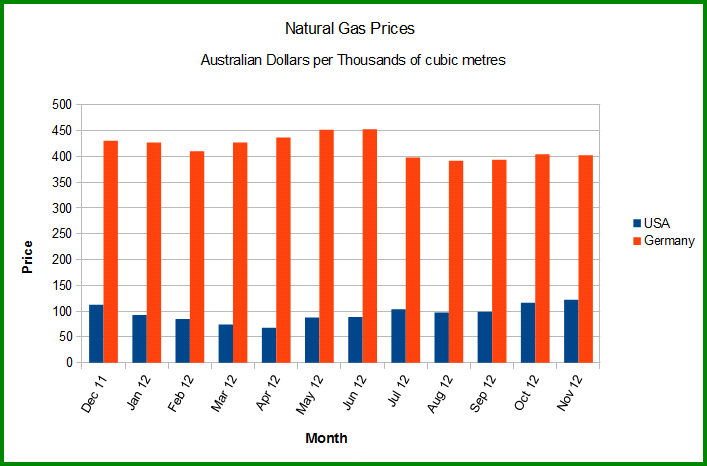
...where Tony Abbott expresses a belief that coal seam gas is needed to have affordable energy and fails to acknowledge the Liberal Party export-parity pricing policy that will see natural gas prices in Australia increase by about 500 percent, from a price similar to that in the United States to the price paid by natural gas importing countries such as Germany and Japan.
Natural Gas Prices Planned for Australia "Export Parity" in Red Bars, USA Price in Blue Bars
26 February 2013
...
TONY ABBOTT:
I want to congratulate the Newman Government for the way it has put
the coal seam gas industry onto a more sustainable footing. We need to
develop our resources. We need to have affordable energy, but we've got
to extract that energy in ways which is fair to farmers and respects the
environment and I think by the changes that Campbell has made, we do
get a system of extraction which respects the environment and is much
fairer to farmers.
QUESTION:
In WA, they’re making sure a certain amount of [inaudible] prices down. Should Campbell Newman do that in Queensland as well?
TONY ABBOTT:
... Really, what we need here in Queensland and in New South Wales
for that matter and around the country more generally is more gas and
if we've got more gas, we can keep power prices down and we can develop
the industries which depend upon gas in order to flourish.
ABCNEWS PM with Mark Colvin. Sue Lannin reporting Updated Mon Mar 4, 2013 7:37pm AEDT
The chief economist of international oil giant, BP, says there needs to more discussion about the implications of coal seam gas drilling and extraction. Christof Ruhl says the natural gas energy source is too plentiful and too precious not to use it.
Coal seam gas treated as a costly waste product
Gas Flaring - Disposing of natural gas keeps prices high
Natural Gas Prices Planned for Australia "Export Parity" in Red Bars, USA Price in Blue Bars
The Australian Energy Market Operator web site lists wholesale prices for natural gas.
These are listed in Australian dollars per gigajoule ($/GJ).
The wholesale price of natural gas in Victoria on 7 January 2013 was about $3 per GJ.
This is equivalent to approximately $111 per 1,000 cubic metres - virtually the same as the US natural gas price at the Henry Hub (the blue bars in the above chart).
AEMO - Victorian Wholesale Natural Gas Market Data 7 January 2013
The Australian Institute of Energy web site is offline at present.
The following is the first few items from a web archive copy -
Australian Institute of Energy
Oil & Gas Special Interest Group
Interesting and Useful Articles
House of Representatives, Standing Committee on Economics
Inquiry into Australia' Oil Refinery Industry
This inquiry into Australia's oil refining industry is about to commence. At time of writing, 21 submissions had been published. Readers with interests in oil refining will find these submissions of value.
An analysis of coal seam gas production and natural resource management in Australia.
Williams J., Stubbs T., and Milligan A. October 2012. A report prepared for the Australian Council of Environmental Deans and Directors by John Williams Scientific Services Pty Ltd, Canberra, Australia.
There has been no greater influence on Australia's energy markets than coal seam gas since production began over 40 years ago of natural gas and crude oil.
This commercial development has ensured that the East Coast again had adequate supplies of natural gas, sufficient enough to lay the foundations for a large LNG industry in Gladstone and
that domestic natural gas prices will in future reflect export parity for LNG, the same concept as import parity for crude oil.
In order to ensure that this development was managed well, an Independent Expert Scientific Committee on CSG is being established under COAG. This report is the most independent, disinterested nationwide analysis yet undertaken and makes two key findings:
Firstly, the environmental risks, especially with groundwater, are serious, and neither decommissioning wells nor replenishing aquifers have been properly considered and
Secondly, this is another land use which needs to be regulated than like all others.
James Fazzino is the managing director and chief executive of Incitec Pivot.
The following are extracts from two articles he has written critical of the Australian Government policy on natural gas pricing.
Government should ensure gas is made available for local manufacturing
BY: JAMES FAZZINO From: The Australian October 01, 2012
Australia has abundant supplies of natural gas but we have the only national government in the world that doesn't give priority to local use, both for downstream processing and for Australian homes.
We have allowed major oil and gas companies to control the use of the gas so that export contracts to Japan and China get priority.
This means that there is either no gas for Australian manufacturing or, at best, gas is made available at up to four times the current price. We are being asked to pay virtually the same price for Australian gas as energy-starved Japan and China.
This is not the global market price because gas is essentially traded in a series of local markets. Only 9 per cent of the world's gas is traded globally. The result is that Australian manufacturing plants will close, hundreds of workers will lose their jobs and Australian household energy bills will skyrocket.
Incitec Pivot chief James Fazzino says ALP's failed to take advantage of the gas boom
BY: JAMES FAZZINO From: The Australian July 27, 2012
INCITEC Pivot chief James Fazzino has accused the Gillard government of lacking the vision to take advantage of its gas interests.
"For me, it's illogical and short-sighted that Australia is not leveraging our abundant gas resources for the greater national interest," he told an American Chamber of Commerce in Australia lunch in Sydney yesterday.
Mr Fazzino said there were fundamental differences between how Australia and the US viewed the access and affordability of energy, in particular gas reserves. "The US sees its gas reserves as an enabler for value-added manufacturing, and this is revitalising their economy," he said.
Mr Fazzino said the US proposed developing its energy reserves in support of manufacturing jobs, but Australia had "naively allowed the unfettered export" of gas and was missing a big opportunity to retain gas reserves, or at least a larger portion of them, onshore.
Award-winning science writer Fred Pearce – environmental consultant to New Scientist and author of Confessions Of An Eco Sinner – reveals that the super-ships that keep the West in everything from Christmas gifts to computers pump out killer chemicals linked to thousands of deaths because of the filthy fuel they use.
...
Bunker fuel is also thick with sulphur. IMO rules allow ships to burn fuel containing up to 4.5 per cent sulphur. That is 4,500 times more than is allowed in car fuel in
the European Union. The sulphur comes out of ship funnels as tiny particles, and it is these that get deep into lungs.
Thanks to the IMO’s rules, the largest ships can each emit as much as 5,000 tonnes of sulphur in a year – the same as 50 million typical cars, each emitting an average of 100 grams of sulphur a year.
With an estimated 800 million cars driving around the planet, that means 16 super-ships can emit as much sulphur as the world fleet of cars.
The Tasmanian ship builder Incat is nearing the completion of what it claims is the world's first high speed car ferry powered by liquefied natural gas [LNG].
Over 200 people have been working on "Hull 69" for the past two years.
The 99-metre catamaran has been bought by an Argentinian company.
The $100 million vessel is capable of transporting 1,000 passengers and 200 cars.
Incat's Craig Clifford says it is the seventh ferry the company has sold to South America.
"The customer wants to make this his flagship so no expense has been spared to make this the best high-speed vessel in the world," he said.
Author: Mike Corkhill who is a technical journalist and consultant specialising in oil, gas and chemical transport, including tanker shipping and chemical logistics. A qualified Naval Architect, he has written books on LNG, LPG, chemical and product tankers and is currently the Editor of both LNG World Shipping and LPG World Shipping.
The agreement in late June by seven Baltic ports to promote the development of an [liquefied natural gas] LNG bunkering infrastructure in the region marks a further important step in ensuring a future global role for natural gas as a clean-burning marine fuel.
The combination of liquefied natural gas (LNG) bunkering and the burning of natural gas in ship engines has been put forward as one of three possible ways of complying with the International Maritime Organization’s (IMO) tightening regime governing the control of harmful pollutants in ship exhaust emissions. The other two options are the continued use of heavy fuel oil (HFO) in tandem with exhaust gas scrubbers and the burning of low-sulphur marine gas oil (MGO)/marine diesel oil (MDO) in ship propulsion systems.
The shipping industry acknowledges that the LNG option will be chosen by many ship owners, but the extent of this take-up remains the big question. Although the burning of natural gas in marine engines meets all existing and proposed emissions standards, the provision of LNG bunkering infrastructure in ports and special shipboard fuelling systems poses logistics and cost challenges.
This includes a discussion on measures in Australia to build a liquefied natural gas (LNG) fueling network for road transport - cutting emissions and fuel costs for road freight and increasing fuel security as Australian reliance on imported oil is set to increase.