Latest Buzz...
                  

Translate

Wednesday, July 11, 2012

Tasmanian Ship Builder a World Leader

Liquefied Natural Gas powered cat meets all ship emissions standards
World leading liquefied natural gas (LNG) powered cat
meets all proposed International Maritime emissions standards

How 16 ships create as much pollution as all the cars in the world

By FRED PEARCE

Award-winning science writer Fred Pearce – environmental consultant to New Scientist and author of Confessions Of An Eco Sinner – reveals that the super-ships that keep the West in everything from Christmas gifts to computers pump out killer chemicals linked to thousands of deaths because of the filthy fuel they use. 
...
Bunker fuel is also thick with sulphur. IMO rules allow ships to burn fuel containing up to 4.5 per cent sulphur. That is 4,500 times more than is allowed in car fuel in the European Union. The sulphur comes out of ship funnels as tiny particles, and it is these that get deep into lungs.

Thanks to the IMO’s rules, the largest ships can each emit as much as 5,000 tonnes of sulphur in a year – the same as 50 million typical cars, each emitting an average of 100 grams of sulphur a year.

With an estimated 800 million cars driving around the planet, that means 16 super-ships can emit as much sulphur as the world fleet of cars.

Gas powered cat - Finishing touches on Incat vessel

Annah Yard, ABC, 7pm TV News TAS


The Tasmanian ship builder Incat is nearing the completion of what it claims is the world's first high speed car ferry powered by liquefied natural gas [LNG]. 

Over 200 people have been working on "Hull 69" for the past two years.

The 99-metre catamaran has been bought by an Argentinian company.

The $100 million vessel is capable of transporting 1,000 passengers and 200 cars.

Incat's Craig Clifford says it is the seventh ferry the company has sold to South America.

"The customer wants to make this his flagship so no expense has been spared to make this the best high-speed vessel in the world," he said.

Baltic LNG bunkering to set global benchmark

Author: Mike Corkhill who is a technical journalist and consultant specialising in oil, gas and chemical transport, including tanker shipping and chemical logistics. A qualified Naval Architect, he has written books on LNG, LPG, chemical and product tankers and is currently the Editor of both LNG World Shipping and LPG World Shipping.

The agreement in late June by seven Baltic ports to promote the development of an [liquefied natural gas] LNG bunkering infrastructure in the region marks a further important step in ensuring a future global role for natural gas as a clean-burning marine fuel.

The combination of liquefied natural gas (LNG) bunkering and the burning of natural gas in ship engines has been put forward as one of three possible ways of complying with the International Maritime Organization’s (IMO) tightening regime governing the control of harmful pollutants in ship exhaust emissions. The other two options are the continued use of heavy fuel oil (HFO) in tandem with exhaust gas scrubbers and the burning of low-sulphur marine gas oil (MGO)/marine diesel oil (MDO) in ship propulsion systems.

The shipping industry acknowledges that the LNG option will be chosen by many ship owners, but the extent of this take-up remains the big question. Although the burning of natural gas in marine engines meets all existing and proposed emissions standards, the provision of LNG bunkering infrastructure in ports and special shipboard fuelling systems poses logistics and cost challenges.

See the related post Road Freight Transport Costs

This includes a discussion on measures in Australia to build a liquefied natural gas (LNG) fueling network for road transport - cutting emissions and fuel costs for road freight and increasing fuel security as Australian reliance on imported oil is set to increase.

Sunday, July 8, 2012

Higgs boson in the history of science

Scientific knowledge has developed over centuries. The journey of discovery includes long periods of experiments and the collecting of careful measurements (empirical data). Every once in a great while important milestones occur when a pattern in this data is recognised.

Identifying chemical compounds, chemical elements and developing processes to separate mixtures of each progressed gradually over centuries. A major milestone was reached in 1869 when Dmitri Ivanovich Mendeleev proposed a Period of Table of Chemical Elements that fitted the known elements according to patterns of physical properties that many scientists and researchers had discovered and studied.

The Periodic Table of Chemical Elements originally contained gaps that suggested a number of chemical elements may exist and that remained to be discovered.
Periodic Table of Chemical Elements
Another milestone occurred at the dawn of the twentieth century when Marie Curie revealed two revolutionary ideas for which she was awarded Nobel Prizes in Physics and in Chemistry.

"Marie drew the conclusion that the ability to radiate did not depend on the arrangement of the atoms in a molecule, it must be linked to the interior of the atom itself. This discovery was absolutely revolutionary."
"For the first time in history it could be shown that an element could be transmuted into another element, revolutionizing chemistry and signifying a new epoch."

Together with her husband, she was awarded half of the Nobel Prize for Physics in 1903 for their study into the spontaneous radiation discovered by Henri Becquerel in 1896, who was awarded the other half of the Prize. Marie Curie was awarded a second Nobel Prize, in Chemistry, in 1911.

This type of scientific milestone is different in character to the work of Mendeleev. It occurs when completely new and previously unknown features of the natural world are revealed. It built on Mendeleev's work - Marie Curie's insights were gained after she discovered two new chemical elements, polonium and radium and devised techniques to isolate radium in sufficient quantities to study its properties. Polonium is named after her homeland, Poland.

Radium's radioactivity was so great that it could not be ignored. It seemed to contradict the principle of the conservation of energy and therefore forced a reconsideration of the foundations of physics. On the experimental level the discovery of radium provided men like Ernest Rutherford with sources of radioactivity with which they could probe the structure of the atom.

Rutherford conducted experiments with alpha radiation and as a result in 1910  introduced a new model of an atom that contained a minute nucleus possessing almost all the atom's mass.

The first half of the twentieth century was a period of remarkable scientific advances including Niels Bohr's atomic model (1913), Erwin Schrödinger's development of quantum mechanics (1925) and Albert Einstein's theory of mass-energy equivalence (1905) among numerous others.

It was also remarkable for an "embarrassment of riches" of fundamental sub-atomic particles that were discovered. At first each discoverer of a new sub-atomic particle was almost guaranteed a Nobel Prize in Physics. Later, each new discovery was greeted with dismay at the growing complexity of what was originally thought to be a simple quest to identify and characterise a limited number of fundamental particles.

The identification of new sub-atomic particles continued and eventually in the mid 1960s a model to fit all this empirical evidence into a coherent framework was more-or-less settled. This model known as The Standard Model of Fundamental Particles and Interactions parallels the breakthrough that Mendeleev's Periodic Table of Chemical Elements achieved in 1869.
The Standard Model of Fundamental Particles and Interactions

Like Mendeleev's model of one century earlier, The Standard Model of Fundamental Particles and Interactions also identified a number of missing pieces that, if the model was correct, should be able to be found.

Of the missing pieces, the Higgs boson was predicted and its existence was crucial in checking the validity of the Standard Model.

See more information on the hunt for the elusive Higgs Boson at How Stuff Works:

What exactly is the Higgs boson?

Saturday, July 7, 2012

Daily Telegraph belittles Small Business

Tony Abbott is concerned about fish and chip shops and spent time with the owner of one recently -
Seagull enjoying some fish and chips


Tony Abbott Doorstop

12 May 2012

"If you take a fish shop, well, there’s the fuel that the fishing boats use, there’s the power that they use at the markets to freeze things, there’s the transport which gets the fish to the markets and to the shops. All of this is going to be impacted by the carbon tax and this is why this carbon tax is so toxic for the families and the workers of Australia."

The Liberal member for Benelong John Alexander shares Tony Abbott's concern for fish and chips -

Carbon Tax on Small Business

26 June 2012

"Small business will be hit the worst because they must pay for the tax at every single step in their production cycle. 
The fish and chip shop owner will pay the carbon tax from the minute the trawler fills up its diesel fuel tanks to go out to sea, through the machinery that processes and cleans the fish, the refrigeration costs that are set to skyrocket, right through to the delivery to the shop and the lights that need to flash outside the front door to attract passers-by."

After Tony Abbott and John Alexander put the Opposition's heart-felt interest in fish and chips shops on the public record Simon Benson of the Daily Telegraph let the Coalition have it with both barrels -

Worth the dung on which it's written?

3 July 2012

"Yesterday it was revealed that a leading Australian and international business group boasting up to 300 firms including Westpac and GE supported the Gillard government's carbon price.
And they took out ads across the nation to prove it.
However, after some scrutiny by the opposition, turns out the group is made up largely of obscure operations - none of which would be liable to pay the tax.
Only one company, AGL, is listed as a liable entity which would have to directly pay the tax.
Alongside some of the big names was ....a fish and chip shop. ..."

Great work Simon. Subtle. Biting.

Tuesday, June 19, 2012

Energy for Life

More than three billion people still burn wood, dung, coal and other traditional fuels inside their homes. The resulting indoor air pollution is responsible for more than 1.5 million deaths a year – mostly of young children and their mothers. Millions more suffer every day with difficulty in breathing, stinging eyes and chronic respiratory disease.

1.5 billion people have no access to electricity, and 85% of the population in Africa don't yet have electricity. 400 million in India have no access to power.

Collecting Firewood
Collecting Firewood

There is enormous unmet demand for access to electricity and clean energy.

In its annual Human Development Report, the UN Development Programme (UNDP) said the UN has designated 2012 as the international year of sustainable energy for all.

Energy is essential to meet our most basic needs: cooking, boiling water, lighting and heating. It is also a prerequisite for good health – a reality that has been largely ignored by the world community.

One of the greatest energy needs across the world is for cooking, something which we take for granted. Without a decent energy supply, people are forced to rely on biomass - wood or animal dung - for cooking. Women and children can spend hours every day searching for increasingly scarce resources. Once they start burning biomass, the thick acrid smoke cause's serious lung diseases turning kitchens into death traps.

Children and their mothers are most at risk, choking, retching and gasping to get air to their lungs which are being attacked and destroyed by smoke. More people die from smoke inhalation than malaria.

According to the World Health Organisation, diseases associated with indoor air pollution claim 1.5 million lives every year - that's one person every 20 seconds.

Green Climate Fund


Source: What the Australian Government is doing > Shaping a global solution

At CancĂșn in December 2010, countries agreed to establish a new Green Climate Fund to support mitigation and adaptation activities in developing countries, including capacity-building, technology development and transfer. Australia anticipates that, over time, a significant portion of long-term financing to support climate change activities in developing countries will be channeled through this Fund.

Throughout 2011 Australia joined 39 other countries on the Transitional Committee which was tasked with the design of the Fund. The Transitional Committee's recommendations, including the draft governing instrument of the Green Climate Fund, were approved by the Conference of the Parties to the UNFCCC in December 2011 at Durban.

As a result, concrete steps are now being taken to operationalise the Fund to ensure the appropriate arrangements are put in place so it can commence operations including allocating funds to support action on climate change in developing countries as soon as possible. Australia, like other developed countries, is providing some financial assistance to support the initial administrative operations of the Fund.

Finance

A central element of bringing developed and developing countries together in an international climate change agreement will be financing to assist developing countries in their transition to climate-resilient and low-carbon economies.

It is in Australia's interest to assist developing countries to build their capacity to reduce emissions and to take urgent adaptation actions while maintaining a priority focus on development, in particular the eradication of poverty. Early action on both adaptation and mitigation will reduce global costs and the costs to individual countries.

To this end, Australia is working to build a coordinated approach that will deliver financing where it is needed most, as soon as possible.

Related links
AusAID - Climate Change
"Australia's funding for 2012/2013 - $172.07 million.
...
Our total climate change expenditure over the fast start period (2010–11 to 2012–13) is expected to exceed the $599 million fast start commitment."

Tuesday, June 12, 2012

Look Mr Abbott-No Carbon Tax

Look Mr Abbott-No Carbon Tax For My Business

VitoBloc CHP unit Module EM-401/549
VitoBloc CHP unit
Module EM-401/549
Tony Abbott visited another Australian business, Aaron's Linen Service, today Tuesday June 12, 2012 and declared the carbon tax would put it under more pressure:
Liberal Chicken Little - Tony Abbott's fear campaign It’s great to be here at Aaron’s Linen Service. I want to thank Vic Stolar and his family for making Bert van Manen and myself so welcome. This is one of the thousands and thousands of businesses right around Australia that is nervously waiting for the carbon tax.

Vic’s business has got a power, gas and electricity, bill of about $1.2 million every year that’s going to go up and up and up - $120,000 just for starters - and that makes it so much harder to employ people. There are about 120 people working here in this factory and laundry.
Liberal Chicken Little
Tony Abbott's fear campaign

Estimate of energy requirement: $120,000 carbon tax for CO2 emissions priced at $23 per tonne implies emissions of about 5,200 tonnes per year.

Allowing about 800 kilograms of CO2 per megawatt-hour implies energy use of about 6,500 megawatt-hours per year.

This is equal to continuous energy use of 750 kilowatt-hours every hour, 24 hours per day, 7 day per week, 365 days per year. Note that some energy is required as electricity and some as heat.


 Using this figure of 750 kilowatt-hours every hour as an indicative guide for in-house power generation, a VitoBloc CHP unit Module EM-401/549 is about the right size.

By generating power in-house the high-cost Australian electricity distribution grid is avoided. This represents the greatest saving. This saving is perhaps 25-40 percent of the $1.2 million annual power bill.

As an added bonus, total emissions will be less than 25,000 tonnes of carbon dioxide per year. As a result NO carbon tax will be payable. This is a further saving of 100 percent of the estimated carbon tax of $120,000 per year.

Coopers Brewery's Cogeneration Plant

Most of Coopers Brewery’s electricity and steam requirements are drawn from a 4.4 megawatt (MW) natural gas-powered co-generation plant located on site. (Source: Generating Smarter Energy)

The co-generation plant was built in 2002 in partnership with AGL, as part of a 20-year energy supply agreement. A dedicated 4 km natural gas supply line was also negotiated to supply the necessary gas at high pressure, which is burned in a gas turbine to drive the electrical generator. Waste heat from the gas turbine is harnessed to produce steam used in the brewing process.

Eighty percent of the fossil fuel energy is converted in the co-generation plant into useful energy of power and steam, approximately 2.5 times greater than a conventional coal-fired power station. This has reduced carbon dioxide emissions by up to 15,000 tonnes per annum compared with using grid electricity and conventional gas-fired boilers.

While the co-generation plant produces 24,000 megawatt hours (MWh) of power per year, the brewery itself only uses about 6,500 MWh. The excess power is fed into the South Australian power grid through a high voltage underground power line.

The plant also generates 50,000 tonnes of steam a year, used for heating in the brewing, evaporation and packaging processes. Steam was previously generated at the brewery by standalone gas fired boilers.

An absorption chiller unit has also been installed, which uses surplus steam from the cogeneration plant to produce chilled water for brewing.

Look Mr Abbott-No Carbon Tax For My Home -
Ceramic Fuel Cell's BlueGen

Ceramic Fuel Cells developed BlueGen, a biomethane or natural gas driven generator that small enterprises and households can buy and install that silently generates electricity and hot water at a cost way under the majors. You can imagine how much opposition the incumbents have created when faced with this threat. (Source: Lights on for an energy minnow)

BlueGen CHP unit garage installation
Ceramic Fuel Cell’s BlueGen micro combined heat and power (mCHP) unit
Garage installation

It’s not often that a small Australian company gets to look at an enormous market and find it is the leading global player. Overseas institutions, a few individuals and Australian self-managed funds are its main shareholders. No large Australian institution is involved.

US based giant – the $4 billion capitalised Jabil – believes this is a product that, one way or another, is going to be manufactured on a massive global scale.

Update Tuesday, June 19, 2012

The BlueGen product uses ceramic fuel cells to turn natural gas into electricity and heat for hot water.
The units generate electricity with the highest electrical efficiency of any small scale generating technology in the world, reducing energy bills and cutting carbon emissions. (Source: BlueGen units to be used in Virtual Power Plant Project in The Netherlands)

Friday, June 8, 2012

Global Warming will Destroy the Coal Industry

Updated July 9, 2012

In June 2011, Opposition Leader Tony Abbott said "The Coalition has been saying now for a long time, that Julia Gillard’s carbon tax will destroy the coal industry." Read more at Tony Abbott does "Hanrahan" for Doorstop Interview

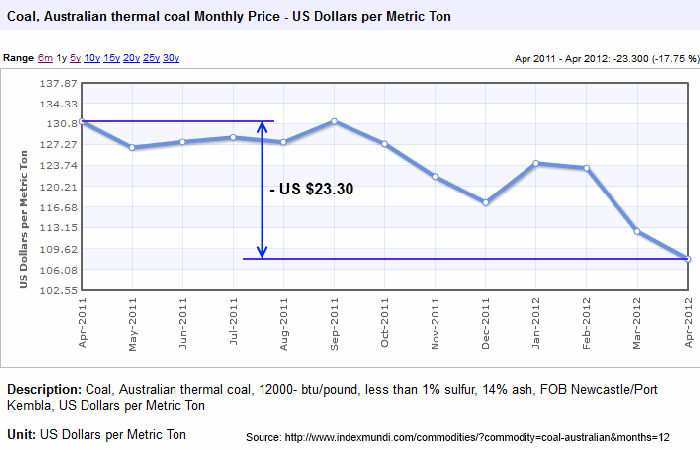
After one of the warmest U.S. winters on record the world price of thermal coal has PLUMMETED.
Tony Abbott JUST DOESN'T GET!

Updated August 20, 2012
COAL prices are falling so fast that China, the world's biggest producer, has cut capacity by more than Australia's entire coal output.
Read more: China cuts capacity  | August 4, 2012 | Chua Baizhen and Andjing Yang

Global coal output is set to shrink over the next year or two as miners grapple with a combination of low prices, weak demand and currency headwinds.

High-cost Australian operations are under particular pressure.
.
Read more: BHP warns of job losses in Australian coal mines  | August 17, 2012 | The Irish Times

Black hole: US coal stocks now down over 60% in 2012 as thermal price hits 2-year low

Posted 11 June 2012
by Frik Els

Coal for power generation at the port of Newcastle in Australia, the benchmark for Asia, was quoted at $87.30 a tonne on Monday, its lowest level since June 2010 and down more than a fifth since the start of the year.

The collapse in thermal coal prices have seen the shares of US producers – which have been switching to exports as domestic demand declined – plummet this year and the bloodletting continued on Monday.

...High inventories thanks to a mild northern hemisphere winter and a resulting surge in US exports have led to a collapse in thermal coal prices.

US producers have been switching to exports as domestic demand collapsed in a record warm winter. According to the latest stats from the Energy Information Administration (EIA), coal-fired power stations represented just 36% of US electricity in the first quarter of 2012 — a rapid decline from 44.6% just one year ago.


Australian Thermal Coal Monthly Price

Thermal coal price cut

11 Apr, 2012
IAN KIRKWOOD

HUNTER coal companies are in for a harder year financially after Japanese electricity companies secured an 11 per cent cut in the annual benchmark price for Newcastle thermal coal.

This year’s benchmark price of $US115.20 ($112.90) a tonne compares with last year’s of $US129.85 ($127.25).

It could cut $1 billion from this year’s Hunter coal earnings.

AUSTRALIA COAL: Asian buyers pressure softening Newcastle thermal market

1 Jun, 2012
Perth (Platts)

Asian buyers kept up the downward pressure on Newcastle thermal coal prices Friday by insisting on asking sellers for price discounts on prompt shipments at risk of going into default.
...
"Some Hunter Valley coal producers will be in serious trouble because current spot prices are close to their production costs," said a participant in the Asia-Pacific market.

"If the market continues in this direction, then some mines might have to close," he said.


Australia's Coal Mining Boom Ends as Prices Tumble

Published: Wednesday, 6 Jun 2012 
By: Reuters

Falling coal prices ...have forced Australia's producers to start trimming output and letting go of some workers, hurting miners, rail and port operators and potentially threatening plans for more than $30 billion of investment in new mines.

Thermal coal prices have fallen 20 percent this year to a near two-year low of  $92 a tonne at the Australian port of Newcastle, based on globalCOAL's index, which has left prices close to the operating cost for some mines.
 ...
Coal exports from the United States have jumped as U.S. power stations have been switching from burning coal to natural gas...

Warm U.S. Winter Whacks Natural Gas To 10-Year Lows

INVESTING | 9 Feb, 2012
By Alan Lammey and Michael Barak, WeatherBELL Analytics

With the recent price collapse in natural gas prices [they are] down to 10-year lows... This is primarily due to the combination of one of the warmest winters seen in the U.S. in decades coupled with several years of non-stop drilling in prolific natural gas shale areas.  These events have created a massive glut...


November 2011-January 2012 Mean Temperature Anomaly

Power Prices Fall This Winter Following Movements Lower in Natural Gas Prices

25 May 2012 
Posted by CNE Market Intel

Since November 2011, natural gas prices declined nearly 50 percent to lows back in April as one of the warmest winters in decades contributed to an oversupplied market. Just four weeks ago, front month natural gas fell to a 10-year low of $1.907/MMBtu.

Coal’s Share of U.S. Electricity Generation Falls to 35-Year Low

Posted 13 Mar, 2012
by Moran Zhang

The share of U.S. power generation that comes from coal has fallen to near a 35-year low, as electric power plants shift to cheaper natural gas.

Although coal is still the main fuel for electricity generation, its share of monthly power generation in the U.S. dropped below 40 percent in the last two months in 2011, according to the Energy Department. The last time coal's share of total generation was below 40 percent for a monthly total was March 1978.
...
...Generation from natural gas rose 12 percent to 86 terawatt-hours. Coal-fired generation, however, fell by 21 percent during the period to 132 terawatt-hours.
...
Natural gas prices have continued their downward trend this winter as a result of warmer-than-normal temperatures...

U.S. natural gas prices slid to a fresh 10-year low Tuesday, with the Nymex April gas dropping nearly 3 percent to a low of $2.204 per million British thermal units.

Meanwhile, U.S. benchmark central Appalachian thermal coal prices fell last week to $58 a metric ton -- the lowest level in nearly two years.
...
Barclays is forecasting a surplus of 20 million to 35 million tons in 2012 in U.S. thermal coal. Analysts believe inventories are at risk of swelling to unsustainably high levels, given utilities inventories are already at 170 million tons, above the historical average of 150 million tons.

The surplus could push coal inventories to about 190 million tons to 205 million tons by year-end. ...

US coal exports hit more than 30-year high

15 May, 2012

Washington, 15 May (Argus) — US coal exports reached a more than three-decade high in March, reaching 11.1 million short tons (10 million metric tonnes) as lower domestic demand allowed more coal to head into seaborne markets.
...
Every US coal-producing region is trying to boost exports as domestic generators increase their reliance on competitively priced natural gas.

Thursday, June 7, 2012

Transition from coal

Coal and Energy Resource Directions

Updated Monday June 18, 2012

The power generation industries in China, India and the U.S. are transforming coal so it may be used more efficiently. This lowers the cost of generating electricity. One coincidental benefit is that cleaner energy is produced. Other benefits are the flexibility to substitute alternate energy sources for coal and to eventually move to hydrogen fuel production without needing to replace gas-fired power stations.
Block diagram with major units of the SNG plant
From coal to clean energy (Topsoe)
Whisker carbon formed on nickel crystal 
In Australia the Opposition Leader Tony Abbott in a recent address to the Minerals Council of Australia revealed he mistakenly believed the policy reform of Australia's energy industry was directed at phasing out the use of coal and gas. He hasn't understood the technology to transform coal into a cleaner and more efficient energy resource.


This is technology being deployed widely in China. India is keen to follow China's example. U.S. plans to increase  use of this technology have been temporarily put on hold with the serendipitous windfall of abundant cheap natural gas.

The Australian coal industry itself may share the same misunderstanding as Tony Abbott. It is seemingly pursuing a strategy to construct as many new coal-fired power stations as possible. The effect of this strategy is to lock-in continuing demand for coal before the mistakenly suspected "phasing-out" of coal can begin.

The U.S. coal industry seems to share similar mistaken views as Tony Abbott and the Australian coal industry. For example, the U.S. Institute for Energy Research president Jim Pyle expresses concerns such as:
  • "Question for Mr. Kushner: Who decides what energy sources make the most sense and why do we need Washington to force transition?"
  • "The public has made the clear connection that making affordable energy more expensive is crippling the economy and will respond."
  • "Transition from coal? What about the rest of the world? And do you also oppose exporting coal, Mr. Waxman?"

You can follow the discussion of policy reform in the U.S. energy industry on Twitter: hashtag "#NJClearair".

China Adopting More Efficient (and Cleaner) Coal Technology

Block diagram with major units of the SNG plant
From coal to clean energy - Topsoe

China has built 50 coal gasification plants in the last 10 years and has another 40 in planning or under construction. On 21 May 2012 the article "China to Invest in Coal Gasification - with GEs help" by John Daly reported:

With more than 50 licensed facilities in China, GE’s gasification technology is one of the most widely deployed in the industry, while Shenhua is one of the world’s largest coal and energy companies, with integrated coal production, power generation, railway, port and shipping infrastructure.
...
Putting the final seal of approval on the project GE Energy Thermal Products president and CEO Paul Browning concluded, “Coal plays an important role in the economies of both the U.S. and China, and gasification technology allows us to use this abundant and low-cost resource in a much cleaner way.
...
The emphasis shift in coal power generation from thermal plants to utilizing IGCC technology is a key element in the Chinese leadership’s efforts to maintain its economic momentum by providing its vast industrial base uninterrupted power supplies.


New technology is increasing efficiency of converting coal to gas. China is building commercial-scale plants as new technology becomes available. For example:


India to Follow China's Lead with More Efficient (and Cleaner) Coal Technology


On 29 May 2012 the Economic Times reported in the article "India needs to master the coal-gasification technology":

India needs to master the coal-gasification technology so as to boost both energy efficiency and attendant security.
...
...Integrated coal-gasification combined-cycle (IGCC) power plants, which incorporate both gas and steam turbines, vastly improve the conversion of coal energy into usable electricity.
...
Note that while the efficiency rate is just about 30% in standard coal-fired stations and 40-odd per cent using super-critical technology, the mavens hold that, in future gasification plants, the ratio could touch 70-80%. We clearly need to adopt IGCC in a big way. 
The likely impact on Australia's coal export industry can be seen from an earlier article on 12 March 2012. Reuters reported in its article "India's coal-to-gas dream takes baby steps":
NEW DELHI, March 12(Reuters) - India is at least a decade behind China in embracing technology that could convert its coal reserves into enough gas and oil to surmount chronic power shortages and halve its energy import bill of $110 billion a year. 

Cheap Natural Gas in the U.S. replacing Coal-Fired Power Generation


In the U.S. plans for the construction of a number of coal gasification plants have recently been put on hold. The reason: a massive over-supply of natural gas in the U.S. has dramatically lowered the price and the continued use of coal is for the time-being at least, not competitive.

On 13 March 2012 the article "Coal’s Share of U.S. Electricity Generation Falls to 35-Year Low" by Moran Zhang reported:
The share of U.S. power generation that comes from coal has fallen to near a 35-year low, as electric power plants shift to cheaper natural gas.

Although coal is still the main fuel for electricity generation, its share of monthly power generation in the U.S. dropped below 40 percent in the last two months in 2011, according to the Energy Department. The last time coal's share of total generation was below 40 percent for a monthly total was March 1978.
...
"Natural gas combined-cycle units operate at higher efficiency than do older, coal-fired units, which increases the competitiveness of natural gas relative to coal," the Energy Department said in a statement.

Natural gas prices have continued their downward trend this winter as a result of warmer-than-normal temperatures, ample natural gas in storage and growing natural gas production, which has been boosted by companies tapping so-called shale reservoirs using a technique called hydraulic fracturing, also known as "fracking."


United Kingdom's Variation on More Efficient (and Cleaner) Coal Technology

Updated Friday August 17, 2012

Stage 1 of the coal gasification technology China is deploying converts coal into synthesis gas. Further stages then convert this to methane ("Substitute Natural Gas" or SNG) and carbon dioxide.

In a variation that eliminates the cost of coal mining and does away with the plant for the initial stage that converts coal to synthesis gas, the United Kingdom is developing Underground Coal Gasification projects.

These projects convert deep coal seams that cannot be commercially mined into synthesis gas which is then piped to the surface for further processing stages as in China's coal gasification plants.


Australian Coal industry seeks 15-year policy reform delay

Why is Australia to spend over $1 billion on CarbonNet and take 15 years developing new Carbon Capture technology ----
 ---- when proven technology has existed for decades in the USA?


A Possible Reason for the Coal Industry to Delay Pre-Combustion Carbon Capture

Post-combustion Carbon Capture and Storage (CCS)  provides a justification to continue construction of coal-fired power stations. It holds out a promise of one day being able to reduce emissions of such power plants.

Once a coal-fired power plant is constructed, the coal industry is guaranteed a customer for at least 40 years.

Gasification of coal with pre-combustion Carbon Capture eliminates the reason for constructing any new coal-fired power stations. Once converted to gas, the fuel can be used in high-efficiency combined-cycle gas turbine (CCGT) power stations. In addition a number of toxic components of coal such as mercury can be economically removed when the coal has been converted to gas.

The demand for coal would go down when natural gas prices fall. There would be no guaranteed demand to provide fuel for new coal-fired power stations.

A gas-fired power station achieves 60 percent thermal efficiency, much higher than the 40 percent for advanced coal-fired power stations. This difference also results in lower demand for coal.

What's Happening?

Source: Travel Outcomes Report, Japan, September 2011, Department of Primary Industry, Victoria -
Since 2009, many Japanese delegations have visited Victoria to discuss low emission coal technologies, carbon capture and storage (CCS), and the use of Victorian brown coal resources.

These visits have reinforced Japan’s interest in Victorian brown coal and collaboration with Victoria on project development and R&D, to develop low emission coal technologies such as gasification, CCS, the production of synthetic natural gas (SNG), and liquid fuels.
Source: CO2CRC Research Symposium 2011, 30 November 2011 -
The Commonwealth is also collaborating with the Victorian Government to evaluate proposals by Japanese companies to apply gasification technologies to brown coal.

The idea is to convert Victoria's abundant supply of brown coal to higher value commodities such as substitute natural gas, hydrogen and liquid fuels whilst capturing the CO2.

Source: Carbon Capture and Storage - Questions and Answers, 14 November 2011, Department of Primary Industry, Victoria -
Investing in this technology will also enable the development of other uses for coal such as production of other carbon sourced products such as diesel or hydrogen, which potentially could be used as a low emissions fuel for cars, synthetic natural gas, fertilisers and methanol.

Tony Abbott Addresses the Minerals Council of Australia

In an Address to the Minerals Council of Australia at Canberra on 30 May 2012, coincidentally just one day after the above article on India's need to follow the example set by China to embrace more efficient energy-from-coal technology, Tony Abbott said:
...We all know what the carbon tax is designed to do: it is designed to reduce our use of coal and our use of gas [sic]. In other words, it is designed to limit the production, ultimately, of the minerals upon which our country so critically depends [sic]...The government’s own documents say that Australia’s energy production from coal, absent carbon capture and storage, will fall from over 70 percent right now to 10 percent by 2050.

So, the carbon tax is designed to damage the very things on which our country's wealth depends 
[sic]. The only way our country's wealth can survive the carbon tax is if other countries don't do what we're doing. If China and India took the same attitude to coal and gas that we are taking, our export industries would be in diabolical trouble...